
How the Right Mobile Application Can Support Customer Retention for Businesses in Jordan
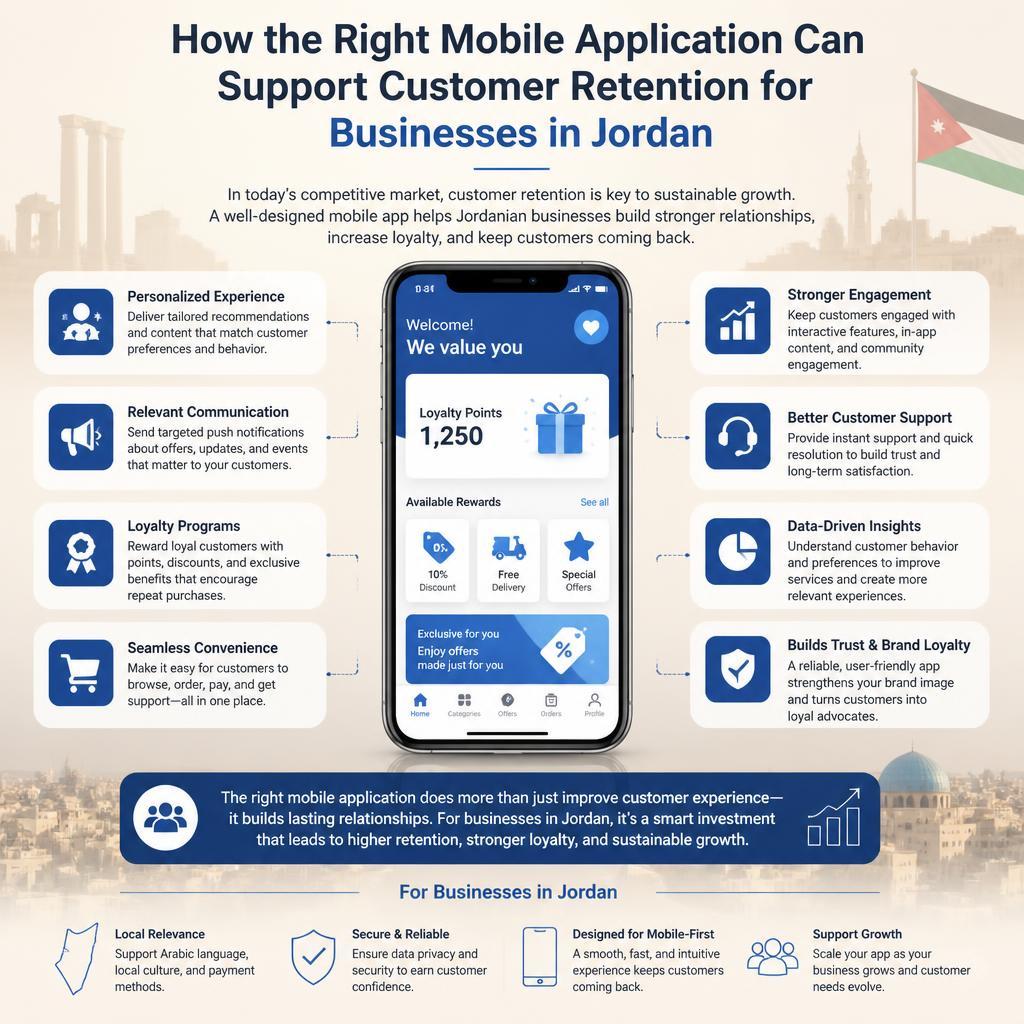
Winning a customer is an important achievement, but encouraging that person to return is what helps a business build lasting value. For companies operating in Jordan, customer retention depends on delivering dependable service, understanding customer expectations, and making every interaction worth repeating. A thoughtfully developed mobile application can support these goals by turning routine transactions into convenient, personalized experiences.
Whether a company serves shoppers in Amman, manages hospitality services in Aqaba, or provides professional solutions in Irbid, mobile technology can create additional opportunities to maintain customer relationships. The key is choosing features that improve the experience instead of simply adding another communication channel.
Understanding the Connection Between Mobile Apps and Customer Retention
Customer retention refers to a business's ability to encourage existing customers to continue purchasing its products or using its services over time. Retained customers may make repeat purchases, recommend a company to others, and develop greater familiarity with its offerings.
However, loyalty rarely develops through discounts alone. Customers are more likely to return when they receive consistent value, experience fewer difficulties, and feel confident that a business understands their needs.
A customer retention mobile app can support these outcomes by making services easier to access and helping businesses maintain useful communication with their audiences.
For example, a retailer could provide saved shopping preferences, purchase histories, and reward points. A fitness center might offer class reservations and membership reminders, while a home maintenance provider could organize service appointments and recurring maintenance schedules.
For businesses across Jordan, these capabilities can help establish convenient habits that encourage customers to remain engaged.
1. Making Repeat Purchases Simpler
Customers often return to businesses that save them time and effort. If completing a second purchase requires entering the same information repeatedly or contacting staff for basic assistance, the experience may become inconvenient.
A well-designed mobile application for businesses in Jordan can simplify repeat transactions through features such as saved preferences, previous order records, quick reordering, and secure checkout.
Consider a grocery retailer serving customers in Amman. Its application could allow users to revisit earlier purchases, save frequently purchased items, and check delivery options. Customers would spend less time repeating familiar steps, while the retailer could make its services more convenient.
Businesses can also introduce practical features such as:
-
Saved delivery addresses.
-
Reusable shopping lists.
-
Purchase histories and digital receipts.
-
Quick appointment rebooking.
-
Clear information about product availability.
-
Convenient access to customer support.
The appropriate functionality depends on the business model. A professional consultancy, for instance, may gain more from simplified appointment scheduling than from a shopping cart.
The goal of mobile app development in Jordan should be to remove unnecessary friction from interactions that customers already value.
2. Creating Loyalty Programs That Deliver Real Value
Loyalty programs can encourage repeat business when their benefits are clear, relevant, and easy to understand. A mobile application offers a practical way to manage rewards without requiring customers to carry physical cards or remember complicated rules.
Businesses might provide points for qualifying purchases, milestone rewards, membership benefits, or exclusive offers. Customers could check their progress and review available rewards directly within the application.
For restaurants in Zarqa, a digital loyalty program might recognize frequent visits with a complimentary item after a defined number of qualifying purchases. A beauty salon in Irbid could offer membership benefits for customers who regularly book selected services.
Effective programs should follow several principles:
-
Explain eligibility and redemption rules clearly.
-
Offer rewards customers genuinely appreciate.
-
Make progress easy to track.
-
Avoid overly complicated conditions.
-
Review participation and redemption results.
A reward system should strengthen the value of the core service rather than disguise an unsatisfactory experience. If customers repeatedly encounter delays or inconsistent quality, discounts alone may not convince them to stay.
A carefully designed customer loyalty app in Jordan can complement dependable service by giving customers an additional reason to continue their relationship with a business.
3. Personalizing the Customer Experience
Customers have different interests, purchasing habits, and service requirements. Treating every user identically can result in irrelevant offers and unnecessary notifications.
With appropriate consent and responsible data practices, an application can help businesses tailor experiences to customer preferences.
For example, a sports retailer could highlight categories that match a customer's selected interests. A travel company operating in Aqaba might provide relevant booking information based on a customer's chosen itinerary. A training provider could display upcoming sessions related to a learner's enrolled course.
Useful personalization features may include:
-
Preferred product or service categories.
-
Relevant appointment reminders.
-
Personalized account dashboards.
-
Recommendations based on appropriate activity data.
-
Updates related to existing bookings or purchases.
Personalization should remain useful rather than intrusive. Businesses need to explain how customer information is used and provide suitable controls over promotional communications.
For organizations investing in custom mobile app development in Jordan, the most effective personalization strategy begins with understanding what helps customers accomplish their goals.
4. Maintaining Communication Without Overwhelming Users
Regular communication can keep customers informed, but excessive messaging may have the opposite effect. If an application repeatedly sends irrelevant promotions, users may disable notifications or stop engaging with the business.
A thoughtful communication strategy prioritizes usefulness and timing.
Mobile applications can support:
-
Order confirmations and delivery updates.
-
Appointment reminders.
-
Service availability notifications.
-
Important account announcements.
-
Relevant loyalty program updates.
-
Follow-up messages after completed services.
For example, a vehicle servicing company in Jordan could remind a customer about an upcoming appointment and provide instructions for preparing the vehicle. Such a message has a practical purpose beyond promoting another purchase.
Businesses should distinguish between transactional notifications and marketing messages, apply appropriate consent requirements, and let customers manage their preferences.
A successful mobile customer engagement strategy measures whether communication helps users, not merely how many notifications a company sends.
5. Improving Customer Support and Resolving Problems Faster
Customer retention can be affected significantly by how a company responds when something goes wrong. A delayed order, missed appointment, or unclear billing issue can weaken trust if customers struggle to obtain assistance.
A mobile application can make support easier to access by organizing requests and keeping relevant information in one place.
Depending on the business, useful features include:
-
In-app customer inquiries.
-
Support ticket tracking.
-
Frequently asked questions.
-
Appointment rescheduling.
-
Complaint submission.
-
Service progress notifications.
Imagine a delivery company serving customers across Amman and Zarqa. Customers could use its application to review shipment information and submit a request when a delivery needs attention. Support staff could access the relevant order details rather than asking the customer to explain everything again.
Businesses should also provide clear escalation options for complicated problems. Automated answers may help with routine questions, but sensitive complaints and unusual situations often require human judgment.
Reliable mobile app customer support in Jordan can help companies demonstrate accountability and make it easier for customers to continue using their services after an issue occurs.
6. Using Customer Feedback to Improve Retention
Retention improves when businesses recognize what customers appreciate and identify problems before they become recurring reasons to leave.
A mobile application can collect feedback at appropriate moments, such as after an appointment, completed order, or customer support interaction.
Short surveys and rating options can help businesses discover patterns involving service quality, usability, delivery reliability, and overall satisfaction.
Companies should consider:
-
Asking focused questions that customers can answer quickly.
-
Reviewing feedback regularly rather than collecting it without action.
-
Identifying repeated complaints and their underlying causes.
-
Prioritizing improvements according to customer impact.
-
Communicating relevant service improvements when appropriate.
A retailer in Jordan might discover that customers value product availability information more than promotional notifications. A service provider could learn that appointment rescheduling is a frequent source of frustration.
These findings can guide improvements to both the application and the company's underlying operations.
Businesses should also monitor appropriate retention indicators, including repeat purchase rates, customer return frequency, subscription renewals, and support resolution times. The right measurements depend on the industry and the company's objectives.
7. Designing an Application Customers Want to Keep Using
Even a feature-rich application will struggle to retain users if it performs poorly or makes everyday tasks difficult.
A useful business mobile application in Jordan should provide a consistent experience across supported devices and remain dependable as customer demand changes.
Important considerations include:
Simple navigation: Customers should be able to locate essential functions without unnecessary steps.
Reliable performance: Screens, searches, and transactions should respond predictably under realistic conditions.
Appropriate security: Authentication, permissions, and information handling should reflect the sensitivity of the data involved.
Accessible design: Readable text, clear controls, and understandable instructions can make the application easier for different users.
Language flexibility: Arabic and English options may be useful for companies serving diverse audiences in Jordan.
Ongoing maintenance: Software updates, compatibility improvements, and defect resolution help preserve the user experience after launch.
Before releasing an application, businesses should test important customer journeys, including registration, purchasing, booking, payment, and support requests.
Choosing an experienced Mobile App Development Company in Jordan can help organizations translate these requirements into a practical development plan.
8. Choosing the Right Development Partner
The right development partner should understand that retention is a business objective, not simply a technical feature.
Before starting a project, business owners should ask potential providers about their experience, development methodology, security practices, estimated costs, and post-launch maintenance arrangements.
They should also discuss how the application will connect with existing business systems, including customer management platforms, inventory tools, or booking software where appropriate.
A clear project scope helps prevent unnecessary features from consuming the budget. Businesses should begin with the functions most likely to improve customer convenience, then use feedback and performance measurements to guide future development.
Five Programmers encourages businesses to approach application planning with defined customer needs and measurable objectives. The focus should remain on creating an experience that customers find useful enough to revisit.
Frequently Asked Questions
1. Can a mobile application increase customer retention for a small business?
Yes, it can support retention through convenient repeat purchases, loyalty rewards, personalized updates, and accessible customer support. Results depend on the quality of the service, customer demand, and how effectively the application addresses real needs.
2. Which mobile app features encourage customers to return?
Features such as saved preferences, quick reordering, appointment reminders, relevant rewards, order tracking, and responsive support can encourage repeat usage when they suit the business and its audience.
3. How can Jordanian businesses measure customer retention?
Businesses can track repeat purchase rates, returning customer activity, subscription renewals, loyalty participation, and customer feedback. Comparisons over consistent time periods help reveal whether changes are improving results.
4. Should every business introduce a loyalty program through its app?
No. Loyalty programs work best when repeat purchases are a natural part of the business model. Companies should first consider whether rewards provide meaningful value and whether another feature, such as improved booking or customer support, would better serve their customers.
Conclusion: Build Lasting Customer Relationships Through Mobile Technology
Customer retention develops through repeated positive experiences, dependable service, and meaningful value. For companies across Jordan, the right mobile application can support these outcomes by simplifying purchases, improving communication, organizing support, and making services more accessible.
The strongest results come from selecting features according to customer needs rather than adding technology for its own sake. With clear goals, appropriate security, and ongoing improvements, businesses can create digital experiences that support lasting customer relationships.
Ready to develop an application that helps your customers stay connected with your business? Contact Five Programmers to discuss your requirements and get a free quote for a customized mobile application solution.

 English
 Arabic
 Spanish
 Portuguese
 Deutsch
 Turkish
 Dutch
Dutch
 Italiano
 Russian
 Romaian
 Portuguese (Brazil)
 Greek
Greek