
What Makes a Scalable Android and iOS Application Worthwhile for a Growing Moroccan Enterprise?
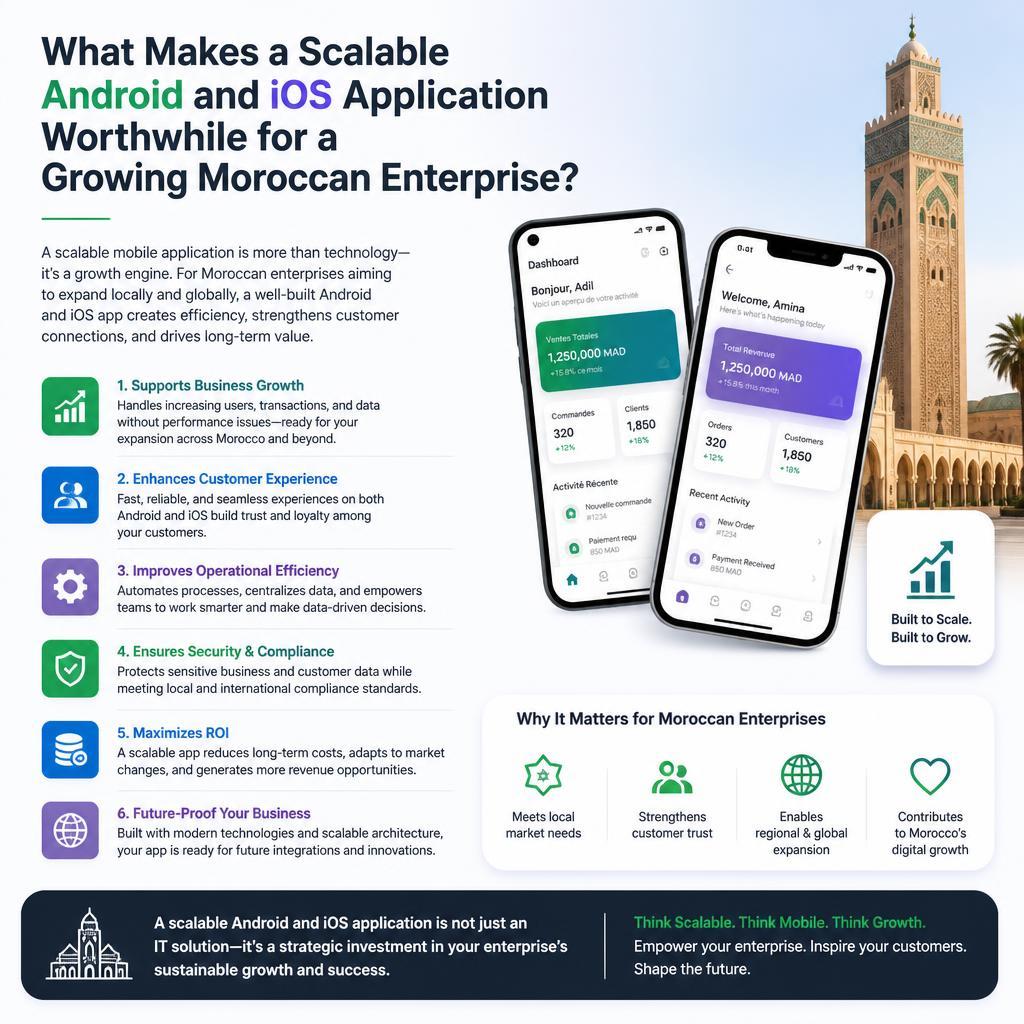
Business growth brings exciting opportunities, but it also introduces new operational demands. As a company attracts more customers, expands its services, or enters additional markets, its digital infrastructure must keep pace. An application that performs well for a small customer base may struggle when transaction volumes increase or new features become necessary.
For ambitious companies in Morocco, investing in scalable Android and iOS application development can provide a stronger foundation for sustainable expansion. A scalable application is designed to accommodate increasing demand, evolving customer expectations, and additional business capabilities without requiring a complete technical rebuild every time the company grows.
Whether an enterprise operates in retail, logistics, tourism, healthcare, or financial services, the right mobile solution can improve accessibility, streamline operations, and create more opportunities for customer engagement. However, scalability involves more than supporting additional users. It also requires sound architecture, appropriate security measures, reliable integrations, and a development strategy aligned with business objectives.
Understanding these elements helps Moroccan enterprises make informed technology investments and prepare their digital products for long-term success.
What Is a Scalable Mobile Application?
A scalable mobile application can accommodate changing workloads, growing user numbers, and additional functionality while maintaining an acceptable level of performance and reliability.
For example, a retailer might initially serve customers in one Moroccan city. As the business expands into other locations, its application may need to support additional inventory, delivery zones, payment options, and customer service workflows.
A scalable solution anticipates these possibilities through flexible architecture and well-planned development.
Important characteristics include:
-
Flexible architecture: New modules and capabilities can be introduced without unnecessarily disrupting existing functions.
-
Performance optimization: The application remains responsive as usage increases.
-
Reliable infrastructure: Backend services can accommodate changing workloads.
-
Secure data management: Customer information remains protected as the platform expands.
-
Integration readiness: The system can connect with suitable business tools and third-party services.
-
Maintainability: Developers can update, test, and improve the product efficiently.
For enterprises exploring mobile app development in Morocco, scalability helps connect present requirements with future business ambitions.
Why Is Scalability Important for Growing Moroccan Enterprises?
1. Supporting Business Expansion Without Rebuilding Everything
Growth frequently changes how a business operates. A company may introduce new products, open additional branches, establish partnerships, or serve customers across multiple regions.
An application designed only for immediate requirements can become restrictive when these changes arrive.
With scalable mobile app development in Morocco, enterprises can plan for additional features and increasing demand from the beginning. A booking platform, for instance, might start with appointment scheduling and later introduce multiple service locations, staff management, customer reminders, and reporting tools.
This approach does not mean building every future feature immediately. Instead, it means creating a technical foundation that allows future improvements without unnecessary complexity.
Businesses can therefore expand functionality as real requirements emerge rather than paying for an entirely new platform whenever their operating model changes.
2. Delivering Consistent Experiences on Android and iOS
Customers use different devices and operating systems. A business that wants to reach a broad audience needs to consider how its application behaves across supported smartphones and operating system versions.
Professional Android and iOS app development in Morocco helps enterprises deliver consistent core functionality while accounting for platform-specific requirements.
A successful application should offer:
-
Intuitive navigation and accessible layouts.
-
Reliable performance across supported devices.
-
Consistent account and transaction experiences.
-
Appropriate notifications and device permissions.
-
Regular compatibility testing and maintenance.
Enterprises should also decide whether native development or a cross-platform framework best suits their requirements. Native solutions may be appropriate when extensive platform-specific capabilities or specialized performance are essential. Cross-platform development may reduce duplicated effort when requirements can be shared effectively between operating systems.
The best option depends on the application's complexity, budget, team capabilities, and long-term maintenance plans.
3. Improving Performance as User Demand Increases
A growing customer base can place additional pressure on databases, APIs, servers, and other backend services. If these components are poorly designed, users may encounter slow loading times, failed transactions, or interruptions during busy periods.
Scalable application architecture helps enterprises prepare for these challenges.
Depending on the product, useful techniques may include:
-
Optimizing database queries and data structures.
-
Using caching for frequently requested information.
-
Separating resource-intensive background tasks.
-
Monitoring application response times and error rates.
-
Adjusting infrastructure capacity when demand changes.
-
Testing expected peak workloads before major launches.
Not every application requires complex cloud infrastructure or a microservices architecture. For many enterprises, a well-structured application with an appropriately designed backend can provide sufficient flexibility.
The objective is to match technical investment with actual demand while preserving a clear path for future growth.
For businesses in Casablanca, Rabat, Marrakech, and other commercial centers, reliable performance can help protect customer confidence as digital activity increases.
4. Controlling Long-Term Development and Maintenance Costs
Initial development costs represent only one part of a mobile application's total investment. Enterprises must also consider hosting, monitoring, security updates, operating system compatibility, bug fixes, and future enhancements.
A poorly structured application can make even small changes expensive. Developers may need to modify multiple interconnected components, increasing the risk of introducing new defects.
By contrast, custom mobile application development with clear module boundaries, documented code, and suitable testing practices can simplify ongoing maintenance.
A practical cost-management strategy includes:
-
Identifying essential features before development begins.
-
Selecting technologies appropriate to the business requirements.
-
Building reusable components where they provide genuine value.
-
Automating suitable testing and deployment tasks.
-
Reviewing infrastructure usage regularly.
-
Planning maintenance and upgrades as part of the project budget.
A scalable application is not necessarily the cheapest option at launch. Its value comes from balancing the initial investment with future flexibility, operational reliability, and the cost of continued development.
5. Strengthening Security as the Enterprise Grows
As applications attract more users and process more transactions, the consequences of security weaknesses can become more serious. Enterprises may handle personal information, purchase histories, account credentials, business records, or payment-related data.
For organizations in Morocco, secure mobile app development should therefore be part of the architecture and development process from the beginning.
Important safeguards include:
-
Strong authentication and appropriate access permissions.
-
Encryption for sensitive data in transit and, where appropriate, at rest.
-
Secure API design and validation of incoming requests.
-
Regular dependency updates and vulnerability assessments.
-
Monitoring for suspicious activity.
-
Backup and recovery procedures.
-
Transparent privacy practices and appropriate consent mechanisms.
Businesses should also assess applicable Moroccan data protection obligations and any relevant requirements associated with their industry or international operations.
Security must continue after launch. Regular assessments, controlled software updates, and a clear incident-response process help enterprises respond to emerging threats while maintaining customer trust.
6. Connecting Applications With Existing Business Systems
Growing enterprises often rely on several tools for accounting, inventory, customer relationships, deliveries, and internal reporting. When these systems operate independently, employees may need to enter the same information repeatedly or reconcile inconsistent records manually.
A well-designed enterprise mobile application can connect suitable systems through APIs and other supported integrations.
For example, a distribution company might link its mobile platform with inventory software, order management, delivery tracking, and customer notifications. When an order changes status, relevant information can flow between connected systems, reducing manual coordination.
Similarly, a retail enterprise may synchronize product availability and customer orders between its application and existing commerce platform.
Before integrating any system, businesses should evaluate compatibility, data ownership, access permissions, reliability, and ongoing support requirements. Third-party services can introduce their own costs and limitations, so integrations should be selected according to measurable business value.
7. Using Analytics to Guide Future Improvements
Scalability also involves understanding how a product evolves after launch. As customer numbers increase, enterprises need evidence to determine which features work well and where improvements are necessary.
Appropriately configured mobile app analytics can help businesses measure:
-
Active usage and customer retention.
-
Completed purchases, bookings, or service requests.
-
Abandoned registration and checkout processes.
-
Application crashes and performance problems.
-
Feature adoption and customer feedback.
-
Operational response times.
Consider an e-commerce enterprise serving several regions in Morocco. If analytics reveal that customers frequently abandon the payment process, the company can investigate usability issues, payment compatibility, or unexpected charges.
This makes development more purposeful. Instead of continually adding features based on assumptions, businesses can prioritize changes that address demonstrated customer needs.
Analytics should be collected transparently, with appropriate privacy protections and only to the extent necessary for legitimate business purposes.
How Should Enterprises Choose the Right Development Partner?
Selecting a development team is an important decision because the team's technical choices can influence the application's performance, maintainability, and future expansion.
When comparing providers offering mobile app development services in Morocco, enterprises should assess more than the initial quotation.
Look for a partner that can demonstrate:
-
Experience with comparable business applications.
-
A clear approach to architecture and scalability.
-
Strong UI/UX design and quality assurance practices.
-
Knowledge of Android and iOS requirements.
-
Appropriate security and privacy procedures.
-
Transparent milestones, communication, and documentation.
-
Defined ownership of source code and project assets.
-
Reliable post-launch maintenance and support.
Ask potential partners how they would accommodate future users, integrations, and features. Their explanations should reflect your actual requirements rather than simply recommending the most complicated technology available.
Five Programmers helps businesses explore tailored mobile application solutions aligned with their product objectives, operational needs, and plans for expansion.
A well-defined project scope and a collaborative development process make it easier to evaluate progress and identify risks before they become costly problems.
Frequently Asked Questions
1. How does a scalable mobile application benefit a growing company?
It allows a business to accommodate increasing usage, introduce additional functionality, and expand operations without necessarily replacing its existing platform.
2. Should a Moroccan enterprise build separate Android and iOS applications?
Not always. Native development may suit specialized requirements, while cross-platform development can be efficient when substantial functionality can be shared. The choice depends on performance, budget, integrations, and maintenance needs.
3. Can a small enterprise build a scalable application with a limited budget?
Yes. Starting with essential features and using a well-structured architecture can keep initial costs manageable while leaving room for future improvements.
4. How can a company determine whether its application is ready to scale?
Monitor response times, error rates, infrastructure usage, transaction completion, and performance under simulated peak demand. Load testing and regular technical reviews can identify limitations before growth exposes them to customers.
Conclusion: Build Today for Tomorrow's Business Opportunities
A scalable mobile application can give a growing enterprise the flexibility to respond to changing customer needs, increasing demand, and new market opportunities. By investing in reliable architecture, strong security, practical integrations, and continuous performance improvements, businesses can build a digital product that remains useful as their operations evolve.
For enterprises across Morocco, the priority should be selecting technology that supports a defined business strategy rather than investing in complexity without a clear purpose. Careful planning helps organizations manage costs, deliver consistent customer experiences, and establish a stronger foundation for expansion.
Five Programmers helps enterprises explore scalable Android and iOS app development solutions in Morocco tailored to their requirements and long-term goals.
Ready to prepare your business for its next stage of growth? Contact Us to discuss your application requirements and Get a Free Quote Today.

 English
 Arabic
 French
 Spanish
 Portuguese
 Deutsch
 Turkish
 Dutch
Dutch
 Italiano
 Russian
 Romaian
 Greek
Greek