
A Fleet Manager's Approach to Grove All-Terrain Crane Hydraulic Problems
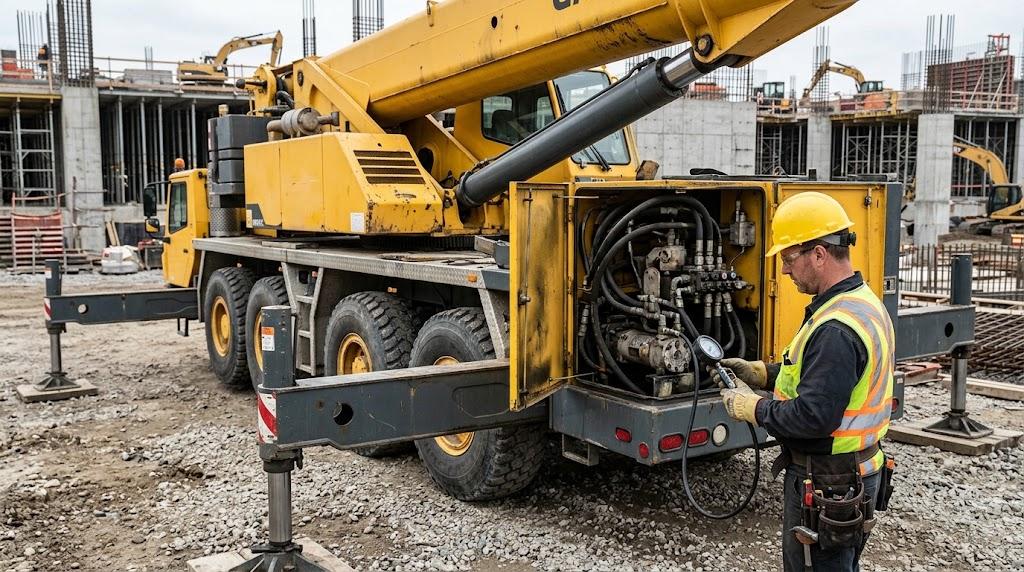
Managing a fleet of all-terrain cranes means accepting that hydraulic downtime is a recurring cost. The question is never whether a Grove machine will present a hydraulic fault, but how quickly the crew can identify it and return the crane to service. Every hour a crane sits idle costs money on both sides of the equation — the rental bill and the project schedule.
The pattern of hydraulic failures on Grove all-terrain cranes is remarkably consistent. A relatively small number of root causes account for the vast majority of call-outs. Learning to distinguish between them saves diagnostic time and prevents the common mistake of replacing parts that are not actually at fault.
Below, the four primary failure modes are examined from the standpoint of a crew trying to get a machine back into production as efficiently as possible.
When Boom Movement Degrades
Operators tend to notice boom problems gradually. The extension rate seems slightly slower this week than it was last week. Retraction takes a beat longer at the top of the stroke. These incremental changes are easy to rationalize away, and doing so is a mistake.
Fluid supply is the foundation of the entire hydraulic circuit. If the reservoir is running low, every downstream function suffers, and the pump bears the brunt of it. Checking the level takes thirty seconds and should be the first step in any boom-related investigation. Low supply explains a surprising percentage of slow-boom complaints.
Filtration is the second most common contributor. A filter element approaching the end of its service life passes progressively less fluid, and the effect shows up at the furthest points in the circuit first — which is exactly where the boom cylinders sit. Inspecting the element takes minutes. Replacing it costs very little. And it saves the far more expensive exercise of pulling a pump that was never the actual problem.
Once supply and filtration are confirmed good, the pump and directional valves come under scrutiny. A flow meter reading below rated output indicates internal pump wear and a need for replacement. Spool valves that stick due to varnish buildup or trapped debris will throttle flow to the boom cylinders independently of pump condition. A technician who stocks Grove crane parts can perform a substitution test on the truck and eliminate guesswork in a single visit. For larger shops, maintaining a working relationship with a crane parts supplier who understands all-terrain hydraulic specifications shortens the turnaround considerably when a component does need to be replaced.
Load Drift and Its Implications
Drift complaints deserve immediate priority on any job site. A load that descends while the controls are at neutral is a load that can injure someone. The root causes are well documented, and they fall into two categories.
The first category involves counterbalance valves. These components seal the cylinder circuit whenever control pressure drops, and they rely on clean, undamaged sealing surfaces to do so. Varnish buildup or particulate on the valve seat allows a slow leak that translates into visible load descent. Disassembly and careful cleaning often restores the seal. This is one of the more satisfying repairs because the diagnosis and the fix are both quick.
A valve seat that has been eroded or scored by contamination is a different matter. Cleaning cannot restore a surface that has lost its dimensional integrity, and attempting to do so wastes shop time. Fitting a new valve is the correct path, and confirming the replacement rating matches the original is a detail that should not be skipped.
The second category covers cylinder seal failure. Piston seals inside the boom or hoist cylinders maintain the separation between the pressure side and the return side of the piston. When those seals wear past their limit, fluid migrates across the piston and the cylinder loses its ability to hold. Rebuilding the cylinder means pulling it from the machine, stripping it, and fitting new seals. Using a kit engineered for your specific Grove model is essential, because seal profiles varied across production generations and a mismatched kit will not perform.
Managing Heat-Related Failures
Overheating is the failure mode that does the most cumulative damage because it is gradual. A crane running hot for a week will not necessarily fail that week, but every seal, hose, and bearing in the circuit is being quietly compromised.
The source of excessive heat is almost always unintended bypass flow. A relief valve that has eroded at its seat or been set below its rated pressure allows fluid to recirculate through a narrow restriction continuously. That restriction converts pressure into heat. A pressure gauge on the test port, compared against the machine's specification plate, confirms or eliminates this cause within a few minutes.
The cooling circuit deserves equal scrutiny. Cooler cores accumulate dust, mud, and vegetation in the field, and a fouled core loses its ability to reject heat. Hydraulic fan motors can also lose speed due to internal wear or supply issues, reducing airflow across the cooler. A thorough cleaning and a tachometer reading on the fan are simple diagnostics that often resolve the temperature complaint outright.
Fluid level contributes to heat generation more than most people expect. A reservoir running below the marked minimum holds less thermal mass, so the same heat load concentrates in a smaller volume of oil and the temperature rises faster. Checking the sight glass should be part of every pre-start inspection. Note also that a persistent overheating pattern appearing after a recent component replacement may indicate that the replacement item was not specified correctly for the application — a situation that sourcing through a crane parts supplier who verifies fitment against serial numbers is designed to prevent.
Erratic Control Response
Smooth, predictable crane movement is a prerequisite for safe operation. When the boom stutters, the swing hunts, or the winch surges during a lift, the operator loses the fine control needed for accurate load placement. Three root causes explain the overwhelming majority of these reports.
Entrained air is the first and most benign. Bubbles in hydraulic lines compress under pressure and release unevenly, causing cylinders to lurch. The fix requires no parts and very little time: cycle each cylinder through its full stroke several times with the hook unloaded. Most erratic behavior traced to air resolves after a thorough bleeding sequence.
Proportional valves are the second cause. Grove cranes route joystick signals through proportional valves that meter fluid flow with fine resolution. Contamination within the valve spool disrupts that metering, producing hesitation and overshoot. Solvent cleaning and dry compressed air can rehabilitate a valve in the early stages of contamination. When the solenoid coil or control electronics have degraded, the valve or its controller needs replacement.
Fluid condition is the third cause and the one most frequently skipped during diagnosis. Water in hydraulic oil changes its pressure-transmission properties and produces movement that feels unpredictable. Silt-sized particles act as an abrasive inside every precision surface. Drawing a sample into a clean container and examining it in daylight takes only a moment. A milky appearance means water. A gritty feel means particulate. Either finding warrants an immediate fluid and filter change.
Sourcing Components That Will Actually Last
At some point in every repair, a decision has to be made about what goes back into the machine. That decision carries more weight than most people assign to it. Hydraulic components on all-terrain cranes operate under extreme pressures and loads, and a part that does not meet the original specification will fail — possibly in a way that puts people at risk.
Grove cranes are engineered with circuit-specific pressure ratings and dimensional tolerances. A valve built for a rough-terrain machine might physically thread into the same port on a Grove all-terrain crane, but it will not respond correctly to the loads a GMK-class machine generates. The margin between "close enough" and "correct" is measured in fractions of a thousandth of an inch on sealing surfaces, and it matters.
Original equipment components are the reference standard whenever the repair timeline permits. Production schedules and warehouse logistics, however, do not always cooperate with a crane sitting idle. For many hydraulic items, qualified aftermarket alternatives exist that meet identical engineering criteria and can ship in a fraction of the time. What matters is having someone who can tell the difference.
A knowledgeable crane parts supplier brings cross-reference data, supersession history, and application knowledge to the conversation. They can identify which part numbers have been replaced by updated versions, which aftermarket options meet all-terrain duty requirements, and which ones do not. That expertise prevents the expensive cycle of installing a part, watching it fail, and ordering again. Well-matched Grove crane parts install once and stay installed.
When you call, have your model designation, serial number, and any casting numbers from the removed component in front of you. Grove's all-terrain range spans decades, including the GMK5130, GMK6300L, and GMK4100L, each with distinct hydraulic configurations. Complete information at the start of the conversation produces an accurate order and eliminates the callbacks that stretch a repair across multiple days.
Preventive Maintenance as a Cost Center
There is a persistent temptation to treat hydraulic maintenance as discretionary spending. This is a miscalculation. The cost of scheduled filtration, fluid sampling, and hose inspection is a fraction of the cost of a single unplanned component failure, and it is a fraction of the cost of crane downtime on an active project.
Filter changes should occur on a fixed schedule, and the schedule should not flex based on how the crane feels. An element run beyond its service interval passes more and more debris with each additional hour, and that debris ends up in the components that cost the most to replace. Periodic oil analysis adds a diagnostic layer that reveals wear metal trends and contamination long before any visible symptom appears.
Hoses are the most visible items on the crane and among the most neglected. A walk-around inspection at each service interval should examine every visible run. Blisters, surface cracking, and abrasion points where rubber contacts steel are all indicators of a line approaching failure. Replacing a suspect hose during scheduled downtime is inexpensive. Watching one fail under pressure on a loaded boom is not.
Cleanliness during service work and disciplined operator habits round out the program. Cap every hydraulic connection the moment it is opened, because contamination entering through an unprotected port creates damage that is both expensive and difficult to trace. Train operators to avoid holding functions against relief valves, since that habit accelerates heat generation and shortens the life of every component in the circuit. These habits cost nothing to implement and extend equipment life measurably.
Closing Perspective
Hydraulic failures on Grove all-terrain cranes follow predictable patterns that reward a methodical response. Slow boom function points first to fluid supply and filtration. Load drift points to counterbalance valves and cylinder seals. Heat points to relief settings and cooler condition. Erratic movement points to air, proportional valves, and fluid quality.
The speed of recovery depends on two factors: systematic diagnosis and correctly specified replacements. Establishing a relationship with a crane parts supplier who understands Grove-specific hydraulic requirements ensures that the component you install is the component your machine needs. Add disciplined maintenance practices to that equation, and the crane spends its service life on the job rather than in the shop.

 English
 French
 Spanish
 Portuguese
 Deutsch
 Turkish
 Dutch
Dutch
 Italiano
 Russian
 Romaian
 Portuguese (Brazil)
 Greek
Greek