
What Are AI Agent Development Services and How Do They Work?
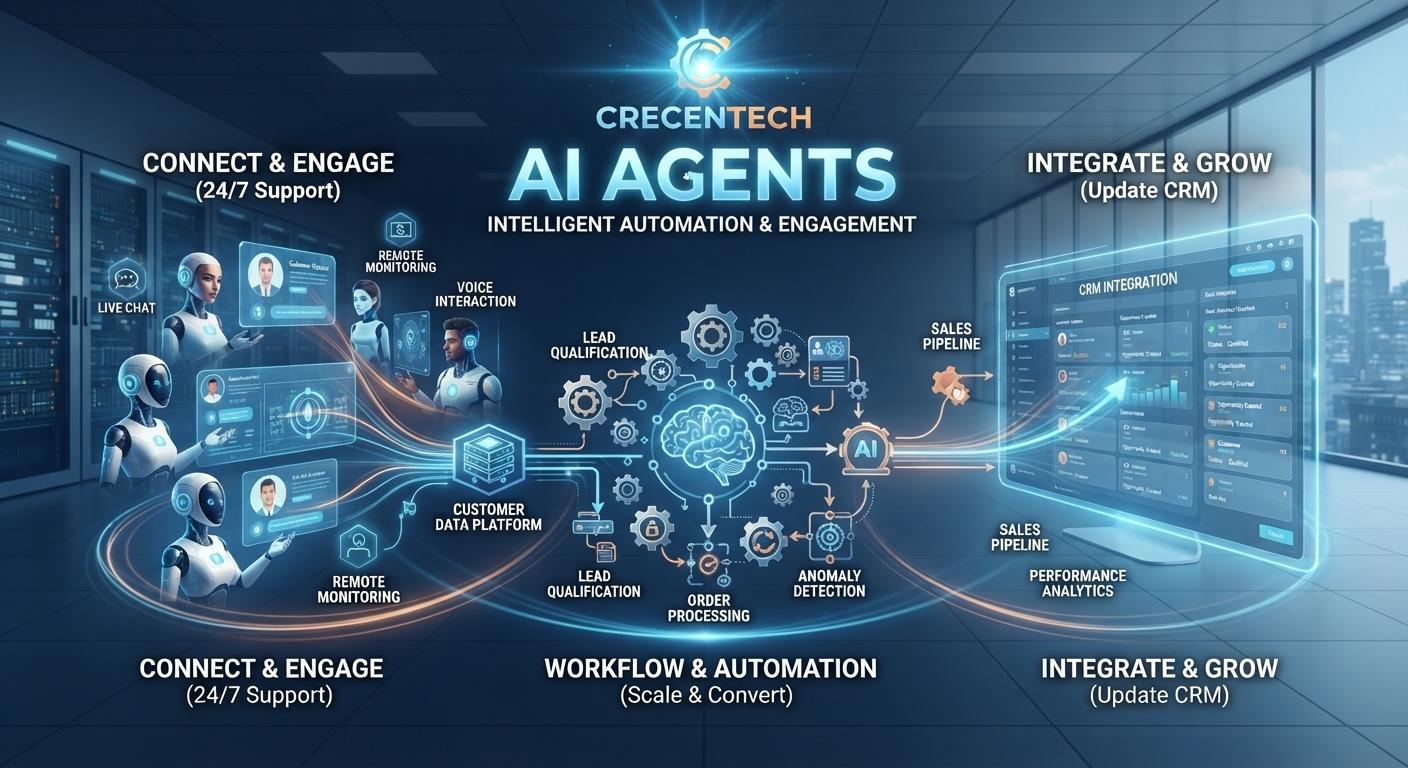
Businesses are increasingly using artificial intelligence to handle tasks that once required constant manual attention. From responding to customer inquiries and qualifying leads to scheduling appointments and updating business systems, intelligent software can now perform many activities with limited human intervention. However, simply adding an AI tool to a business does not automatically create an effective automated workflow.
This is where AI agent development services become valuable. These services focus on designing, developing, integrating, and maintaining AI agents that can understand information, make decisions within defined parameters, use connected tools, and complete specific business tasks. Instead of functioning only as conversational interfaces, AI agents can become active participants in business workflows.
Understanding AI Agent Development
An AI agent is a software system designed to interpret information, determine an appropriate action, and complete a task toward a defined objective. Depending on its design, an agent may communicate through chat, voice, email, or other digital channels while interacting with business applications in the background.
How an AI Agent Operates
A typical AI agent receives an instruction or event, processes the available information, determines what needs to happen, and then takes an action. For example, when a potential customer submits an inquiry, an agent could identify the customer's requirements, ask follow up questions, record the information in a CRM, and notify a sales representative.
The agent can also use business rules and connected data to determine what action should happen next. This makes the technology different from a basic chatbot that primarily provides predefined responses to user questions.
What AI Agent Development Services Include
Professional development involves more than creating a conversational interface. The process usually starts by understanding the business objective and identifying where an intelligent agent can provide measurable value.
Designing the Agent Around a Business Goal
The first step is defining what the agent needs to accomplish. A company might want an agent to qualify leads, schedule appointments, answer customer questions, process internal requests, or support employees.
Clear objectives help developers determine the agent's capabilities, data requirements, integrations, permissions, and escalation rules. For example, a customer service agent may be allowed to answer common questions independently but transfer billing disputes to a human representative.
Connecting the Agent to Business Tools
Modern AI agents become significantly more useful when they can interact with existing software. CRM platforms, calendars, help desk systems, databases, communication platforms, and internal applications can provide the information and functionality an agent needs.
Effective AI agent integration allows the agent to do more than generate a response. It can retrieve relevant information, update records, schedule meetings, trigger workflows, and pass information between systems.
Real World Business Applications
AI agents can support a wide range of operational processes, depending on the organization's requirements.
Sales and Lead Qualification
A sales agent can engage with prospects immediately after they submit an inquiry. It can ask qualifying questions, identify the nature of the request, capture contact details, and send relevant information. Qualified leads can then be transferred to a salesperson with the conversation history already available.
This can reduce delays between initial interest and human follow up while allowing sales teams to spend more time on qualified opportunities.
Customer Service and Support
Customer support teams frequently handle repetitive questions. An AI agent can manage routine conversations, retrieve information from approved sources, and provide responses at any time.
For more complex requests, the agent can transfer the conversation to an employee. This creates a workflow where automation handles predictable interactions while people remain responsible for cases requiring judgment or specialized assistance.
Appointment Scheduling
Appointment management is another practical use case. An agent can communicate with customers, identify suitable times, check calendar availability, and confirm appointments. The business does not need an employee to manually coordinate every scheduling request.
AI Agent Integration Requires Careful Planning
Connecting an AI agent to business systems requires attention to security, permissions, data quality, and workflow logic. An agent should only have access to information and actions necessary for its assigned responsibilities.
Businesses should also establish clear escalation procedures. If an agent encounters an unfamiliar request, sensitive information, or a situation outside its defined capabilities, the workflow should provide a reliable way to involve a human employee.
Testing is equally important. Organizations should evaluate how the agent responds to normal requests, incomplete information, unusual questions, and potential errors before making it widely available.
Building Enterprise AI Agents
Larger organizations often have more complex requirements because they operate across multiple departments, systems, locations, and security environments. Enterprise AI agents may need to interact with several applications while following strict access controls and organizational policies.
For example, an enterprise sales agent might retrieve customer information from a CRM, check product information from an internal database, schedule meetings through a calendar platform, and create follow up tasks for a sales representative.
Successful enterprise deployment therefore requires architecture, governance, monitoring, integration planning, and ongoing optimization rather than simply connecting an AI model to a business application.
How to Approach AI Agent Development
Businesses should begin with one clearly defined workflow rather than attempting to automate every process simultaneously. Identify a repetitive task that consumes employee time, establish the desired outcome, and determine which systems the agent must access.
Next, define what the agent can do independently and when human intervention is required. After development, test the workflow using realistic scenarios and measure results such as response time, task completion, employee workload, and customer satisfaction.
Once the initial implementation demonstrates value, the organization can gradually expand the agent's responsibilities or introduce additional agents for other departments.
Conclusion
Enterprise AI agents help businesses transform artificial intelligence from a simple conversational tool into an active part of their daily operations. By combining intelligent decision making with business applications, agents can support sales, customer service, scheduling, internal operations, and other repetitive workflows.
The most effective implementations begin with a specific business objective, reliable data, appropriate system integrations, clear permissions, and human oversight. Businesses considering AI agent implementation can explore CrecenTech to learn how intelligent agents can be developed and integrated into practical business workflows.
FAQs
What are AI agent development services?
AI agent development services involve designing, building, integrating, testing, and maintaining intelligent software agents that can perform defined business tasks and interact with users and business systems.
How do AI agents differ from traditional chatbots?
Traditional chatbots generally focus on responding to user messages. AI agents can perform broader tasks by reasoning through a workflow, using connected tools, accessing approved information, and taking actions on behalf of a business.
Can AI agents integrate with an existing CRM?
Yes. AI agents can be connected with compatible CRM systems to retrieve information, create records, update customer details, qualify leads, and trigger other sales workflows.
What businesses can benefit from AI agent development?
Businesses with repetitive customer service, sales, scheduling, administrative, or operational processes can potentially benefit from AI agents. The best use case depends on the organization's workflow and automation requirements.
What are enterprise AI agents used for?
Enterprise AI agents can support complex organizational workflows such as customer service, sales operations, internal support, document processing, knowledge retrieval, and coordination between multiple business systems.
How long does it take to develop an AI agent?
Development time varies according to the agent's complexity, required integrations, data sources, security requirements, and workflow scope. A simple agent may require significantly less development than a system connected to multiple enterprise applications.
Are AI agents capable of working without human supervision?
Some tasks can be automated with limited human involvement, but businesses should establish appropriate monitoring and escalation procedures. Sensitive or complex decisions may still require human review.
How should a company start an AI agent project?
A company should begin by identifying a specific repetitive workflow, defining measurable objectives, reviewing the required systems and data, and determining where human oversight is necessary before development begins.

 English
 Arabic
 French
 Spanish
 Portuguese
 Deutsch
 Turkish
 Dutch
Dutch
 Italiano
 Russian
 Portuguese (Brazil)
 Greek
Greek