
Hemp Fiber Market to Grow from USD 276.0 Mn in 2026 to USD 825.0 Mn by 2036 at 11.2% CAGR
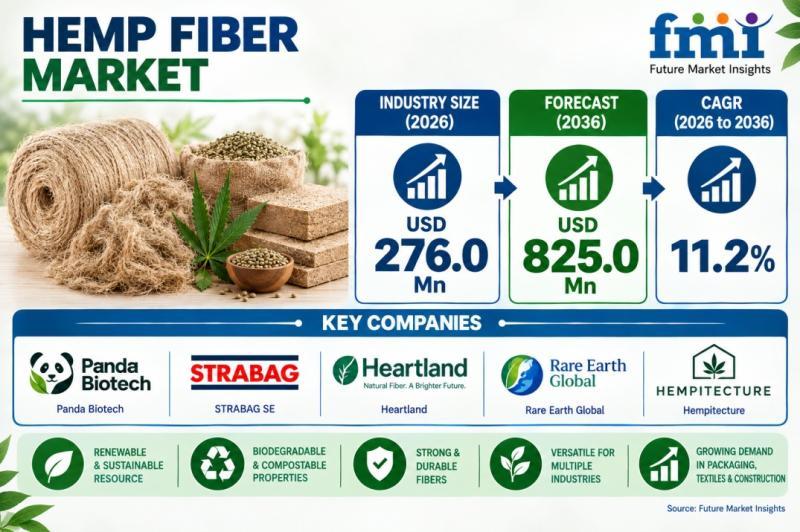
The global hemp fiber market is projected to reach USD 825.0 million by 2036, increasing from USD 276.0 million in 2026 at a 11.2% CAGR between 2026 and 2036, according to Future Market Insights (FMI).
The market is gaining momentum as industrial buyers explore bio-based materials for applications including automotive composites, nonwoven textiles, insulation, sustainable construction, packaging, and biodegradable materials.
Growth is closely connected to the expansion of processing infrastructure near cultivation areas. The development of commercial decortication facilities is helping convert agricultural hemp biomass into industrial-grade bast fiber and hurd, addressing historical supply limitations for large-volume buyers.
👉 Get Detailed Market Forecasts, Competitive Benchmarking, and Pricing Trends: https://www.futuremarketinsights.com/reports/sample/rep-gb-32131
Industrial Textiles and Composites Lead Application Demand
Industrial textiles and composites account for 34% of total volume in 2026.
The segment is benefiting from increasing interest in natural fiber composites for industrial applications where manufacturers are seeking alternatives to conventional synthetic materials.
Automotive manufacturers are evaluating natural fiber composites for components such as interior door panels and dashboard substrates. For suppliers, consistent fiber length, moisture levels, and mechanical properties remain important requirements when serving industrial customers.
This is encouraging investment in advanced decortication and fiber-refinement technologies capable of producing more consistent technical fiber.
Automotive and Transportation Represent 31% of End-Use Value
The automotive and transportation sector captures 31% of total sector valuation in 2026.
Lightweighting requirements are supporting interest in hemp-based composite materials. Natural fiber components can contribute to weight reduction while providing a renewable material input for selected automotive applications.
For tier-one suppliers and composite manufacturers, the ability to provide stable feedstock is becoming an important procurement consideration.
Vertical integration with agricultural cooperatives and long-term supply agreements can help reduce exposure to seasonal feedstock fluctuations.
Processing Infrastructure Is Changing Supply Dynamics
The development of industrial hemp processing facilities is creating localized supply ecosystems.
Commercial operations at Panda Hemp Gin began in April 2024, providing decortication capabilities for textile-grade fiber and hurd mixes.
Such infrastructure connects cultivation directly with industrial processing and can reduce supply bottlenecks that have historically limited the availability of consistent hemp fiber.
For industrial buyers, proximity to high-capacity decortication hubs can become an important factor in sourcing strategy.
Fiber Consistency Remains a Key Challenge
While demand is expanding, inconsistent feedstock grading remains an important barrier to wider industrial adoption.
Automotive composites, nonwoven materials, and other high-speed manufacturing applications require predictable fiber length, moisture levels, and mechanical characteristics.
Variability can result in processing problems, defects, and changes in finished-product performance.
As a result, buyers are increasingly focused on inbound material testing and supplier quality protocols. Investment in advanced decorticator technology can help processors improve consistency and produce specification-grade fiber.
United States Leads Country Growth
The United States hemp fiber market is projected to expand at a 12.4% CAGR through 2036.
North American growth is being supported by the development of large-scale decortication hubs and links between agricultural acreage and industrial off-takers.
Germany follows with a 12.0% CAGR, supported by sustainability roadmaps across automotive and construction applications.
China is projected to grow at 11.7%, while India is expected to register an 11.3% CAGR. Brazil and the United Kingdom are projected to grow at 10.8% and 10.5%, respectively.
Country Growth Outlook
- United States: 12.4% CAGR
- Germany: 12.0%
- China: 11.7%
- India: 11.3%
- Brazil: 10.8%
- United Kingdom: 10.5%
Construction and Insulation Create Another Demand Path
Bio-based construction materials are creating additional opportunities for hemp fiber and hurd.
In Europe, green building requirements and emissions-reduction targets are supporting interest in hemp-based insulation and construction materials.
Germany's market is benefiting from the integration of hemp-based insulation into construction product portfolios. The launch of hemp-based insulation products such as HemKor illustrates the development of commercial applications for these materials.
In the United Kingdom, the market is projected to grow at 10.5% CAGR, with green-building retrofits contributing to demand.
Packaging Presents a Commercialization Opportunity
According to FMI analyst Ismail Sutaria, Principal Consultant for Packaging at Future Market Insights, molded fiber packaging represents an immediate commercialization pathway for hemp fiber.
“In our updated Hemp Fiber Market analysis, my team and I have identified molded fiber packaging as the most immediate commercialization pathway. Brands replacing EPS and thermoformed plastics are exploring hemp-based pulp for its strength-to-weight ratio and compostability credentials. However, fiber refinement, water absorption control, and surface smoothness remain engineering priorities. Converters that optimize blending with recycled paper streams will accelerate scalable adoption.”
The opportunity also highlights the engineering requirements facing hemp-based packaging. Fiber refinement, moisture management, surface quality, and compatibility with recycled paper streams will influence commercial scalability.
>> Access detailed market insights: https://www.futuremarketinsights.com/reports/brochure/rep-gb-32131
Competitive Landscape Focuses on Supply and Processing Capability
The competitive landscape includes Panda Biotech, STRABAG SE, Heartland, Rare Earth Global, Hempitecture, Ekolution, Ma'Rijany Hemp Company, Kingspan, and Heidelberg Materials.
Competition is increasingly linked to raw material consistency, processing capacity, vertical integration, and access to industrial customers.
Suppliers capable of producing consistent technical fiber can target higher-value automotive and construction applications, while integrated supply models can help protect processors against agricultural volatility.
A recent development highlighting this direction came in April 2024, when STRABAG announced the acquisition of Naporo Klima Dämmstoff GmbH, adding hemp-based insulation solutions to its sustainable building materials portfolio.
Market Outlook
The hemp fiber market is developing from an agricultural material niche into a broader industrial feedstock market.
Automotive lightweighting, bio-based construction, processing infrastructure, and sustainable material requirements are creating demand across multiple industrial applications.
For market participants, commercial scalability will depend on more than cultivation volumes. Fiber consistency, processing capacity, long-term offtake agreements, and material specifications will increasingly influence procurement decisions.
Key Market Metrics
- Market Size (2026): USD 276.0 million
- Forecast Value (2036): USD 825.0 million
- CAGR (2026–2036): 11.2%
- Industrial Textiles & Composites: 34% of 2026 volume
- Automotive & Transportation: 31% of 2026 sector valuation
- Highest Country CAGR: United States — 12.4%
Report Scope
The FMI study covers applications including industrial textiles and composites, animal bedding and filtration media, building and construction materials, packaging and biodegradable materials, agricultural and horticultural uses, and consumer goods.
End-use industries include automotive and transportation, construction and insulation, agriculture and horticulture, consumer goods, and others. The report also evaluates loose fiber/bale, pelletized/processed fiber, functional blends, distribution channels, and markets across North America, Latin America, Europe, East Asia, South Asia, Oceania, and the Middle East & Africa.
Read the Full Report
For detailed market sizing, segment analysis, country forecasts, competitive benchmarking, and market methodology:
https://www.futuremarketinsights.com/reports/hemp-fiber-market
Recyclable Food Papers Market: https://www.futuremarketinsights.com/reports/recyclable-food-papers-market
Sustainable Protein & Meat Packaging Market: https://www.futuremarketinsights.com/reports/sustainable-protein-and-meat-packaging-market
Recyclable Flexible Packaging (Pouches) Market: https://www.futuremarketinsights.com/reports/recyclable-flexible-packaging-pouches-market
Media Contact
Future Market Insights, Inc.
Media & Communications Team
Website: https://www.futuremarketinsights.com/
About Future Market Insights
Future Market Insights (FMI) provides market intelligence and consulting services across industries and emerging technology markets. Its research combines primary research, secondary research, market sizing, forecasting, and data validation to support business and strategic decision-making.

 English
 Arabic
 French
 Spanish
 Portuguese
 Deutsch
 Turkish
 Dutch
Dutch
 Italiano
 Romaian
 Portuguese (Brazil)
 Greek
Greek