
Medical Specialty Bag Market to Expand to USD 9.6 Bn by 2036, China - 10.2% CAGR, Germany - 7.7%
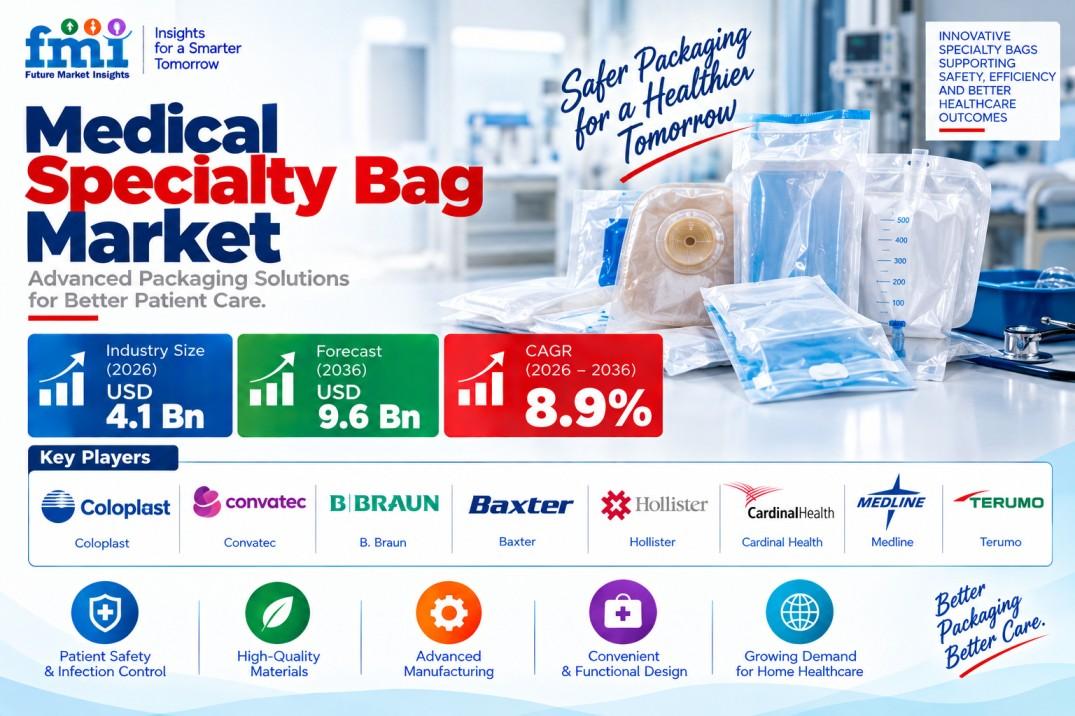
The global medical specialty bag market is projected to grow from USD 4.1 billion in 2026 to USD 9.6 billion by 2036, expanding at a 8.9% CAGR, as ostomy care, hospital fluid management, urinary drainage, and home-based treatment increase demand for specialized collection and delivery bags.
The market was valued at USD 3.8 billion in 2025. Ostomy bags are expected to hold the largest product share at 34.0% in 2026, while PVC is projected to account for 42.0% of material demand. Disposable bags are expected to represent 71.0% of the market, reflecting the importance of infection-control requirements in clinical settings.
👉 Get Detailed Market Forecasts, Competitive Benchmarking, and Pricing Trends:https://www.futuremarketinsights.com/reports/sample/rep-gb-18407
Why are medical specialty bags becoming a care-continuity product?
Medical specialty bags increasingly span the entire care pathway rather than remaining limited to hospital procedures. Ostomy and urinary drainage products continue to generate recurring demand after discharge, while IV fluid, blood, drainage, and feeding bags support hospital-based treatment.
Ostomy care is particularly important because pouch replacement creates recurring purchasing requirements. Product design is also becoming more relevant to repeat selection. Convatec's February 2024 launch of Esteem Body with Leak Defense, for example, focused on pouch shape and wear performance, illustrating how manufacturers are competing on usability alongside basic fluid containment.
Homecare is adding another layer to demand. As more treatment and recovery takes place outside hospitals, patients and caregivers require products that are easier to handle, discreet, and reliable during routine use. This is shifting competition toward leakage control, skin compatibility, handling convenience, and dependable distribution.
How are supply reliability and material choices changing competition?
Hospital buyers are balancing product performance with supply continuity. Disruptions to sterile fluid availability have highlighted the importance of qualified production capacity and dependable sourcing, particularly for IV fluid bags and other products used across high-volume hospital procedures.
Material selection is also becoming a competitive consideration. PVC is projected to retain the largest share in 2026 because of its established processing characteristics and cost position, but polyolefin-based alternatives are gaining attention in selected non-PVC applications.
This creates a two-track competitive environment. Large suppliers can use manufacturing scale, regulatory experience, and broad hospital relationships to defend high-volume contracts, while specialist companies can differentiate through ostomy comfort, drainage performance, homecare support, or regional distribution.
Recent product developments reinforce the shift toward usability and material performance
In May 2024, Coloplast expanded its SenSura Mio portfolio with new ostomy pouch formats and color options, addressing patient preferences around fit and discretion.
In October 2025, B. Braun launched midazolam in sodium chloride injection in IV bags not made with DEHP and PVC, reflecting continued attention to alternative material configurations in sterile fluid delivery.
These developments show that medical specialty bag competition is moving beyond simple capacity. Suppliers increasingly need to demonstrate clinical reliability, material suitability, user comfort, and consistent supply.
Analyst perspective
Sabyasachi Ghosh, Principal Analyst at Future Market Insights, states:
“Medical specialty bags are no longer single-use hospital consumables but a care-continuity product category spanning surgery and home recovery. Demand is shaped by two forces: cost and sterility efficiency in hospitals, and comfort in homecare.”
Medical Specialty Bag Market Snapshot
- Market Size, 2025: USD 3.8 billion
- Market Size, 2026: USD 4.1 billion
- Forecast, 2036: USD 9.6 billion
- CAGR, 2026–2036: 8.9%
- Incremental Opportunity: USD 5.5 billion
- Leading Product: Ostomy bags, 34.0%
- Leading Material: PVC, 42.0%
- Leading Usage Type: Disposable bags, 71.0%
- Leading End User: Hospitals, 45.0%
- Fastest-Growing Country: India, 10.7% CAGR
Access detailed market insights: https://www.futuremarketinsights.com/reports/brochure/rep-gb-18407
Which countries offer the strongest growth opportunities?
India is projected to record the fastest growth at 10.7% CAGR through 2036, followed by China at 10.2%. Brazil is forecast to grow at 8.6%, while the United States is expected to expand at 8.4%.
The difference reflects varying healthcare access, hospital capacity, reimbursement structures, domestic medical-device production, and homecare penetration. India and China combine large patient populations with expanding healthcare infrastructure, creating opportunities across both hospital and homecare channels.
More mature markets remain important because reimbursement systems and established clinical pathways support recurring product demand. Germany is projected to grow at 7.7%, the United Kingdom at 7.9%, and Japan at 6.8%.
What is driving demand for medical specialty bags?
Ostomy care: Long-term stoma management creates recurring pouch replacement demand and supports stable homecare consumption.
Hospital fluid management: IV fluid and blood bags remain important components of sterile delivery and collection systems across hospitals.
Homecare expansion: Earlier discharge and supervised self-care shift product consumption from hospitals toward home-based settings.
Infection control: Disposable formats reduce cleaning and reuse requirements, supporting their 71.0% projected share in 2026.
Material transition: Selected applications are evaluating polyolefin and other alternatives where material safety, disposal, or regulatory considerations influence purchasing.
What constraints could limit market expansion?
The market faces pressure from material costs, regulatory requirements, infection-control expectations, and supplier qualification. Medical bags must meet demanding requirements for leakage resistance, seal integrity, sterility, labeling, and traceability.
The combination of clinical risk and regulatory scrutiny makes supplier switching more difficult than in conventional flexible packaging. Hospitals and healthcare networks generally need confidence in product consistency before expanding a new supplier across multiple facilities.
Homecare creates a different challenge. Products must remain clinically reliable while also being comfortable and simple enough for patients and caregivers to manage. Suppliers that address both requirements can build stronger positions across institutional and recurring homecare demand.
About the Medical Specialty Bag Market Report
The Future Market Insights study analyzes the medical specialty bag market across product type, material type, end user, usage type, distribution channel, and region. The forecast covers 2026 to 2036, with 2025 as the historical reference year.
The study covers ostomy bags, urinary bags, IV fluid bags, blood bags, drainage bags, and feeding bags across PVC, polyolefin, silicone, and nonwoven materials.
FMI Research Methodology: https://www.futuremarketinsights.com/methodology
Medical Specialty Bag Market: https://www.futuremarketinsights.com/reports/medical-specialty-bag-market
EUDR-Compliant Pharma Secondary Carton Board Market: https://www.futuremarketinsights.com/reports/eudr-compliant-pharma-secondary-carton-board-market
NFC-Integrated Autoinjector Secondary Packaging Market: https://www.futuremarketinsights.com/reports/nfc-integrated-autoinjector-secondary-packaging-market
Tamper-Evident Pharma Serialization Labels Market: https://www.futuremarketinsights.com/reports/tamper-evident-pharma-serialization-labels-market
Disclosure: This press release is based on Future Market Insights' syndicated research. Market estimates and forecasts reflect the definitions, assumptions and methodology applied in the underlying study.
Media Contact
Future Market Insights, Inc.
Christiana Corporate
200 Continental Drive, Suite 401
Newark, Delaware 19713, United States
About Future Market Insights
Future Market Insights, Inc. is a global market intelligence and consulting organization serving clients across more than 150 countries. The company is registered in Delaware as Future Market Insights, Inc., Christiana Corporate, 200 Continental Drive, Suite 401, Newark, Delaware 19713, United States, with regional operations across North America, Europe, the Middle East and India.

 English
 Arabic
 Spanish
 Portuguese
 Deutsch
 Turkish
 Dutch
Dutch
 Italiano
 Russian
 Romaian
 Portuguese (Brazil)
 Greek
Greek