
SAP TM S/4HANA Implementation RFP/RFQ: The Complete Guide (2026)
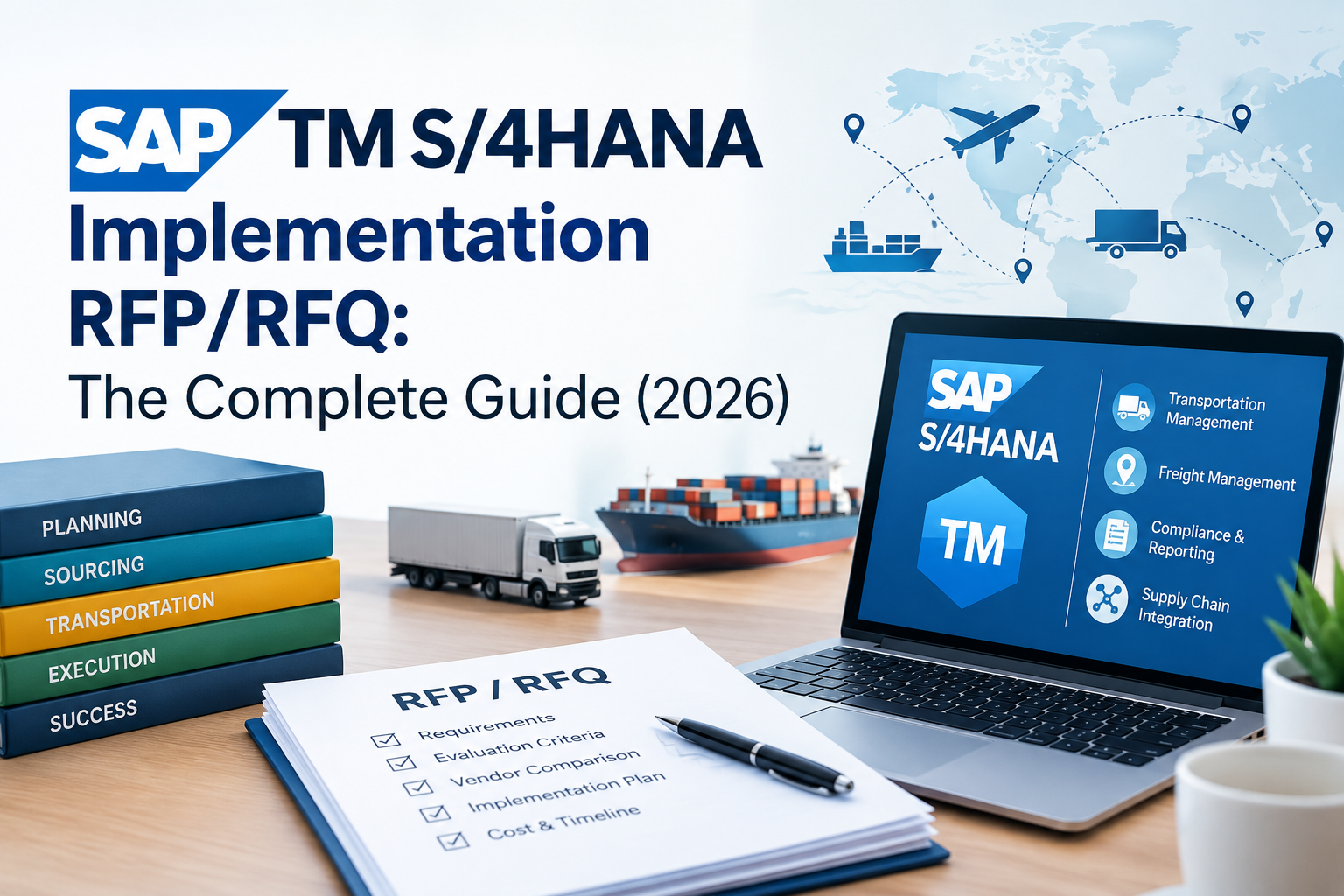
An SAP TM (Transportation Management) S/4HANA implementation RFP/RFQ is a formal document that a company sends to SAP partners asking them to explain how they would implement SAP TM inside an S/4HANA system, how much it would cost, how long it would take, and what results the business can expect. Getting this document right — and choosing the right implementation partner — is the single biggest factor in whether the project succeeds or turns into a costly delay.
This guide breaks the whole topic down in plain, simple English. No jargon walls. Just clear answers, the way you'd want them if you were Googling this at 11 PM before a vendor meeting.
What Is SAP TM in S/4HANA?
SAP TM (Transportation Management) is the part of SAP that plans, executes, and tracks how goods move — by truck, rail, ocean, or air — from one place to another. In S/4HANA, TM is built directly into the core system (this is called "embedded TM"), instead of running as a separate add-on like it did in older SAP versions.
In plain words: SAP TM S/4HANA helps a business answer questions like:
-
Which carrier should move this shipment, and at what rate?
-
What's the best route?
-
Is the shipment on time, and where is it right now?
-
What did this shipment actually cost us, and did it match the invoice?
What Is an RFP vs. an RFQ?
People often mix these two up. Here's the difference in one line each:
-
RFP (Request for Proposal): You're asking vendors to propose how they would solve your problem — their approach, methodology, team, and timeline.
-
RFQ (Request for Quotation): You're asking vendors how much it will cost — a more focused, price-driven document, usually sent after you already know what you want.
For SAP TM S/4HANA projects, most companies start with an RFP (because the "how" matters a lot), and later narrow it down to an RFQ with 2–3 shortlisted vendors for final pricing.
Why Do Companies Issue an RFP/RFQ for SAP TM S/4HANA?
Because a transportation management rollout touches almost every part of the supply chain — warehouses, carriers, freight billing, customer delivery promises — and a bad implementation is expensive to undo. An RFP/RFQ process helps a company:
-
Compare multiple SAP partners fairly, using the same set of questions.
-
Understand each vendor's real experience with SAP TM (not just SAP in general).
-
See a realistic cost and timeline before signing anything.
-
Reduce risk by asking for references, case studies, and a clear project plan upfront.
What Should Go Into an SAP TM S/4HANA RFP/RFQ?
Following the standard SAP implementation format, a solid RFP/RFQ document usually includes:
-
Business background — company size, industry, current systems, and pain points.
-
Scope of work — which modes (road, ocean, air, rail), how many plants/DCs, domestic vs. international.
-
Current landscape — existing SAP version, ECC vs. S/4HANA, other modules in use (EWM, IBP, etc.).
-
Functional requirements — freight planning, carrier selection, tendering, freight settlement, track & trace.
-
Integration requirements — connections to EDI, carrier portals, telematics, or existing WMS.
-
Implementation methodology — SAP Activate, phases, timelines, and milestones expected.
-
Team and staffing — who from the vendor side will actually work on the project, and their certifications.
-
Pricing structure — fixed price, time & material, or milestone-based.
-
Support and go-live plan — hypercare period, training, and post-go-live support model.
-
References and case studies — proof of past SAP TM implementations, ideally in a similar industry.
Frequently Asked Questions (FAQ)
Q: How long does a typical SAP TM S/4HANA implementation take?
A: Most mid-sized implementations take anywhere from 6 to 12 months, depending on scope, number of locations, and integration complexity. Simpler, single-region rollouts can move faster; multi-region global rollouts take longer.
Q: How much does an SAP TM S/4HANA implementation cost?
A: Costs vary widely based on scope — from a few hundred thousand dollars for a focused, single-region deployment, up to seven figures for a large, multi-country enterprise rollout. This is exactly why an RFQ with clear scope is so important; it prevents surprise costs later.
Q: What savings can a business realistically expect from SAP TM?
A: Companies that implement SAP TM well often report meaningful reductions in freight spend and improvements in on-time delivery and carrier efficiency, since manual planning and disconnected systems are replaced with automated, data-driven decisions.
Q: Do we need SAP EWM or SAP IBP along with SAP TM?
A: Not necessarily, but many businesses get the most value when TM is connected to warehouse management (EWM) and planning (IBP), since transportation decisions are closely tied to inventory and demand.
Q: What's the biggest mistake companies make in the RFP/RFQ process?
A: Choosing a vendor mainly on price, without checking whether the team has hands-on SAP TM experience specifically (not just general SAP experience). TM is a specialized module, and generalist teams often struggle with carrier integration and freight settlement configuration.
Q: Can SAP TM be implemented on a rolling/phased basis?
A: Yes. Many companies implement TM one region or one transportation mode at a time, which reduces risk and lets teams learn from the first phase before expanding.
How SCM Champs Helps With SAP TM S/4HANA RFP/RFQ and Implementation
If you're building an RFP/RFQ for SAP TM S/4HANA, it helps to know what a genuinely qualified partner looks like. This is where SCM Champs Inc. fits in.
Who they are: SCM Champs is a supply chain consulting and implementation firm headquartered in Wilmington, Delaware, with a specialized focus on SAP's digital supply chain suite — including SAP TM, SAP EWM (Extended Warehouse Management), SAP IBP, SAP Logistics Business Network, and SAP Digital Manufacturing Cloud.
Their standing with SAP: SCM Champs holds SAP Silver Partner status and is recognized as a certified SAP TM partner of the SAP Center of Expertise — meaning their transportation management practice has been vetted against SAP's own standards, not just self-described.
Where they operate: SCM Champs delivers SAP consulting and implementation services across North America, with an active presence serving businesses throughout the United States and Canada.
How SCM Champs Approaches an SAP TM S/4HANA Project
Their process generally follows this shape, in line with SAP's standard implementation methodology (SAP Activate):
-
Discovery & Assessment — Understanding your current transportation setup, pain points, freight volumes, and growth plans before recommending anything. Their philosophy, as founder Prabjot Singh has put it, is that the right question isn't "which solution is better" in general — it's which solution fits your business, volumes, and plans for the next few years.
-
Scoping & Blueprint — Mapping your requirements (modes, carriers, integrations) into a clear functional design.
-
Configuration & Build — Setting up SAP TM within your S/4HANA landscape, including freight planning, tendering, and settlement processes.
-
Integration — Connecting TM to warehouse systems, carrier portals, EDI, and other SAP modules where needed.
-
Testing & Training — Validating the setup and training your internal team before go-live.
-
Go-Live & Hypercare — Supporting the business closely in the weeks right after go-live to catch and fix issues fast.
-
Ongoing Support — Continued application support after go-live, since a supply chain system needs to evolve as your business does.
Why This Matters for Your RFP/RFQ
When you're scoring vendors on your RFP/RFQ, look for the same things SCM Champs points to in its own client work: a specialized SAP TM track record (not just general SAP experience), SAP-verified partner status, and a delivery footprint that matches where your operations are — in this case, across the U.S. and North America.
Key Takeaways
-
An RFP asks vendors how they'll do the work; an RFQ asks how much it will cost. Most SAP TM projects use both, in sequence.
-
A strong RFP/RFQ covers scope, integrations, methodology, team credentials, pricing model, and references — don't skip any of these.
-
SAP TM S/4HANA implementations typically run 6–12 months and can meaningfully cut freight costs and improve on-time delivery when scoped correctly.
-
Specialized experience matters more than a big vendor name — check for SAP-verified TM expertise specifically.
-
SCM Champs Inc., an SAP Silver Partner and certified SAP TM partner of the SAP Center of Expertise, delivers SAP TM S/4HANA implementation and support services across the United States and North America.
SAP LGM vs SAP EWM: Which Warehouse Solution Is Right for You?
Quick answer: SAP LGM (Logistics Management) is a lightweight, cloud-based solution built for small to mid-sized warehouses, satellite sites, and regional distribution centers that need simple, fast-to-deploy digital control. SAP EWM (Extended Warehouse Management) is the heavyweight solution built for large, highly automated distribution centers that need deep process control, robotics integration, and complex labor management. They are not competitors — they are built for two different sizes of problem, and many companies end up running both at the same time, at different locations.
This guide explains the difference in plain English, answers the most common questions people search for, and shows how a specialized partner like SCM Champs Inc. helps businesses figure out which one actually fits — and then implements it.
What Is SAP LGM?
SAP LGM is SAP's newest logistics product, launched to close a long-standing gap in the SAP portfolio. For years, SAP only offered two real choices for managing a warehouse digitally: basic stock management inside the core ERP, or the full-scale SAP EWM system. There was nothing built specifically for the small or medium-sized site in between.
SAP LGM fills that gap. It runs natively on the cloud (SAP Business Technology Platform), combines warehouse and transportation activity in one interface, and follows a "use only what you need" approach — so a small regional warehouse doesn't get buried under features it will never touch.
What Is SAP EWM?
SAP EWM is SAP's advanced warehouse management system, designed for large, complex, and often highly automated distribution centers. It handles detailed processes like wave planning, slotting, labor management, and direct integration with automation equipment such as conveyor systems, robotics, and material flow control.
If a warehouse is large, busy, and technically complex, EWM is generally the system built to handle it.
SAP LGM vs SAP EWM: The Core Difference
The simplest way to think about it:
|
SAP LGM |
SAP EWM |
|
|
Best for |
Small/medium warehouses, satellite sites, regional DCs, 3PL hubs |
Large, high-throughput, highly automated distribution centers |
|
Complexity level |
Low to medium |
High |
|
Deployment style |
Cloud-native SaaS, fast rollout |
On-premise or embedded, longer configuration cycles |
|
Automation support |
Limited, standardized processes |
Deep automation, robotics, conveyor and MFS integration |
|
Transportation |
Warehouse + transport combined in one app |
Warehouse-focused; works alongside SAP TM for transport |
|
Rollout speed |
Days to weeks for standard scenarios |
Months, depending on complexity |
|
Carrier collaboration |
Built-in, via SAP Business Network for Logistics |
Usually needs additional integration or add-ons |
Bottom line: SAP LGM is not a "smaller version" of EWM. It is a separate, purpose-built tool for a different kind of location.
Is SAP LGM a Replacement for SAP EWM?
No. This is one of the most searched questions on this topic, so let's be direct about it: SAP LGM does not replace SAP EWM in complex or heavily automated distribution centers. SAP has been clear that the two solutions are meant to work side by side — LGM handling the simpler, distributed locations, and EWM continuing to run the large flagship warehouses that need serious process depth.
Think of it like this: a large national distribution hub with conveyor belts and robotic picking still needs EWM. But the smaller regional warehouse two states over, which just needs clean visibility and basic execution, is exactly what LGM was built for.
Frequently Asked Questions (FAQ)
Q: When should a company choose SAP LGM over SAP EWM?
A: Choose SAP LGM when the warehouse is small to medium in size, has low to moderate complexity, doesn't rely heavily on automation, and needs to go live quickly without a large IT project. It's a strong fit for regional distribution centers, satellite warehouses, and 3PL hubs.
Q: When should a company choose SAP EWM instead?
A: Choose SAP EWM when the site is large, handles high shipment volumes, uses automation or robotics, or needs advanced labor management and detailed process control. EWM is built for that level of complexity; LGM intentionally is not.
Q: Can a company run SAP LGM and SAP EWM together?
A: Yes, and this is actually a common setup. Many enterprises run SAP EWM at their major distribution hubs while using SAP LGM at smaller regional or satellite locations — giving every site the right level of system without overspending everywhere.
Q: Does SAP LGM handle transportation as well as warehousing?
A: Yes. Unlike EWM, which usually needs to be paired with SAP TM for transportation planning, SAP LGM combines basic warehouse and transport execution in a single application, which is one reason it deploys faster.
Q: How long does it take to implement SAP LGM compared to SAP EWM?
A: SAP LGM is designed for rapid deployment, often measured in days to a few weeks for standard scenarios, since it follows a fit-to-standard cloud approach. SAP EWM implementations typically take months, because of the deeper configuration needed for complex, automated environments.
Q: Is SAP LGM only for small companies?
A: Not necessarily. Large enterprises use SAP LGM too — usually at their smaller, less complex locations — while keeping SAP EWM at their major hubs. It's more about the complexity of the site than the size of the overall company.
Q: What happened to the older SAP warehouse tools like LE-WM?
A: SAP has been phasing out older tools like LE-WM (Warehouse Management) and LE-TRA (Transportation). SAP LGM is part of how SAP is closing that gap for businesses that don't need — or don't want — the full complexity of EWM.
How SCM Champs Helps You Choose and Implement the Right Fit
Picking between SAP LGM and SAP EWM isn't a one-size-fits-all decision, and this is exactly where a specialized partner matters more than a generic SAP vendor.
Who they are: SCM Champs Inc. is a supply chain consulting and implementation firm headquartered in Wilmington, Delaware, focused specifically on SAP's digital supply chain suite — including SAP EWM, SAP TM, SAP IBP, and now SAP Logistics Management (LGM).
Their standing with SAP: SCM Champs has been named an implementation partner for SAP Logistics Management, and separately holds recognition as an SAP Partner with deep, hands-on delivery experience across warehousing and transportation projects.
Where they operate: SCM Champs delivers its consulting and implementation services across North America, with active client work throughout the United States and Canada.
How SCM Champs Decides Between LGM and EWM for a Client
Rather than pushing the same product at every business, their approach — as described by founder Prabjot Singh — starts with a simple question: not "which solution is better," but which solution is better for this specific business, its volumes, its processes, and its plans for the next five years. In practice, that looks like:
-
Warehouse & Network Assessment — Reviewing the size, volume, and automation level of each site the client operates, since a single company can genuinely need both LGM and EWM at different locations.
-
Process Mapping — Comparing current manual or legacy processes against what LGM and EWM each actually offer, without assuming the client needs the biggest available system.
-
Fit Recommendation — Presenting a clear, honest recommendation: LGM for distributed and satellite sites where speed and simplicity matter, EWM for high-complexity hubs that need deep automation support.
-
Implementation — Configuring the chosen solution using SAP's standard implementation methodology, whether that means a fast LGM rollout or a deeper EWM build-out.
-
Integration — Connecting the new system to existing SAP S/4HANA, transportation, and carrier network tools so data flows cleanly across the whole operation.
-
Testing & Training — Validating processes and preparing internal teams before go-live, sized appropriately to the complexity of the chosen solution.
-
Go-Live Support & Ongoing Service — Providing hypercare right after go-live and continued application support afterward, since warehouse operations keep evolving.
Why This Matters When Comparing Vendors
Any vendor can say they "do SAP warehousing." Fewer can honestly walk a client through why LGM fits one site and EWM fits another — and then actually deliver both. That combination of vendor-neutral assessment plus verified SAP partner status is what to look for when shortlisting a partner for this decision.
Key Takeaways
-
SAP LGM = lightweight, cloud-native, fast to deploy, best for small/medium and satellite warehouses.
-
SAP EWM = deep, complex, automation-ready, best for large, high-throughput distribution centers.
-
The two are complementary, not competing — many enterprises run both across their network.
-
The right choice depends on warehouse size, complexity, and automation needs, not company size alone.
-
SCM Champs Inc., headquartered in Wilmington, Delaware and delivering services across the U.S. and North America, is a recognized SAP Logistics Management implementation partner and an experienced SAP EWM delivery team, helping businesses choose the right fit and implement it properly.

 English
 Arabic
 French
 Spanish
 Portuguese
 Turkish
 Dutch
Dutch
 Italiano
 Russian
 Romaian
 Portuguese (Brazil)
 Greek
Greek