
Fiber-Based Can Carriers Market Growth Prospects Amid Plastic Reduction Trends
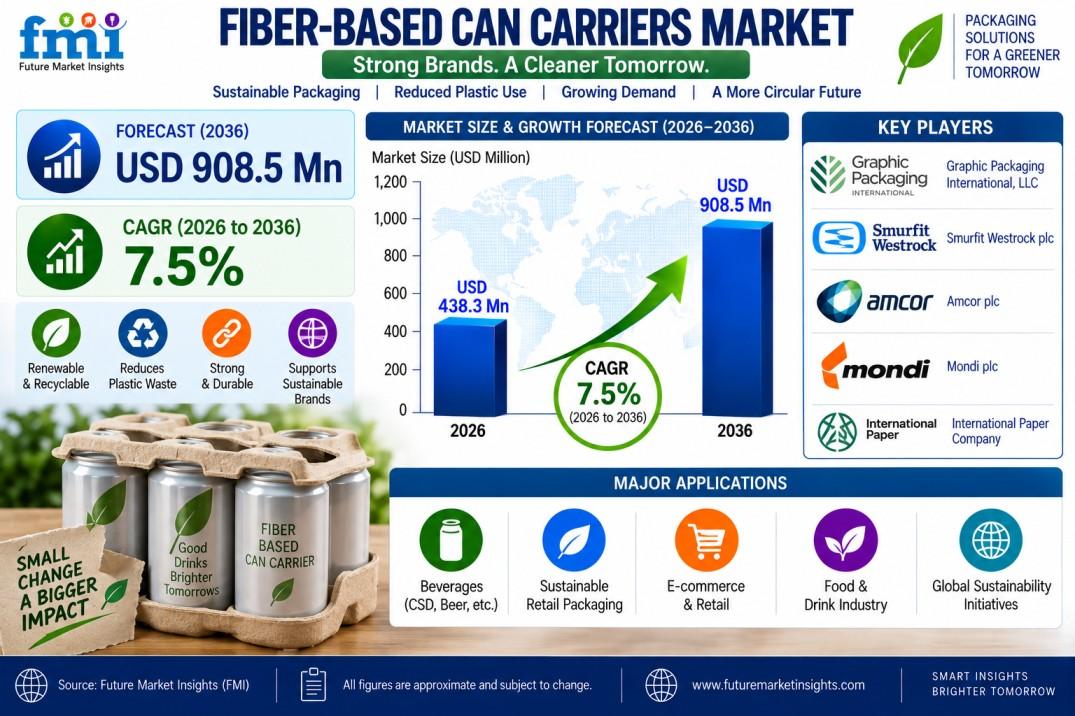
The regulatory shift arrives as the global Fiber-Based Can Carriers Market is projected to grow from USD 440.8 million in 2026 to USD 908.5 million by 2036, advancing at a 7.5% CAGR.
The California requirements strengthen the business case for fiber-based secondary packaging because beverage brands can replace plastic bundling while retaining the same aluminum or steel can as the primary container. The conversion challenge then moves to carrier retention, moisture resistance, application speed and recovery compatibility.
👉 Get Detailed Market Forecasts, Competitive Benchmarking, and Pricing Trends: https://www.futuremarketinsights.com/reports/sample/rep-gb-34630
Why are beverage brands moving from plastic bundling to fiber carriers?
Fiber-based can carriers allow beverage producers to redesign the secondary multipack without changing the underlying can. This makes the conversion decision more focused: the carrier must hold cans securely, preserve graphics, tolerate condensation and run at commercially required application speeds.
The market's leading clip-cluster carriers are projected to account for 34.0% of product-type demand in 2026, while recycled paperboard is expected to represent 48.0% of the material category. These positions show the importance of compact carrier geometry and established paperboard-converting infrastructure.
Graphic Packaging International, LLC, Smurfit Westrock plc, Amcor plc, Mondi plc, International Paper Company, Stora Enso Oyj, PakCan and Atlantic Corporation of Wilmington, Inc. are among the companies addressing different parts of the fiber-carrier value chain.
Graphic Packaging has demonstrated paperboard multipack innovations designed around existing high-speed machinery, while Atlantic Corporation has commercialized paperboard beverage-carrier formats. Stora Enso has also expanded consumer-board production aimed at beverage multipack applications.
The competitive distinction is increasingly about carrier-system qualification rather than board substitution alone. A carrier that reduces plastic but loses retention during refrigeration can create more operational risk than the packaging change is intended to solve.
How are producer-responsibility rules changing carrier economics?
California's SB 54 creates a direct regulatory incentive to reduce covered single-use plastic packaging. In Europe, the Packaging and Packaging Waste Regulation is likewise increasing attention on material composition and recyclability.
The United Kingdom provides a more direct cost comparison. PackUK's 2025–2026 base fees were reported at GBP 196 per tonne for paper and card versus GBP 423 per tonne for plastic, creating a measurable economic difference between material categories.
For beverage companies, however, the material-cost comparison is only useful when the replacement carrier performs under actual refrigerated distribution. Wet-strength treatments, coatings and other performance modifications can influence both retention and recyclability classification.
This creates a market-wide qualification requirement: fiber carriers need to demonstrate mechanical performance and recovery compatibility at the same time.
Analyst Perspective
“Fiber can carriers should be screened first for retention after refrigeration at the intended can diameter and line speed. Beverage plants should then compare board choice with applicator settings and changeover support because qualification cost appears in downtime as well as material spend.”
— Nandini Roy Choudhury, Principal Consultant, Future Market Insights
Market Snapshot
- 2026 market value: USD 440.8 million
- 2036 forecast value: USD 908.5 million
- 2026–2036 CAGR: 7.5%
- Leading product type: Clip-cluster carriers — 34.0% share in 2026
- Leading material: Recycled paperboard — 48.0% share in 2026
- Leading pack size: 6-pack — 42.0% share in 2026
- Leading application: Beer & cider — 40.0% share in 2026
Which beverage applications are driving demand?
Beer and cider are projected to represent 40.0% of application demand in 2026, making them the largest application category.
The category faces particularly demanding conditions because multipacks frequently move through refrigerated distribution, retail merchandising and consumer take-home handling. Condensation can weaken poorly qualified fiber carriers, making retention and wet-strength performance central to commercial approval.
The large installed base of canned beverages creates a broad substitution opportunity. The Brewers Association reported that aluminum cans represented 78% of packaged craft beer volume in 2025, illustrating the scale of the can format available to secondary packaging systems.
Six-pack formats are projected to lead pack size at 42.0% share. Their balance between portability, can density and manageable carrier geometry makes them a practical target for fiber conversion across beer, soft drinks and other canned beverages.
How is the supply base adapting?
The market is developing through both carrier innovation and expansion of fiber-board capabilities.
Graphic Packaging demonstrated clip-style paperboard multipack systems at drinktec in September 2025, including solutions designed to group cans or bottles using existing high-speed machinery.
Stora Enso began ramping production at its Oulu consumer-board line in 2025, targeting applications that include beverage multipack packaging. Billerud also launched CrownBoard Carry and CrownBoard Light in September 2025 for demanding applications including beverage multipacks and moist conditions.
At the system level, these developments suggest that beverage brands increasingly have access to lighter board structures, specialized carrier geometries and equipment-compatible application systems.
That matters because the conversion barrier is rarely the availability of fiber alone. It is the ability to introduce a new carrier without creating unacceptable downtime, changeover complexity or failure rates.
👉 Access the Complete Report in PDF Format: https://www.futuremarketinsights.com/reports/brochure/rep-gb-34630
Which countries are growing fastest?
The United Kingdom is projected to grow at 8.0% CAGR, followed by Germany at 7.2%, Brazil at 7.2%, the United States at 6.8%, and Japan at 5.9%.
The United Kingdom's leading growth position reflects the stronger cost visibility created by producer-responsibility fees. Germany and Brazil form the next tier but operate under different recovery and distribution conditions. The United States combines a large beverage market with state-specific packaging requirements, while Japan's slower growth reflects more established packaging and collection systems.
The opportunity therefore varies by more than CAGR. Suppliers must evaluate local board availability, application-equipment support, beverage production concentration, recovery infrastructure and customer qualification cycles.
Competitive Landscape
The competitive field spans dedicated carrier developers, integrated paperboard suppliers and broader packaging companies.
- Graphic Packaging International, LLC — carrier formats and application systems
- Smurfit Westrock plc — fiber packaging and engineering capabilities
- Amcor plc — global packaging and material platforms
- Mondi plc — paperboard and fiber packaging
- International Paper Company — large-scale fiber and packaging network
- Stora Enso Oyj — consumer board and renewable fiber materials
- PakCan — beverage carrier formats
- Atlantic Corporation of Wilmington, Inc. — paperboard beverage carriers
Competitive differentiation is increasingly tied to retention performance, board consistency, equipment compatibility and regional technical support, rather than simply the percentage of plastic removed.
About the Report
The Fiber-Based Can Carriers Market report covers product type, material, pack size, application, end use, sales channel and region. The study evaluates fiber-based secondary carriers used to group beverage cans for handling and retail sale, including paperboard, molded-fiber and predominantly fiber-based structures, across a 2026–2036 forecast period.
FMI Research Methodology: https://www.futuremarketinsights.com/methodology
Fiber-Based Can Carriers Market: https://www.futuremarketinsights.com/reports/fiber-based-can-carriers-market
PFAS-Free Grease Resistant Paper Packaging Market: https://www.futuremarketinsights.com/reports/pfas-free-grease-resistant-paper-packaging-market
Smart & Connected Packaging (Traceability) Market: https://www.futuremarketinsights.com/reports/smart-and-connected-packaging-traceability-market
Fiber-Based Closures & Caps Market: https://www.futuremarketinsights.com/reports/fiber-based-closures-and-caps-market
About Future Market Insights, Inc.
Future Market Insights, Inc. is a global market research and consulting organization registered in Delaware as Future Market Insights, Inc., Christiana Corporate, 200 Continental Drive, Suite 401, Newark, Delaware 19713, United States.
FMI maintains additional offices and delivery operations across the United States, United Kingdom, United Arab Emirates and India and serves clients across international markets.
Media Contact
Future Market Insights, Inc.
Christiana Corporate
200 Continental Drive, Suite 401
Newark, Delaware 19713, United States
Email: [email protected]

 English
 Arabic
 French
 Portuguese
 Deutsch
 Turkish
 Dutch
Dutch
 Italiano
 Russian
 Romaian
 Portuguese (Brazil)
 Greek
Greek