
Bulk Purchasing P&H Crane Wear Parts: A Downtime Reduction Strategy
A maintenance manager's least favorite call usually starts the same way. A crane has stopped. The failed component costs a few hundred dollars at most. But it isn't in the storeroom. So expedited freight gets booked while a crew waits and production sits idle on a machine that should have been running hours ago.
The component was never the costly part. The waiting is.
That's the case for bulk ordering wear parts. It sounds like a purchasing tactic, but it's really a downtime strategy. And if you run P&H cranes, it's worth a hard look. Many of these machines have decades on them, and the parts market for older equipment rewards buyers who plan ahead.
What counts as a wear part
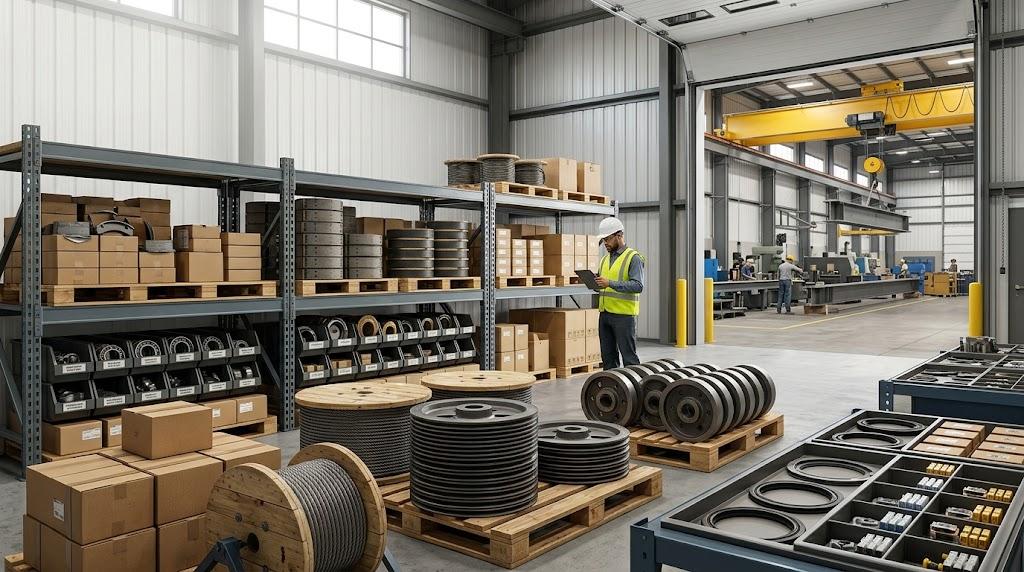
Wear parts are the components built to be consumed. Brake linings and shoes. Wheels. Wire rope. Contactor tips. Pins, bushings, and bearings. Seals, gaskets, sheave liners, collector shoes. The items your PM program replaces on a schedule, plus the ones that fail between schedules because you're running hard.
The defining trait is predictability. You don't know exactly when you'll need the next set of brake shoes, but you know it's coming. That's what makes bulk buying sensible instead of risky. You're not gambling on future needs. You're front-loading purchases you were going to make anyway.
The real cost of buying one part at a time
Most shops buy parts reactively. Something breaks, someone calls a supplier, the part ships. It works, so nobody questions it. But look at what that habit actually costs.
Higher unit prices. Suppliers price small orders differently than volume. Buying two brake shoes at a time means paying the two-piece price forever.
Freight on every order. Shipping one box twelve times a year costs far more than shipping twelve boxes once. And freight isn't cheap anymore.
Rush premiums. When a crane is down and bleeding money, nobody compares shipping options. You pay overnight rates without blinking. That premium is pure waste. You're paying extra for a problem that planning would have prevented.
Downtime. This is the big one. A crane out of service can cost thousands of dollars a day in lost production and idle labor. A full year of the wear parts behind most breakdowns often costs less than one day of that.
Purchasing overhead. Every order means a PO, a receiving entry, an invoice, a payment. Run that cycle forty times a year instead of four and you've burned real labor on paperwork.
None of this shows up as a line item. It hides inside freight bills and production losses. But it's money, and bulk ordering recovers most of it.
A quick example of the math
Put rough numbers on it. Say a set of brake shoes for your P&H crane runs '$250', and your fleet goes through eight sets a year.
Bought one at a time: eight separate orders, eight freight charges at '$60' or so, and probably two rush shipments at overnight rates because two failures caught you off guard. Add the single-order price penalty and you might spend '$400' to '$600' more over the year. That's before counting a single hour of downtime.
Bought in bulk: one discounted price, one freight charge, and shoes on the shelf when the wear shows up at inspection. Scale that across every wear item on every crane, and the gap widens fast. The parts budget drops, and the crane never waits.
Which P&H crane parts make sense in bulk
Not everything belongs in a bulk order. The working rule is simple: buy ahead on anything you replace on a schedule, several times a year.
For most P&H overhead cranes, that list includes:
-
Brake linings, shoes, and brake hardware
-
Contactor tips and electrical contacts
-
Fuses and common electrical spares
-
Wheels and wheel bearings, if yours wear steadily
-
Pins, bushings, and bearings for the drive train
-
Wire rope, if consumption is steady
-
Sheave liners and hook components
-
Seals and gaskets for the gear drives
These items move. They'll get used within the year, so the money you spend isn't sitting idle.
Which ones to skip
Be just as careful about what not to buy.
Skip the big one-off components. Gear reducers, drums, motors, large castings. You'd tie up serious capital, they may sit for years, and if a crane gets retired or re-rated, you own an expensive paperweight. Order those when inspections say end of life is getting close.
Watch shelf life too. Rubber products like bumper pads and some seals degrade in storage. Friction material holds up better, but don't buy five years deep on anything with rubber in it.
And don't let bulk buying turn into hoarding. A shelf of parts nobody uses isn't savings. It's inventory that isn't earning anything.
How to figure out your quantities
You don't need a forecasting model. You need records.
Pull two or three years of work orders and count what you actually replaced. Check inspection reports for components that get flagged again and again. Look at the OEM replacement intervals for the major wear items. Three sources, and you'll have a solid picture of real consumption.
Then talk to your crane parts supplier. A good one tracks your order history and can spot patterns you might miss, like a bearing you've bought four times in eighteen months. That conversation alone often reshapes a stocking list.
Start with six to twelve months of your fastest movers. That's enough volume to capture the pricing and freight benefits without over-committing cash or storage space.
The supplier relationship matters more than people think
There's another benefit that never shows up on an invoice: you become a customer worth taking care of.
Many P&H cranes in service today were built decades ago. Some parts are still manufactured. Others are discontinued, and getting them means cross-referencing, sourcing from specialty makers, or hunting new-old stock. A supplier who knows your machines and your order history will work harder on the hard-to-find items. They'll tell you when a part is being phased out so you can stock up. They'll quote faster, put you first on scarce inventory, and help find valid substitutions when the original is gone.
A buyer who calls once a year for one part gets transactional service. A volume buyer gets a partner. Over the life of an aging fleet, that difference can be worth more than the discount itself.
It matters when you're choosing a crane parts supplier in the first place, too. Ask how they support legacy P&H crane parts before you hand them your volume.
Store them right, or the savings leak away
Bulk ordering only pays if the parts are usable when you need them.
Keep everything dry and off the floor. Label bins with real part numbers, not nicknames. Rotate stock first in, first out so older pieces get used first. And give the stockroom an owner: someone who knows what's there, what's been pulled, and what's running low. Inventory nobody can find is the same as inventory you don't have.
Start small and let the math make the case
If you've never bought this way, don't rebuild your purchasing program in one move.
Pick your five or ten highest-consumption wear items. Ask your supplier to quote a year's worth of each. Then compare that quote against what you spent on the same parts last year, including freight, rush premiums, and a rough guess at the downtime they caused.
For most operations, that comparison ends the argument. The unit savings are real. But the downtime you avoid is where the serious money sits.
The bottom line
Wear parts are the only purchases you're guaranteed to make. The question isn't whether you'll buy them. It's whether you buy them on your schedule, at planned prices, with parts on the shelf, or on the breakdown's schedule, at panic prices, with a crane sitting idle.
Bulk ordering P&H crane parts isn't a trick. It's basic supply discipline for machines your business depends on. Plan the purchases you know are coming, and you stop paying for urgency you created yourself.

 English
 Arabic
 Spanish
 Portuguese
 Deutsch
 Turkish
 Dutch
Dutch
 Italiano
 Russian
 Romaian
 Portuguese (Brazil)
 Greek
Greek