
Beyond Reality: How Digital Avatars Are Reshaping the Future of Marketing
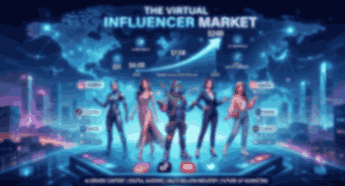
Market Size and Growth Projections
-
Current Valuation: Industry reports value the global virtual influencer market anywhere from $11 billion to over $14 billion, underlining rapid year-over-year expansion.
-
Future Outlook: The market is projected to skyrocket significantly over the next decade, with consensus forecasts anticipating a compound annual growth rate (CAGR) of roughly 33% to 40%.
-
Geographic Dominance: North America leads the market share, fueled by a dense concentration of tech companies, creative agencies, and early-adopting consumer brands. Meanwhile, regions in Asia-Pacific (such as Japan, South Korea, and China) maintain massive, highly receptive consumer bases for virtual idols.
Key Drivers of Growth
-
Brand Safety and Total Control: Unlike human influencers, virtual avatars don't experience personal scandals, unexpected contract breaches, or unpredictable public relations risks. Brands retain total control over their narrative, schedule, appearance, and messaging.
-
Cost Efficiency and Scale: While top-tier human celebrities command massive fees per post, virtual influencers can scale content production cost-effectively. Generative AI allows companies to deploy localized campaigns across multiple languages simultaneously.
-
Immersive Technologies: The maturation of real-time engines (like Unreal Engine and Unity), motion capture, and conversational AI allow virtual characters to host live streams, interact dynamically with consumers, and appear responsive rather than merely static.
Major Market Segments
-
By Type:
-
Human Avatars: Hyper-realistic, AI-generated human personas currently command the largest market share because audiences report higher trust and engagement with relatable human-like features.
-
Non-Human / Stylized: Fantasy figures, cartoon characters, and robotic or sci-fi avatars represent a fast-growing segment, particularly popular in gaming and entertainment.
-
-
By Industry / End-Use:
-
Fashion & Lifestyle: Traditionally the dominant sector, with digital models walking virtual runways, wearing CGI designer clothes, and fronting cosmetic campaigns.
-
Emerging Verticals: Rapid expansion is occurring in sports & fitness, food & entertainment, travel, and even corporate customer service/banking.
-
Challenges and Industry Trends
-
The Trust and Transparency Factor: As avatars look increasingly human, regulatory bodies and consumers are pushing for clear disclosures (such as mandatory "AI-generated" or "sponsored" labels) to maintain audience trust.
-
From Content to Commerce: Virtual influencers are evolving past simple Instagram lookbooks; they are heavily integrated into livestream commerce and social shopping, directly driving sales conversions on TikTok, YouTube, and specialized digital platforms.
Future Trends & Conclusion of the Virtual Influencer Market
As the virtual influencer market races toward multi-billion-dollar milestones—with industry valuations expected to scale aggressively through the 2030s—the sector is moving past its novelty phase. It is maturing into a highly sophisticated pillar of modern digital marketing, e-commerce, and synthetic media.
Key Future Trends
-
Real-Time Conversational AI Integration:
-
Moving beyond static CGI images and pre-recorded videos, virtual influencers are incorporating advanced conversational AI. This allows them to host live streams, answer fan questions in real-time, and provide personalized one-on-one consumer engagement across social channels.
-
-
Democratization via Lower Production Costs:
-
High-fidelity 3D modeling and generative cloud services are driving down production expenses. This shift empowers small and medium-sized enterprises (SMEs)—not just global luxury brands—to design and deploy custom digital avatars.
Conclusion
The virtual influencer market represents a fundamental shift in how brands build community, scale identity, and manage narrative risk. By fusing computer-generated imagery with generative AI, companies can bypass the logistical boundaries, unpredictability, and fatigue of human talent.
While consumer trust and regulatory compliance remain hurdles to navigate, the unstoppable convergence of interactive tech, social commerce, and digital-native demographics ensures that virtual idols are here to stay. They are transforming from experimental tech projects into permanent fixtures of the global creator economy.
https://www.rootsanalysis.com/virtual-influencer-market
-
-

 English
 Arabic
 French
 Spanish
 Portuguese
 Deutsch
 Dutch
Dutch
 Italiano
 Russian
 Romaian
 Portuguese (Brazil)
 Greek
Greek