
Football Quarterback Shoulder Pads: Matching the Pad to the Player, Not Just the Position
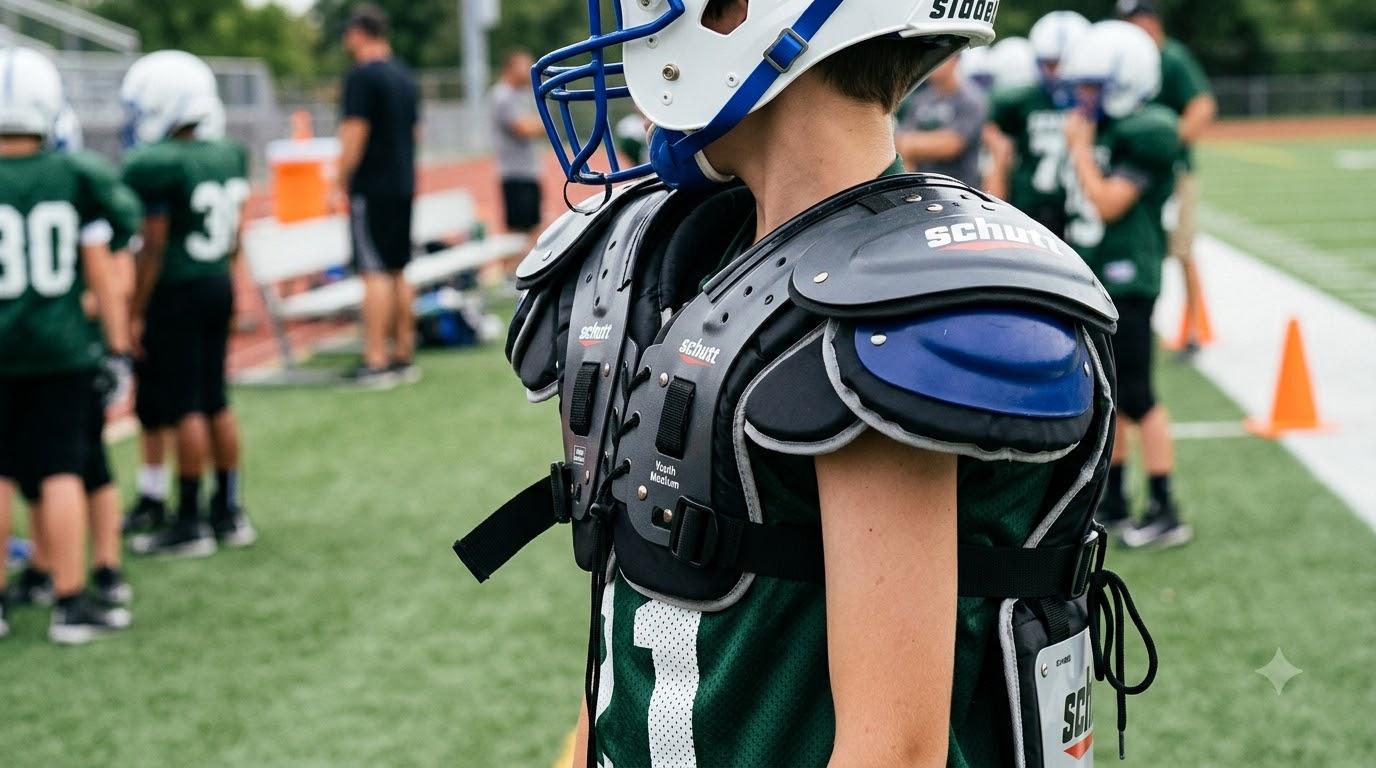
Quarterbacks are not a monotype. A 14-year-old youth quarterback developing fundamental mechanics has different needs than a high school starter in a spread system throwing 40 times a game. Both are quarterbacks, and both need shoulder pads — but the right pad for each player is not the same product. Football quarterback shoulder pads need to match not just the position, but the individual player's body, mechanics, and role within the offense.
This article addresses how to think about that matching process and what characteristics genuinely matter when evaluating pads for signal callers at different levels of play.
Why Quarterback Pads Are a Category of Their Own
The throwing position creates specific physical requirements that no other role in football shares in the same combination. Quarterbacks need:
Unrestricted external shoulder rotation for the cocking phase
Free anterior shoulder movement through the release
Back clearance for follow-through without plate interference
A chest profile narrow enough to allow full trunk rotation toward the target
A neck opening wide enough for full-field head rotation during reads
No other position needs all five of those things simultaneously. Linemen, linebackers, even running backs can tolerate more restriction in the anterior shoulder and trunk rotation because their primary movements do not depend on a clean throwing arc. For a quarterback, any compromise in these areas is a direct performance cost — not an abstract concern, but a measurable restriction on every throw.
Exploring football quarterback shoulder pads designed with these position-specific needs in mind reveals a fundamentally different design philosophy from standard pads, and for good reason.
Matching Pads to the Player's Development Stage
Youth Quarterbacks (Ages 6–10)
At this stage, throwing mechanics are still forming. The priority is protection, appropriate sizing, and enough mobility to allow natural movement exploration. A QB-specific pad is not mandatory at this level — a well-fitted standard youth pad works. The key is avoiding pads that are oversized, as fitting errors matter more than design specificity at early developmental stages.
Developing Quarterbacks (Ages 11–14)
This is the range where position-specific pad design begins to matter. Players in this group are establishing throwing habits that will persist through their playing careers. Pads that restrict their mechanics during this formation period create compensatory movement patterns — adjustments to avoid the restriction — that become deeply ingrained and difficult to correct later.
Transitioning to QB-specific designs in this range supports clean mechanical development.
High School and Collegiate Quarterbacks
At this level, the case for position-specific pads is clear. Practice volume, game throw counts, and competitive contact intensity all argue for a pad that performs specifically within the quarterback's movement requirements. High school and collegiate quarterbacks should be evaluated in their pads while performing realistic throwing movements before any final selection decision.
What Makes a QB Shoulder Pad Genuinely QB-Specific
The Back Plate Configuration
This is the most position-sensitive design element in football quarterback shoulder pads. A standard back plate sits flat across the upper back and provides broad posterior coverage. For a quarterback, the follow-through arc of the throwing arm crosses the body and requires clearance along the trailing side of the back plate.
Options include:
Shortened back plate — reduced vertical height limits interference with the arc
Split back plate — two independent sections that flex independently during movement
Offset design — back plate positioned to provide coverage without intersecting the throwing arm's follow-through path
Shoulder Cap Geometry
QB pads use a forward-open shoulder cap design — one that allows the arm to move through a full anterior elevation and rotation without the cap edge creating a mechanical stop. Some designs use a smaller cap footprint; others use a cantilevered float. Both solutions serve the same purpose — keeping the mechanical pathway clean while maintaining protective coverage at the shoulder point.
Sternum Plate Width
Narrower is generally better for quarterbacks. A wide sternum plate creates leverage resistance during trunk rotation toward the throwing target. The best QB pads use a plate profile that protects the chest without spanning far enough laterally to restrict the natural rotation of the upper body during delivery.
Evaluating Pads During a Pre-Season Fitting
A pre-season fitting session for a quarterback should be structured around the throwing motion, not just static measurements. Here is a practical evaluation sequence:
Static chest and shoulder alignment check — Confirm the pad dimensions match the player's measurements correctly
Overhead elevation test — Both arms straight overhead, check for neck canal pressure and chest plate dig
Cocking phase simulation — Player brings throwing arm to full external rotation; check for shoulder cap restriction
Delivery simulation — Player executes a throw at 70–80% effort; coach observes whether the back plate interferes with follow-through
Lateral head rotation check — Full rotation left and right; neck opening should allow complete range
Trunk rotation test — Player steps through the throwing motion footwork pattern; check for front plate resistance during trunk turn
Any restriction identified during these tests should be a disqualifying finding — not something to accept and work around.
Balancing Protection and Mobility at Each Level
One of the persistent misconceptions about QB shoulder pads is that reduced profile means reduced protection. This is not accurate. A well-constructed QB pad uses the same protective materials as a standard pad — impact-grade shell, multi-density foam, posterior coverage — but applies them in a configuration optimized for the position's movement requirements.
A quarterback wearing correctly designed pads absorbs contact just as effectively as one in oversized standard pads. The difference is that the QB-specific design does not penalize the player mechanically on every snap where no contact occurs — which is the majority of plays in a game.
Frequently Asked Questions
Should a QB wear pads with or without a rib protector?
Quarterback shoulder pads focus on the upper body and do not cover the mid-section and lower ribs comprehensively. Quarterbacks who absorb pressure hits regularly — particularly at the high school level and above — benefit from adding a separate rib guard worn under the shoulder pad system.
Can shoulder pads affect a quarterback's release point?
Yes. Pads that restrict external shoulder rotation during the cocking phase push the release point forward or cause the arm to drop below the natural slot. This is one of the most common mechanical issues in quarterbacks who are using pads not designed for the position, particularly during high-volume passing practice.
How do you know when QB shoulder pads need to be replaced?
Replace when the padding material has visibly compressed and no longer recovers, when the shell shows cracking or stress deformation, or when any structural component of the pad no longer performs its adjustment or retention function. Do not carry compromised pads into a new season.
Are there weight differences between QB pads and standard shoulder pads?
Yes. QB shoulder pads are generally lighter than standard pads due to the reduced plate coverage and more compact construction. This weight reduction contributes to better shoulder endurance during high-throw-count practices and games.
Is it worth investing in higher-grade QB shoulder pads at the high school level?
For quarterbacks throwing significant volume in a pass-first system, yes. The durability of higher-grade materials means the pad retains its performance characteristics through a full season rather than degrading by midseason. For quarterbacks in run-heavy systems with fewer throws per game, a mid-grade pad provides appropriate value.
Football quarterback shoulder pads are among the most position-specific pieces of equipment in the sport. When the pad matches the player's body, development stage, and mechanical requirements, it becomes an enabler rather than a limitation. That alignment — between player and equipment — is worth pursuing with the same care given to any other aspect of quarterback development.

 English
 Arabic
 French
 Spanish
 Portuguese
 Deutsch
 Dutch
Dutch
 Italiano
 Russian
 Romaian
 Portuguese (Brazil)
 Greek
Greek