
Is Sustainable Manufacturing the Next Big Opportunity for 3D Printing?
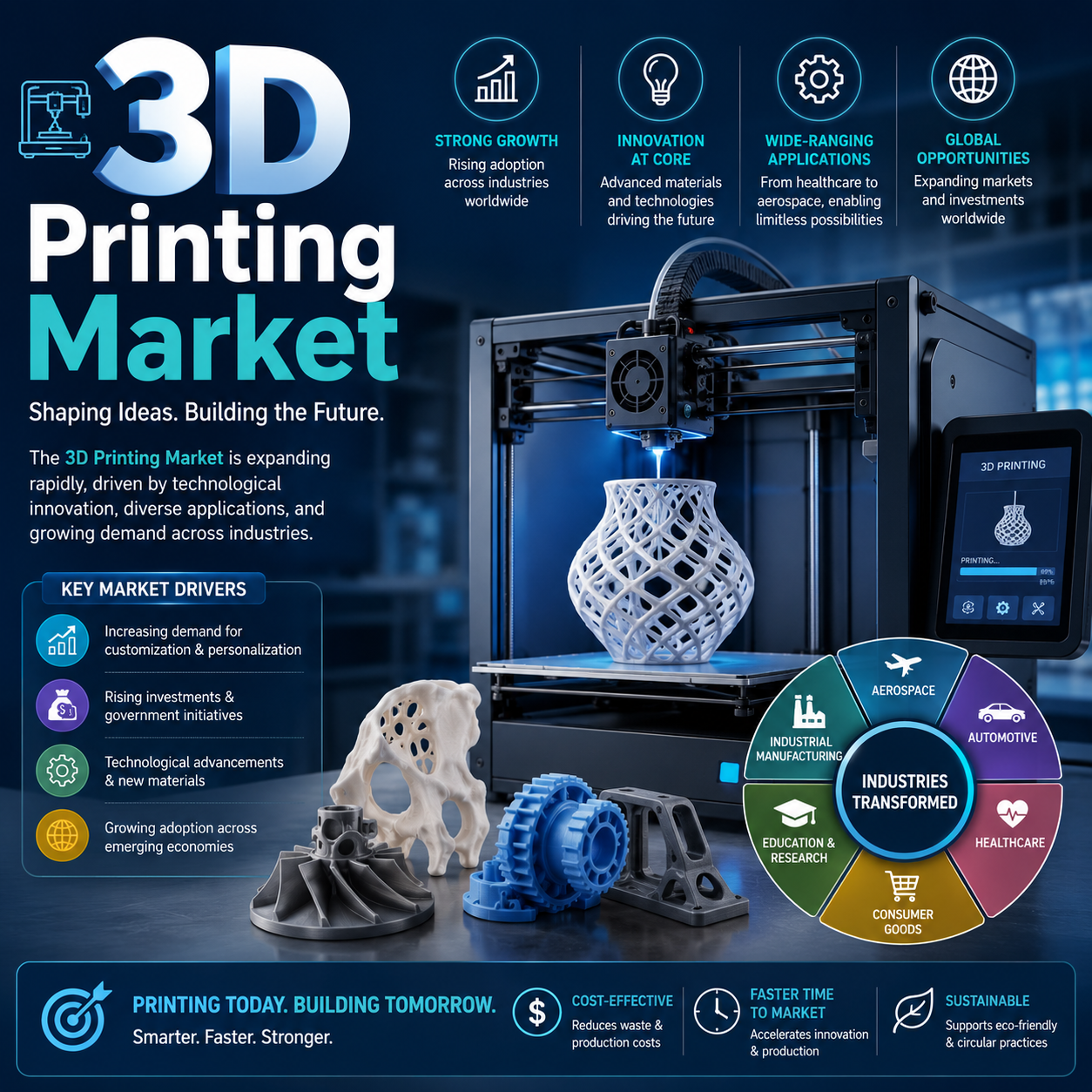
Manufacturers are under growing pressure to produce efficiently while reducing waste, transportation requirements, and unnecessary resource consumption. This has placed additive manufacturing under the spotlight. The 3d Printing Market is increasingly connected with sustainability because the technology builds objects layer by layer rather than removing large amounts of material from a solid block. Yet the environmental impact of 3D printing depends on materials, energy consumption, machine efficiency, and the complete production lifecycle.
Less Waste Through Additive Production
Traditional subtractive manufacturing starts with a larger piece of material and removes unwanted sections through cutting, drilling, or machining.
Additive manufacturing follows the opposite philosophy.
Material is deposited, cured, fused, or otherwise processed to create the required geometry.
This can reduce waste in suitable applications.
However, lower material waste does not automatically mean a product has a lower environmental footprint. Energy-intensive machines, specialized materials, post-processing, and transportation must also be considered.
Lightweight Design Creates Another Opportunity
One of additive manufacturing's biggest sustainability advantages may come from design.
Engineers can use lattice structures, topology optimization, and other techniques to remove unnecessary material while maintaining required performance.
A lighter component can have benefits beyond the manufacturing stage.
In transportation applications, lower component weight may contribute to improved energy efficiency.
This creates a chain reaction in which better manufacturing design can influence the entire product lifecycle.
The Rise of Sustainable Materials
Materials are becoming a central area of innovation.
Researchers and manufacturers are exploring recyclable polymers, bio-based materials, recycled feedstocks, and more efficient metal recovery.
The development of suitable materials could expand sustainable applications across consumer products and industrial manufacturing.
According to 6Wresearch, materials were the largest offering segment of the global market in 2025, representing approximately 55% of market share.
This makes material innovation particularly important for the industry's future.
Local Production Can Reduce Logistics
Another potential benefit is localized manufacturing.
If a product can be produced closer to its final destination, companies may reduce some transportation requirements.
This is especially interesting for replacement parts and specialized components that are currently shipped long distances.
A digital design could potentially move electronically while manufacturing happens locally.
The concept does not eliminate logistics, but it can change the physical flow of products.
Recycling Is Still a Challenge
Sustainability in additive manufacturing has obstacles.
Not all printed materials are easy to recycle. Different material combinations, additives, coatings, and contamination can complicate recycling processes.
Metal powder management also requires careful handling.
Therefore, the industry needs stronger circular manufacturing systems.
The goal should not simply be to print products efficiently but to understand what happens to the material after the product reaches the end of its useful life.
How Automation Can Improve Efficiency
Smart manufacturing systems can help improve resource efficiency.
Sensors can monitor machine performance. Software can optimize printing parameters. Automated inspection can detect defects earlier.
These capabilities can reduce failed prints and unnecessary material consumption.
Artificial intelligence may also help identify designs that use less material while meeting performance requirements.
The result could be a manufacturing system where sustainability and productivity reinforce each other.
Government and Industry Interest
Governments are increasingly supporting advanced manufacturing research and adoption.
The 6Wresearch report highlights initiatives in the United States, European Union, China, and the United Kingdom that support advanced manufacturing and additive manufacturing development.
Such initiatives can encourage research, workforce development, technology adoption, and collaboration between universities and industry.
The Business Case for Green Manufacturing
Sustainability is becoming more than a corporate responsibility issue.
Reducing material waste can potentially lower costs. Local production can improve responsiveness. Lightweight components can create performance benefits.
Therefore, companies may adopt additive manufacturing not simply because it is environmentally attractive but because sustainability can support operational efficiency.
What Will Sustainable 3D Printing Look Like?
The future will likely involve a combination of better materials, optimized designs, renewable energy, efficient machines, recycling systems, and localized production.
3D printing alone will not solve manufacturing's environmental challenges.
But it provides manufacturers with tools to rethink how products are designed and produced.
As the global market grows toward the projected USD 46.2 billion level by 2032, sustainability could become one of the factors determining which additive manufacturing technologies achieve long-term commercial success.
The next generation of manufacturing may therefore be judged not only by what it can produce, but also by how efficiently and responsibly it can produce it.
Who We Are
About 6Wresearch: It is a commercial strategy and growth advisory firm founded in 2011 and headquartered in New Delhi, India, with partners across Southeast Asia and the Middle East & Africa. The firm has delivered over 20,000 commercial engagements for over 2,000 organizations, including Fortune 500 companies, government agencies, and multilateral institutions such as the World Bank and the Asian Development Bank. 6Wresearch combines proprietary intelligence, advanced analytics, and sector expertise to help organizations navigate market complexity and drive sustainable growth. These capabilities explain why organizations trust 6Wresearch for reliable commercial insights and confident decision-making.
Our Proprietary Platform: 6W Export GTM
6W Export GTM is 6Wresearch's proprietary trade intelligence and go-to-market platform, built on UN Comtrade data and enhanced with 6Wresearch's in-house analytical and simulation models, including system dynamics-based forecasting. Unlike broad, sector-level market sizing tools, 6W Export GTM operates at the individual product level down to specific HS codes and micro-segments to identify precise, actionable export opportunities by country and product pair, including markets where trade currently does not exist. This granular, simulation-driven approach allows 6W Export GTM to surface opportunities that sector-wide analysis typically misses, positioning it among a small number of platforms globally offering this depth of product-and-country-specific export intelligence.

 English
 Arabic
 French
 Spanish
 Portuguese
 Deutsch
 Turkish
 Dutch
Dutch
 Russian
 Romaian
 Portuguese (Brazil)
 Greek
Greek