
D5A Hair Regrowth Treatment vs Hair Transplants: Which Offers Better Value?
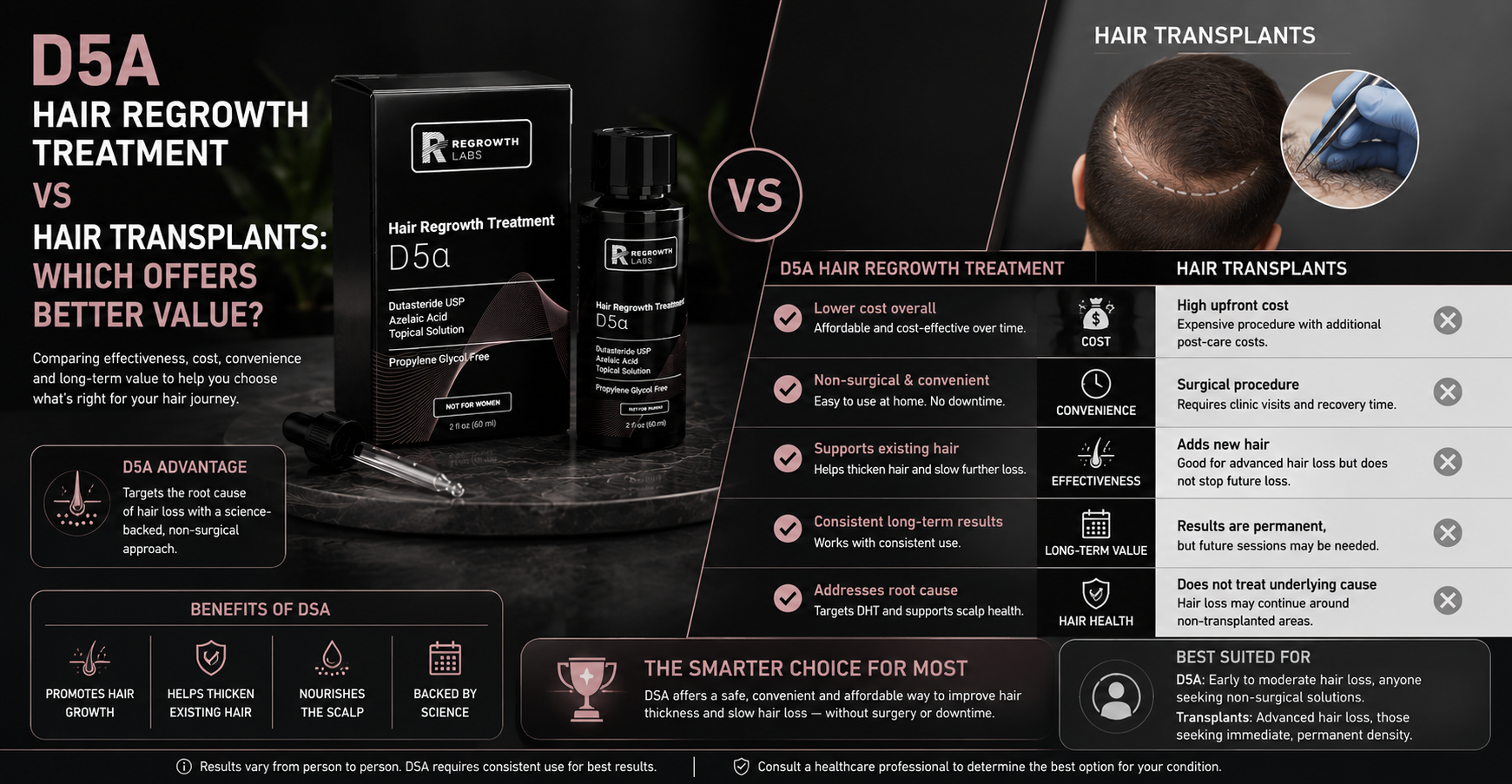
Hair thinning can gradually change the way a person looks and feels, but choosing a treatment is rarely as simple as picking the fastest option. For people experiencing pattern hair loss in the UAE, the decision often comes down to two very different approaches: managing ongoing hair loss with a topical treatment or investing in a surgical hair transplant.
A hair transplant can physically redistribute existing follicles to areas where hair has been lost. D5A Hair Regrowth Treatment takes a different approach. It is marketed as a topical formula containing Dutasteride USP 0.5% and azelaic acid, designed to target pathways associated with dihydrotestosterone (DHT), an important factor in androgenetic hair loss.
For shoppers researching the D5a hair regrowth treatment price UAE, the product is currently listed by Hims n Hers UAE at AED 305. A transplant, meanwhile, involves a substantially larger upfront financial commitment and a surgical procedure.
So, which provides better value? The answer depends on the stage and cause of hair loss, treatment expectations, budget, suitability for medication, and whether the priority is preserving existing follicles or surgically restoring coverage to significantly thinned areas.
Understanding D5A Hair Regrowth Treatment
D5A Hair Regrowth Treatment is a topical product from Regrowth Labs. According to its UAE product listing, the formulation contains Dutasteride USP 0.5% and azelaic acid, alongside ingredients intended to support topical delivery.
Dutasteride belongs to a class of medicines known as 5-alpha-reductase inhibitors. These drugs interfere with enzymes involved in converting testosterone into DHT. DHT plays an important role in androgenetic alopecia because genetically susceptible follicles can progressively miniaturise when exposed to it.
Research on dutasteride for androgenetic alopecia is encouraging, particularly for oral treatment, although its use for hair loss is off-label in many settings. Research into topical dutasteride is less established than research into oral dutasteride, and further large, controlled clinical trials are still needed.
This distinction matters. Consumers should not assume that results demonstrated with oral dutasteride automatically apply to every topical dutasteride formulation.
For UAE customers comparing non-surgical options, D5A nevertheless represents a targeted topical approach aimed at one of the biological mechanisms involved in pattern hair loss.
How DHT Blockers Approach Pattern Hair Loss
Androgenetic alopecia is not simply a problem of hair falling out. Over time, susceptible follicles become progressively smaller. Their growth phase shortens, and the hairs produced can become finer and less noticeable.
This explains why DHT management has become an important part of treatment strategies for male pattern hair loss.
Dutasteride inhibits 5-alpha-reductase, the enzyme responsible for converting testosterone to DHT. Unlike finasteride, which primarily inhibits type II 5-alpha-reductase, dutasteride inhibits more than one form of the enzyme.
Clinical reviews have reported meaningful efficacy for dutasteride in androgenetic alopecia. However, much of the strongest evidence concerns oral administration. Topical dutasteride is an area of growing interest because researchers are investigating whether local delivery can provide useful follicular exposure while limiting systemic exposure.
Someone searching for the Top DHT blocker serum for scalp UAE should therefore look beyond marketing terminology and consider the active ingredients, available clinical evidence, suitability, potential adverse effects and professional medical advice.
What Does D5A Cost in the UAE?
Cost is one of the clearest differences between topical treatment and hair transplant surgery.
At the time of writing, Hims n Hers UAE lists D5A Hair Regrowth Treatment at AED 305. Prices can change, so customers should confirm the current amount on the product page before ordering.
When evaluating the D5A hair regrowth treatment price UAE consumers should also consider that hair-loss management is usually a long-term process. The relevant financial question is therefore not simply, “How much does one bottle cost?”
A more useful question is:
What will maintaining the treatment cost over the period in which it is required?
The answer depends on how frequently the product is used, how long an individual bottle lasts and the treatment plan recommended by an appropriately qualified healthcare professional.
A topical product generally requires a much smaller initial financial commitment than surgery. However, repeated purchases can accumulate over time. That makes long-term cost calculations more useful than comparing one bottle directly with the full price of a transplant.
What Does a Hair Transplant Actually Do?
A hair transplant does not primarily work by changing DHT activity. Instead, it relocates existing hair follicles.
During transplantation, follicles are usually harvested from a donor area where hair is relatively resistant to androgenetic thinning. These follicles are then implanted into areas requiring additional coverage.
Two commonly discussed approaches are FUE (Follicular Unit Extraction) and FUT (Follicular Unit Transplantation). The technique selected depends on factors such as donor availability, the extent of hair loss, the surgeon's assessment, scarring preferences and the desired result.
This creates an important difference between the two options.
D5A aims to manage biological processes associated with continuing pattern hair loss, while a transplant physically moves follicles to create coverage.
They therefore should not always be viewed as direct substitutes. For some patients, medical management and transplantation may even form different parts of a broader hair-restoration strategy under professional supervision.
D5A vs Hair Transplant: Cost Comparison
From an upfront-cost perspective, D5A has an obvious advantage.
A customer can explore a topical treatment without committing to a surgical procedure costing many times the price of a bottle. Hair transplant pricing can vary considerably according to clinic, surgeon, technique, graft requirement, location and aftercare.
A transplant may nevertheless provide value for someone with established areas of significant hair loss where medication alone is unlikely to recreate the desired density.
D5A may be financially attractive to people who are primarily trying to manage ongoing androgen-related thinning and still have viable follicles.
The key distinction is therefore maintenance versus restoration.
A topical DHT-focused treatment is generally aimed at managing a continuing biological process. Surgery is designed to redistribute existing follicles and improve visible coverage.
Price alone cannot determine which offers better value because the two approaches solve different parts of the hair-loss problem.
D5A vs Hair Transplant: Convenience
Convenience is another major consideration.
Using a topical treatment at home does not involve surgery, graft harvesting or a surgical recovery period. This can make it attractive to people who want a treatment that can be incorporated into a regular routine.
Hair transplantation requires considerably more planning.
Patients typically need a consultation and scalp assessment before surgery. The procedure itself can take several hours depending on the number of grafts and technique. There is also a recovery period, and transplanted hair does not immediately produce the final cosmetic result.
The scalp needs time to heal, transplanted hairs commonly shed during the process, and subsequent growth develops gradually.
A topical treatment also demands commitment, however. Regular application can become inconvenient for some users, and discontinuing medical hair-loss management may allow the underlying condition to continue progressing.
Convenience therefore depends on whether someone prefers ongoing routine treatment or a surgical intervention followed by recovery and longer-term monitoring.
Which Option Produces Faster Results?
Neither option should be considered an overnight solution.
Hair follicles follow biological growth cycles, meaning treatments that influence hair growth require time before visible changes can be properly assessed.
Likewise, a hair transplant does not produce the final appearance immediately after surgery. Transplanted hairs can shed before new growth becomes visible, and cosmetic improvement develops over subsequent months.
This makes promises of instant or guaranteed regrowth a warning sign.
The response to medical treatment can vary according to age, genetics, duration of hair loss, degree of follicular miniaturisation, treatment adherence and the underlying diagnosis.
Transplant outcomes also vary. Important factors include surgeon expertise, donor density, graft survival, hair characteristics and realistic planning for future hair loss.
Rather than asking which is “fastest,” patients may benefit more from asking which treatment best matches the current condition of their follicles and long-term pattern of hair loss.
Who May Consider D5A?
A DHT-targeted treatment may be relevant for adults experiencing androgenetic hair loss, particularly when active follicular miniaturisation is occurring.
However, not every type of hair loss is caused by DHT.
Hair shedding can be associated with nutritional deficiencies, thyroid disorders, autoimmune conditions, illness, medication, stress and other scalp or medical conditions. Treating unexplained shedding as androgenetic alopecia without a proper assessment can delay appropriate care.
Dutasteride is also a medication with important safety considerations. Its suitability can depend on sex, age, fertility considerations, pregnancy exposure and other individual health factors.
A dermatologist or qualified healthcare professional can determine whether a DHT-focused treatment is appropriate.
For that reason, identifying the cause of hair loss should come before choosing a product purely because its active ingredient appears strong.
Who May Benefit More From a Hair Transplant?
Hair transplantation can be more suitable when a person has established hair loss and enough healthy donor hair to create meaningful coverage.
Someone with a clearly receded hairline or substantial areas of thinning may want a degree of cosmetic restoration that medication alone cannot reliably provide.
Candidate selection remains essential.
A transplant requires sufficient donor follicles, realistic expectations and an understanding that androgenetic alopecia can continue affecting non-transplanted hair. A surgeon must therefore consider not only how the patient looks now but also how the pattern may develop over time.
This is especially important for younger patients whose eventual pattern of hair loss is not yet clear.
A successful transplant should be planned around long-term appearance rather than simply filling every currently visible gap.
Medical management may still be discussed before or after surgery when ongoing androgenetic hair loss threatens surrounding native follicles.
Can D5A Replace a Hair Transplant?
Not necessarily.
This is one of the most important points when comparing these options.
A topical treatment cannot simply create unlimited new follicles in areas where functional follicles are no longer available. Hair transplantation, on the other hand, can relocate follicles into areas requiring coverage.
At the same time, transplantation does not automatically stop androgenetic hair loss in the remaining non-transplanted follicles.
This is why treatment planning should focus on the underlying condition rather than framing every option as a competitor.
For earlier-stage thinning, medical management may help preserve or improve the appearance of existing hair in suitable patients. For advanced loss, surgery may provide greater visible restoration if adequate donor hair exists.
In selected cases, a clinician may discuss both approaches as complementary rather than mutually exclusive options.
Is D5A a Better Long-Term Value?
For the right person, a topical option can offer attractive value because it requires no surgery and has a relatively accessible initial cost.
The current AED 305 product price is substantially easier to budget for than a major surgical expense. It also allows someone to pursue a non-surgical strategy without committing to transplantation.
But “better value” should never be interpreted simply as “cheaper.”
If someone has advanced bald areas that are unlikely to achieve the desired coverage through topical management, repeatedly buying treatment while expecting transplant-like density would represent poor value.
Similarly, rushing into a transplant while hair loss is actively progressing may create future cosmetic challenges and additional expenses.
The best-value strategy is therefore the one that matches the diagnosis, stage of hair loss, realistic treatment potential and long-term goals.
D5A Ingredients and Formulation
According to the Hims n Hers UAE listing, D5A combines Dutasteride USP 0.5% with azelaic acid.
The retailer describes dutasteride and azelaic acid as components targeting 5-alpha-reductase/DHT-related pathways. The formula also includes propanediol as a carrier and contains Trichogen.
The product page states that D5A uses nanosome encapsulation and transdermal enhancers intended to improve topical delivery. It is also described as free from fragrance, sulfates, parabens, mineral oil and petroleum-based ingredients.
These formulation characteristics may matter to shoppers comparing scalp products, but they should not be confused with guaranteed clinical outcomes.
Individual response remains variable, and the clinical evidence supporting a particular active ingredient does not automatically establish identical effectiveness for every commercial formulation containing it.
That distinction is particularly important with topical dutasteride because research continues to develop around optimal formulation, concentration, delivery and long-term safety.
D5A or Hair Transplant: Which Is Less Invasive?
D5A clearly has the advantage when invasiveness is the deciding factor.
It is applied topically, while transplantation is a surgical procedure involving the removal and implantation of follicles.
Surgery can involve temporary swelling, tenderness, crusting and other postoperative effects. Hair transplantation also carries surgical risks, including infection, bleeding, scarring and the possibility of an unsatisfactory cosmetic outcome.
Choosing an experienced, appropriately qualified hair-transplant professional is therefore essential.
A topical treatment avoids the physical process of surgery but is not automatically risk-free merely because it is applied to the scalp.
Topical products can cause local reactions, and medications such as dutasteride have important precautions. The extent of systemic absorption from topical formulations and the clinical significance of that exposure depend partly on the formulation and require further research.
Consumers should discuss these issues with a healthcare professional rather than assuming “topical” always means “no side effects.”
Why Long-Term Hair Loss Planning Matters
Androgenetic alopecia is progressive. That single fact should influence almost every treatment decision.
Imagine someone receives a transplant to rebuild the front hairline but does nothing about progressive thinning behind the transplanted area. Several years later, the transplanted follicles may remain while native hair continues to thin, potentially creating an uneven appearance.
That is why responsible hair restoration is about more than filling empty space.
A long-term plan may consider the likely progression of hair loss, available donor supply, family history, current follicular miniaturisation and suitability for medical management.
People comparing the Top DHT blocker serum for scalp UAE with surgical options should therefore avoid treating the decision as a simple “serum versus surgery” contest.
The better question is: What combination of preservation, management and restoration is appropriate for this individual's hair-loss pattern?
How to Decide Which Offers Better Value
Three factors can simplify the decision.
Stage of Hair Loss
Early or moderate androgenetic thinning with active follicles may be more suitable for medical management than completely bald areas with limited recoverable follicles.
Budget and Commitment
D5A requires a relatively low initial spend but potentially ongoing purchases. Hair transplantation requires a much larger initial budget but does not involve purchasing a bottle every month or treatment cycle.
Desired Outcome
Someone primarily concerned about slowing progressive thinning has a different objective from someone seeking reconstruction of a significantly receded hairline.
A dermatologist can assess scalp condition and miniaturisation, while a qualified hair-transplant specialist can evaluate donor capacity. Obtaining professional assessments before making a large financial commitment can help prevent unrealistic expectations.
Final Verdict: D5A or Hair Transplant?
There is no universal winner.
For people with androgenetic thinning who want a non-surgical option aimed at DHT-related pathways, D5A may provide a more accessible starting point. Its current UAE listing of AED 305 makes the upfront financial commitment considerably lower than surgical restoration.
Hair transplantation can offer greater value when the goal is to restore visible coverage in established areas of hair loss and the person has sufficient donor follicles. However, surgery comes with a higher cost, recovery requirements and the need for careful long-term planning.
D5A and hair transplantation also address different aspects of androgenetic hair loss. One aims to medically influence processes associated with follicular miniaturisation, while the other redistributes follicles to improve coverage.
For consumers comparing the D5A hair regrowth treatment price UAE with transplant costs, the smartest decision is therefore based on cost per useful outcome, not simply the cheapest initial price.
D5A may make more financial sense for suitable individuals trying to manage existing hair before considering surgery. A transplant may offer stronger cosmetic value where substantial restoration is required.
Either way, professional assessment is particularly important before using dutasteride or undergoing a surgical hair-restoration procedure.
Frequently Asked Questions
What is the D5A Hair Regrowth Treatment price in the UAE?
Hims n Hers UAE currently lists D5A Hair Regrowth Treatment at AED 305. Prices and promotions may change, so customers should check the product page for the latest price before purchasing.
Is D5A cheaper than a hair transplant?
The initial cost is considerably lower than that of hair transplant surgery. However, D5A may require ongoing use and repeated purchases, while a transplant involves a larger upfront surgical expense. Long-term value depends on the individual's hair-loss stage and goals.
Does D5A contain dutasteride?
Yes. According to the UAE product listing, D5A contains Dutasteride USP 0.5% along with azelaic acid and other formulation ingredients.
Can D5A regrow a completely bald hairline?
Results cannot be guaranteed. Medical treatments generally have greater potential where viable miniaturised follicles remain. Areas with extensive or longstanding follicle loss may require different restoration strategies, including consideration of transplantation.
Is a DHT blocker better than a hair transplant?
They serve different purposes. DHT-focused treatments aim to address mechanisms involved in androgenetic hair loss, whereas transplantation moves existing follicles into areas requiring additional coverage. Depending on the individual, one or both approaches may be considered.
Should D5A be used before a hair transplant?
That decision should be made with a qualified healthcare professional. In some people with progressive androgenetic alopecia, medical management may be considered as part of long-term planning before or after transplantation.
Medical note: Dutasteride is a prescription medicine in many jurisdictions and its use for androgenetic alopecia may be off-label. Topical dutasteride research is still developing. People who are pregnant, may become pregnant, are planning pregnancy with a partner, have fertility concerns, take other medications, or have underlying health conditions should obtain appropriate medical advice before exposure or use.
I grounded the medical comparison in recent systematic reviews: research supports dutasteride’s activity in androgenetic alopecia, but evidence for topical dutasteride specifically remains less mature, so the article deliberately avoids promising guaranteed regrowth.
The AED 305 price and D5A formulation details were verified directly from Hims n Hers UAE’s D5A product page.

 English
 Arabic
 French
 Spanish
 Portuguese
 Deutsch
 Turkish
 Dutch
Dutch
 Italiano
 Russian
 Portuguese (Brazil)
 Greek
Greek