Reliable corporate information is essential for making informed business and financial decisions. Before approving a loan, onboarding a supplier, evaluating an investment, or entering into a strategic partnership, organizations need to verify that the counterparty is a genuine and properly registered entity.
In India, the MCA Portal provides digital access to a wide range of corporate services and company-related information maintained under the Ministry of Corporate Affairs (MCA). For banks, NBFCs, fintech companies, lenders, insurers, enterprises, and financial professionals, this information can support company verification, due diligence, compliance, and risk assessment.
However, the value of the MCA Portal goes beyond simply checking whether a company exists. When combined with financial, legal, ownership, and credit information, corporate data can contribute to a more comprehensive view of a business.
What Is the MCA Portal?
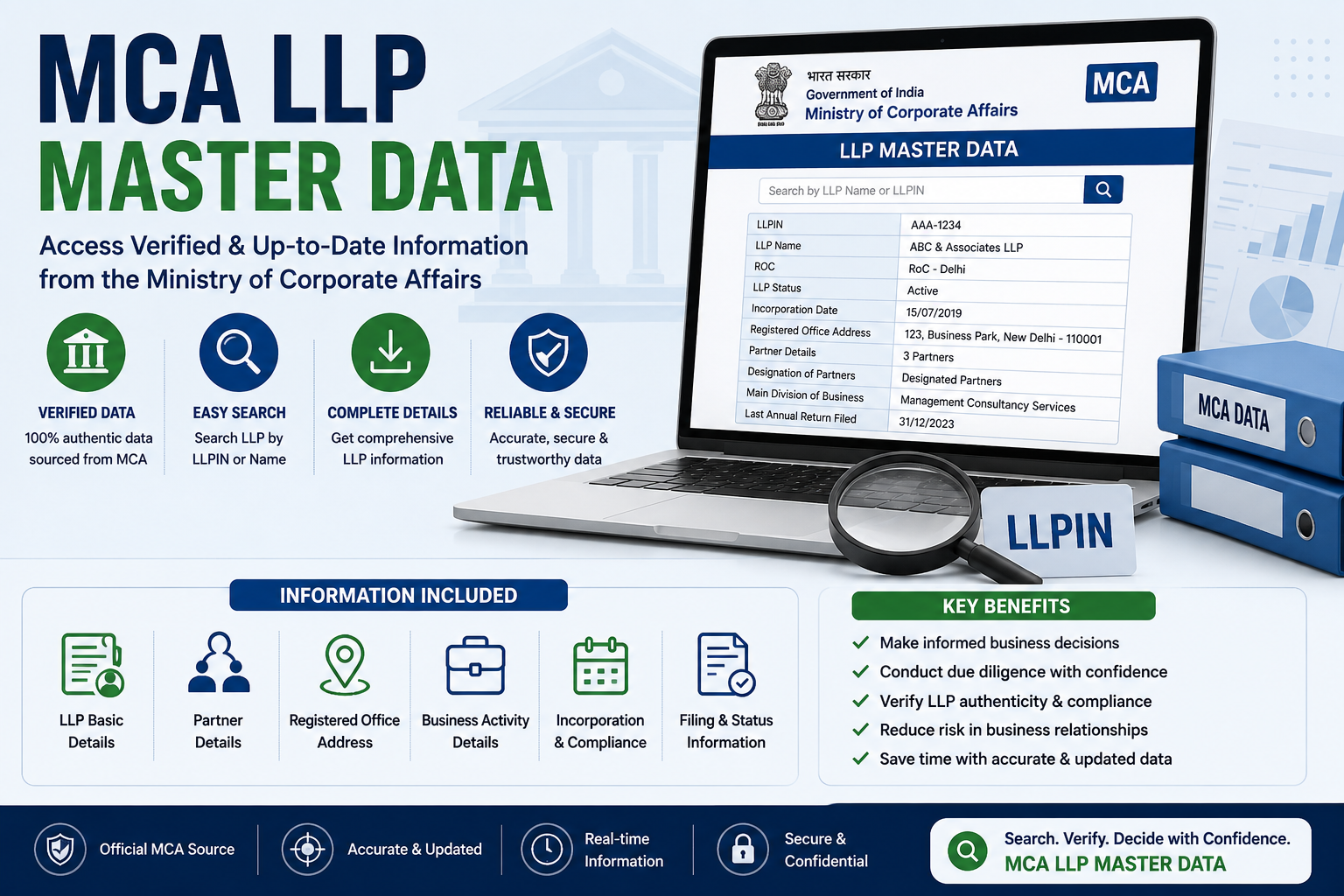
The MCA Portal is the online platform of the Ministry of Corporate Affairs through which users can access corporate services, regulatory filings, company-related information, and other services associated with companies and applicable entities in India.
The platform supports various corporate compliance and information-related activities. Depending on the entity and service being accessed, users may find information such as:
- Company or LLP name
- Corporate Identification Number (CIN)
- Date of incorporation
- Company status
- Registered office address
- Company category and classification
- Authorized and paid-up capital
- Registrar of Companies (ROC)
- Director-related information
- Filing and compliance information
The exact information available can depend on the entity and the specific MCA service being used.
Why Is the MCA Portal Important for Businesses?
1. Company Verification
One of the most common uses of the MCA Portal is verifying corporate identity.
For example, a lender receiving a loan application from an SME can compare the applicant's legal name, CIN, registered address, and incorporation details with available corporate records.
If the information differs, the lender can investigate the reason before proceeding with the application.
2. Due Diligence
Corporate information is an important starting point for company due diligence.
A financial institution may combine MCA data with credit reports, financial statements, litigation checks, ownership information, regulatory records, and other risk intelligence.
This layered approach provides a stronger basis for decision-making than relying on a single source.
3. Compliance and Onboarding
Accurate company information can support KYC, corporate onboarding, vendor verification, internal controls, and compliance processes.
For organizations handling a large number of customers or counterparties, accessing structured company information can also reduce repetitive manual verification.
What Information Can Be Checked on the MCA Portal?
Company Master Data
Company master data helps establish the basic identity and registration profile of an organization.
Important fields may include the legal name, CIN, incorporation date, registered office, company status, capital information, and ROC details.
Directors and Management
Where relevant information is available through applicable MCA services, director details can provide additional context about the company's management and governance structure.
Lenders and enterprises can use this information as one component of broader management and ownership checks.
Corporate Filings
Corporate filings can provide useful information about a company's reporting and compliance activities.
For financial professionals, reviewing relevant filings can support more detailed corporate and financial due diligence.
It is important, however, to interpret filings in context. The availability of a filing does not by itself establish that a company is financially strong or creditworthy.
How to Check Company Details on the MCA Portal
The general company verification process can be approached as follows:
Step 1: Identify the Legal Entity
Start with the company's legal name or CIN. Using the correct legal identifier reduces the possibility of confusing companies with similar names.
Step 2: Access the Appropriate MCA Service
Navigate to the relevant company-information or master-data service available on the MCA Portal.
Step 3: Search for the Company
Enter the available corporate details and identify the appropriate company record.
Step 4: Review the Information
Compare the MCA information with documents provided by the company.
Pay attention to the legal name, CIN, incorporation details, registered office, company status, and other relevant information.
Step 5: Investigate Differences
If information does not match, investigate the reason before making a decision. A discrepancy may result from a recent address change, corporate restructuring, outdated documents, or an administrative error.
MCA Portal for Credit Risk Assessment
For banks, NBFCs, and fintech lenders, corporate verification is an important part of the lending process.
Consider an NBFC assessing a business loan application. The company submits its incorporation documents, CIN, registered address, and financial statements. The credit team uses the MCA Portal to verify the company's basic corporate information.
The lender can then combine these findings with:
- Revenue and profitability analysis
- Cash-flow assessment
- Existing debt
- Credit history
- Banking information
- Promoter assessment
- Industry risk
- Legal and regulatory checks
This creates a more comprehensive credit risk assessment.
MCA information helps establish the identity and corporate profile of the borrower, while financial and credit analysis determines its repayment capacity and overall risk.
Role of the MCA Portal in Vendor Due Diligence
Enterprises can also use corporate information when evaluating suppliers, distributors, agents, and other counterparties.
For example, a company considering a long-term supplier can verify the supplier's legal name, registration information, address, and other relevant corporate details before completing onboarding.
If the information submitted by the supplier does not match corporate records, the procurement or compliance team can request clarification.
This can help reduce onboarding errors and counterparty risk.
MCA Portal and Ongoing Risk Monitoring
Corporate verification should not always be a one-time activity.
For financial institutions with large borrower portfolios, relevant changes in corporate information may provide useful signals for ongoing monitoring.
Depending on internal risk policies, changes involving company status, directors, registered address, ownership, or corporate structure may justify additional review.
For example, significant corporate restructuring involving an existing borrower could prompt a lender to reassess the borrower's exposure and risk profile.
Benefits of Using the MCA Portal
Faster Company Verification
Digital access to corporate information can reduce the time required for basic entity checks.
Better Data Quality
Comparing internal records against corporate information can help identify outdated or inconsistent data.
Improved Operational Efficiency
Digital verification reduces repetitive manual research during onboarding and due diligence.
Stronger Compliance Controls
Corporate information can support customer onboarding, KYC processes, vendor verification, and internal compliance procedures.
Better Financial Decision-Making
Verified corporate information provides a stronger foundation for lending, investment, procurement, and partnership decisions.
Limitations of MCA Portal Information
The MCA Portal should not be considered a complete company risk assessment solution.
Corporate records may not provide a complete picture of:
- Current cash-flow strength
- Creditworthiness
- Fraud risk
- Customer concentration
- Management quality
- Commercial performance
- Industry-specific risks
Organizations should therefore combine MCA information with appropriate financial, credit, legal, ownership, and commercial data.
Information can also change over time, so important decisions may require current verification.
Practical Example
Suppose a fintech lender is evaluating an SME for a working-capital facility.
The applicant provides its company name, CIN, registered address, and financial documents. During verification, the lender finds that the registered address in the application differs from the available corporate record.
Rather than automatically rejecting the application, the lender requests clarification. The borrower explains that the company recently moved and provides supporting documentation.
This simple verification step helps the lender identify and resolve a data inconsistency before making the final credit decision.
Best Practices for Using the MCA Portal
Organizations should:
- Verify the legal entity before onboarding.
- Use CIN as an important entity-matching reference.
- Compare corporate records with submitted documents.
- Investigate significant discrepancies.
- Review relevant filings where necessary.
- Combine MCA information with financial and credit data.
- Recheck information before significant financial decisions.
- Maintain appropriate verification records.
- Use technology to automate high-volume checks.
- Avoid relying solely on corporate master data for credit decisions.
Conclusion
The MCA Portal is an important source of corporate information for businesses and financial professionals in India. It can support company verification, due diligence, compliance, vendor onboarding, credit assessment, and counterparty risk management.
For banks, NBFCs, fintech companies, lenders, insurers, and enterprises, the greatest value comes from combining MCA information with other relevant financial, legal, commercial, and risk data.
The MCA Portal can help organizations answer a fundamental question: Who is the legal entity we are dealing with? From there, additional analysis can determine its financial strength, creditworthiness, legal exposure, and commercial risk.
Used as part of a broader data-driven process, MCA information can help organizations improve data quality, reduce manual work, strengthen controls, and make more informed business decisions.
Frequently Asked Questions
What is the MCA Portal?
The MCA Portal is the Ministry of Corporate Affairs' digital platform for corporate services, filings, registrations, and company-related information in India.
What information can be checked on the MCA Portal?
Depending on the service and entity, users may find information such as company name, CIN, incorporation date, company status, registered office, capital details, ROC information, and certain director or filing-related information.
How does the MCA Portal help lenders?
Banks, NBFCs, and fintech lenders can use corporate information to verify a borrower's legal identity and compare company details with information provided during the lending and due diligence process.
Is MCA Portal information enough for due diligence?
No. MCA information is an important source for corporate verification but does not provide a complete assessment of financial, credit, legal, operational, or commercial risk.
Can MCA Portal data support ongoing company monitoring?
Yes. Relevant corporate changes can be incorporated into ongoing monitoring processes. Depending on internal policies, changes in company status, management, address, ownership, or corporate structure may warrant further investigation.


 English
 Arabic
 French
 Spanish
 Portuguese
 Deutsch
 Turkish
 Dutch
Dutch
 Italiano
 Russian
 Romaian
 Greek
Greek