
Zoho Consulting Services in USA: From CRM to Complete Business Automation
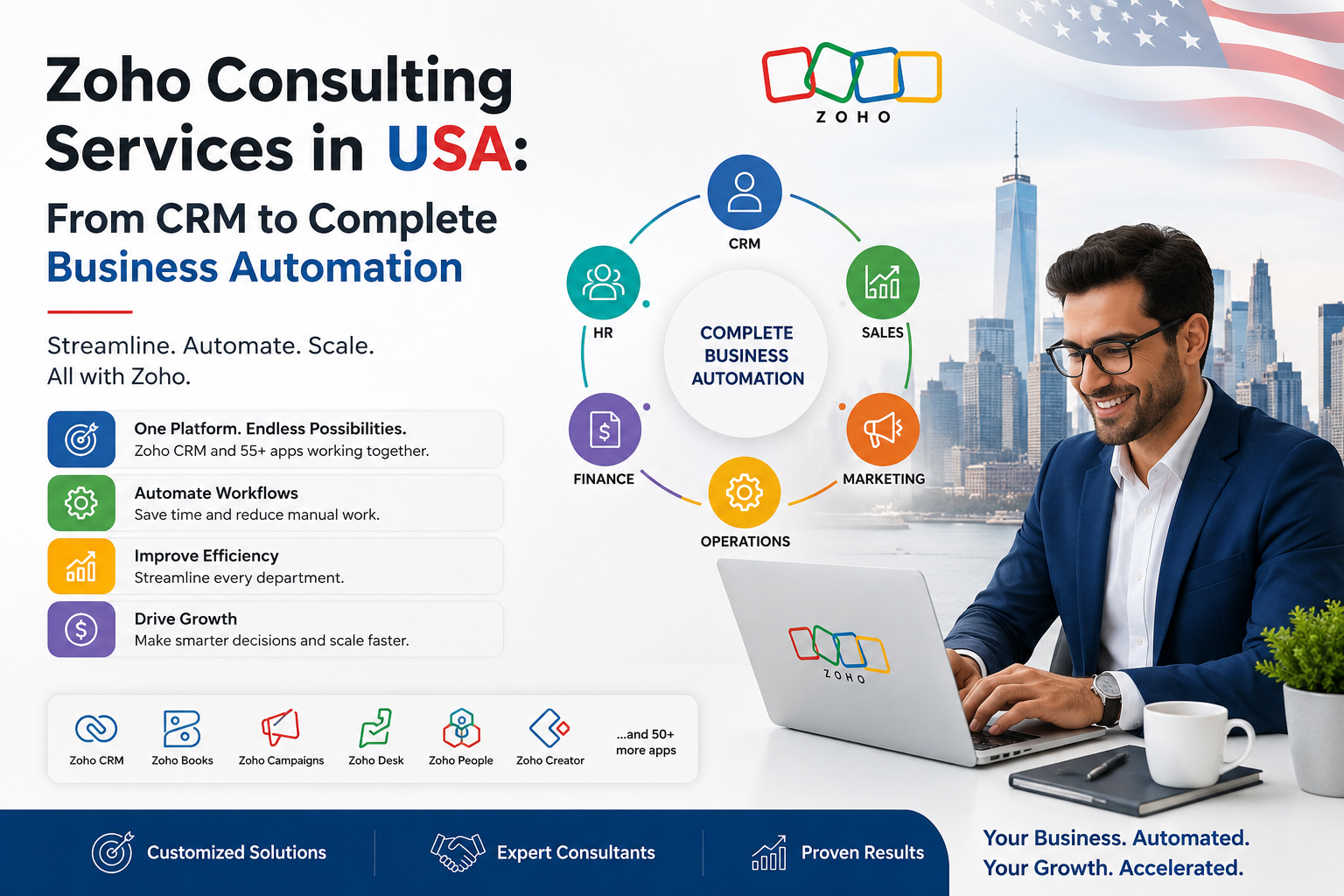
Most businesses don't wake up one day and decide to overhaul their entire operations. It usually starts small, a CRM that's supposed to make sales easier but somehow makes it more confusing, or a marketing team sending campaigns manually because nobody's had time to set up automation. Then, a year or two later, the same business looks around and realizes almost everything, sales, marketing, accounting, support, is running through disconnected tools that don't talk to each other.
That's the point where "we should look into Zoho" usually comes up. And it's also where things get interesting, because Zoho isn't really a single product you install and move on from. It's a journey, one that often starts with CRM and, if it's done right, ends up touching almost every part of how the business runs.
This is exactly the kind of progression we see a lot at Vision Infotech: businesses that come to us for CRM help and, six months later, are asking about marketing automation or accounting integration because the CRM implementation actually worked. So let's walk through what that journey looks like, stage by stage, and what good Zoho consulting services in USA should actually deliver at each point.
Stage One: Getting CRM Right (Because Everything Else Depends On It)
CRM is almost always the starting point, and there's a good reason for that. It's usually the most visible pain point, leads falling through the cracks, sales reps tracking deals in their own personal spreadsheets, managers with no real visibility into what's actually in the pipeline.
A good Zoho CRM Consultant in USA doesn't treat CRM setup as a checkbox exercise. The real work is in translating how your sales team actually operates into the system, rather than forcing your team to adapt to Zoho's default structure. That usually means:
- Custom pipeline stages that reflect your real sales process, not a generic template
- Lead capture connected directly to your website and ad campaigns, so nothing needs manual entry
- Automatic lead assignment based on territory, product, or rep workload
- Follow-up sequences that keep leads warm without relying on someone remembering to check in
- Dashboards built around the metrics your leadership team actually looks at
Here's the part that often gets missed: CRM done well isn't really an endpoint. It's the foundation everything else gets built on. Once your CRM data is clean, structured, and trustworthy, it becomes the source of truth that marketing automation and accounting integration can actually build from. Skip this step, or rush it, and everything downstream inherits the same mess.
Stage Two: Where Marketing and Sales Finally Start Talking to Each Other
Once CRM is solid, the next natural step for a lot of businesses is connecting marketing to it, and this is where things often start feeling genuinely transformative rather than just "organized."
Zoho Marketing Automation Services in USA typically bring Zoho CRM together with Zoho Marketing Plus, Zoho Campaigns, and related tools, so marketing and sales are finally working off the same data instead of two separate systems that occasionally export a spreadsheet to each other. In a properly connected setup, a website visitor filling out a form doesn't just create a lead in the CRM, it can also trigger a welcome email sequence, tag the contact for future campaigns based on their interests, and notify the right sales rep if the lead meets certain criteria.
This matters more than it might sound like on paper. Without this connection, marketing often ends up guessing which campaigns actually influenced a sale, and sales teams complain that marketing sends them unqualified leads. With CRM and marketing automation properly linked, you get an actual feedback loop, marketing can see which campaigns produced real, closed revenue, and sales can see the full history of how a lead engaged with the business before that first call.
A consultant handling this stage well will typically set up lead scoring based on engagement, automated nurture sequences for leads that aren't ready to buy yet, and clear reporting that connects marketing spend to actual pipeline and revenue, not just clicks and opens.
Stage Three: Bringing Accounting Into the Same Ecosystem
By the time CRM and marketing are running smoothly, a lot of businesses hit the same realization: their accounting is still sitting completely separate from everything else. Invoices get created manually after a deal closes. Someone re-types customer information that already exists in the CRM. Financial reporting doesn't line up neatly with sales data because the two systems were never designed to talk to each other.
This is where the conversation around accounting software services in USA becomes relevant, and it's worth approaching honestly rather than assuming one tool is automatically right for every business. Zoho Books is a natural fit if you're already deep into the Zoho ecosystem, since it shares data seamlessly with CRM and the rest of the suite. But plenty of businesses are already comfortable with QuickBooks or Xero, and their accountant may have a strong preference for sticking with what they know.
A trustworthy consultant won't push you toward Zoho Books just because it's part of the same suite. They'll look at your existing accounting setup and figure out the right path, which might mean migrating fully to Zoho Books, or it might mean integrating your current accounting software so invoices, payments, and customer records sync automatically without requiring anyone to switch platforms. Either way, the goal is the same: your financial data should reflect what's actually happening in sales, without someone manually reconciling two different systems every month.
Why the Full Journey Matters More Than Any Single Piece
It's easy to treat CRM, marketing automation, and accounting as three separate projects, each with its own budget and timeline. But the real value of Zoho as a platform shows up when these pieces are connected, not when they're implemented in isolation.
Think about what a fully connected setup actually looks like in practice. A lead comes in through a marketing campaign. The CRM automatically assigns it to the right sales rep, with full context on which campaign brought them in and what content they've engaged with. The rep closes the deal, and an invoice generates automatically in the accounting system, pulling the correct customer details without anyone retyping anything. Marketing can later see exactly which campaign led to that closed revenue. Finance can see exactly which deals are outstanding without chasing sales for updates.
None of that happens by accident. It requires a consultant who understands how these systems are meant to connect, not three separate specialists who each configure their piece in isolation and hope it lines up.
What Separates a Consultant Who Can Do This From One Who Can't
They Think in Terms of the Whole Business, Not Just One Module
Ask a potential consultant how they'd approach connecting CRM, marketing, and accounting, even if you're only planning to start with CRM right now. Their answer will tell you whether they're thinking about your long-term setup or just the immediate sale.
They Have Real Experience Across Multiple Zoho Products
A consultant who's only ever configured CRM will struggle when it's time to bring marketing automation or accounting into the picture. Ask directly what other parts of the Zoho suite they've implemented, and ask for specific examples rather than a general list of capabilities.
They're Honest About Sequencing
Trying to implement everything at once, CRM, marketing automation, and accounting integration, in a single rushed project usually leads to a shaky rollout across the board. A consultant who understands the journey will often recommend a phased approach: get CRM solid first, then layer in marketing automation, then tackle accounting integration. If someone insists on doing everything simultaneously regardless of your team's capacity to absorb that much change at once, that's worth questioning.
They Ask About Your Existing Tools Before Recommending New Ones
Whether it's your current accounting software, your existing email marketing tool, or a CRM you're migrating away from, a good consultant asks what you're already using and why, before recommending you replace it. Sometimes the right answer is integration, not replacement.
They Plan for Support Beyond Launch
Each stage of this journey, CRM, marketing automation, accounting, needs adjustment as your business grows. A consultant who's genuinely invested in your long-term success will offer real post-launch support, not just a handoff and a wave goodbye.
What to Ask Before You Commit to Any Stage of This Journey
A few direct questions tend to clarify things quickly: What would a phased rollout across CRM, marketing, and accounting look like for a business our size? Can you show me an example where these systems were connected for a past client? How do you handle the transition between stages so nothing breaks along the way? What ongoing support is included once each stage goes live?
Vague or overly confident answers to any of these are worth a second look. Specific, grounded answers usually mean you're talking to someone who's actually done this before.
How Vision Infotech Approaches the Full Journey
At Vision Infotech, we don't treat CRM, marketing automation, and accounting integration as three unrelated projects. We approach every engagement with the full picture in mind, even when a client starts small. Our work spans Zoho CRM configuration, Zoho Marketing Automation Services in USA, and accounting software integration or migration, always sequenced in a way that matches what your team can realistically absorb.
We start by understanding where you are right now, whether that's a business just getting CRM off the ground or one that's ready to connect sales, marketing, and finance into a single working system. From there, we build in stages, test carefully at each step, train your team properly, and stay involved as your needs evolve, because a connected system only stays connected if someone's paying attention to it.
Final Thoughts
The businesses that get the most out of Zoho aren't usually the ones that tried to do everything at once. They're the ones that started with a solid CRM foundation, brought marketing automation in once that foundation was working, and connected accounting once the rest of the picture was clear. It's a journey, not a single project, and choosing the right consultant means choosing someone who understands that from the start.
If you're figuring out where your business fits in that journey, whether you're just beginning with CRM or ready to connect the rest of your operations, that's exactly the kind of conversation Vision Infotech is built to have.

 English
 Arabic
 French
 Portuguese
 Deutsch
 Turkish
 Dutch
Dutch
 Italiano
 Russian
 Romaian
 Portuguese (Brazil)
 Greek
Greek