
Japan Group Tour for Students: An Unforgettable Educational Journey
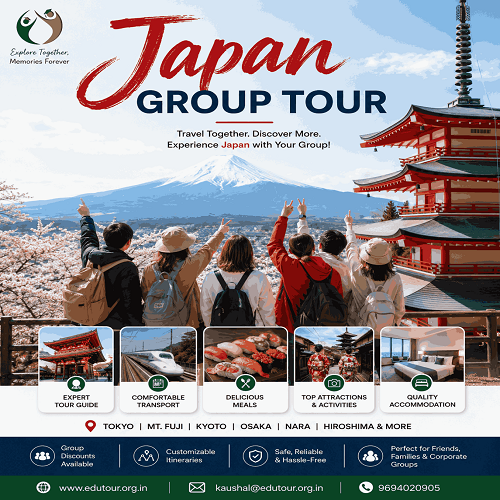
For Indian students, an international educational trip can turn familiar classroom concepts into real-world experiences. A Japan Group Tour offers an especially valuable combination of history, technology, culture, science, architecture, and social learning. Students can explore centuries-old traditions in one part of the country and observe advanced infrastructure and modern innovation in another, creating a learning experience that is both diverse and memorable.
Japan is more than a popular international destination. It is a country where students can observe how heritage and modern development exist side by side. Historic temples, museums, traditional neighborhoods, technology centers, efficient railway networks, and highly organized urban environments can all become part of an academic journey.
For schools, colleges, teachers, and parents, the real value of such travel lies in planning. An educational trip should not simply involve visiting famous attractions. It should encourage students to ask questions, compare cultures, observe systems, and connect what they see with subjects they study in the classroom.
Why Japan Is an Excellent Destination for Student Learning
Japan provides an unusually broad range of educational opportunities within a relatively compact travel environment. Students interested in history can explore important cultural landmarks, while those studying science and engineering can examine technological developments and transportation systems.
The country is also an excellent setting for understanding social development. Students can observe how public spaces are maintained, how transportation is coordinated, how traditional customs influence everyday life, and how cities accommodate large populations.
This variety makes Japan suitable for interdisciplinary educational programs. A single itinerary can incorporate lessons related to:
- History and heritage
- Science and technology
- Architecture and urban planning
- Environmental studies
- Economics and business
- Art, design, and culture
The objective should be to create connections between these subjects rather than treating every attraction as an isolated sightseeing stop.
Learning Beyond the Traditional Classroom
Travel can become an effective educational tool when students are encouraged to observe rather than simply look. Before departure, teachers can introduce the historical, geographical, and cultural background of Japan. During the trip, students can then identify examples of those concepts in real surroundings.
For example, a lesson about urban development can become more meaningful when students observe transportation networks and high-density neighborhoods firsthand. A history lesson can gain greater context when students stand inside a historic district or visit a museum containing original artifacts.
This approach also encourages students to develop independent thinking. Instead of memorizing information, they can ask why certain traditions continue, how technology affects daily life, and what similarities or differences they notice between Japan and India.
The experience becomes even more valuable when students discuss their observations afterward. Reflection helps convert temporary impressions into knowledge that can remain useful long after the journey.
Exploring Japanese History and Heritage
Japan's long history provides countless opportunities for academic exploration. Historic temples, shrines, castles, museums, gardens, and traditional neighborhoods can help students understand the country's cultural development across different periods.
Kyoto is particularly valuable for students studying history, culture, religion, architecture, or traditional arts. Its heritage sites demonstrate how historical values can continue to influence contemporary life.
Students can examine architectural details, traditional gardens, craftsmanship, religious practices, and cultural preservation. Rather than simply taking photographs, they can be encouraged to research the historical purpose of a site and explain its importance to the group.
Tokyo provides a different perspective. As a major modern city, it allows students to explore Japan's transformation into an influential economic and cultural center. Comparing Tokyo with historic destinations can help students understand how modernization can occur without completely eliminating cultural identity.
Technology, Science, and Innovation
Japan's reputation for technological innovation makes it particularly interesting for students pursuing science, engineering, robotics, computing, or related subjects.
Technology-focused museums and educational institutions can provide opportunities to understand concepts through demonstrations and interactive experiences. Students can see how engineering principles are applied to transportation, manufacturing, communication, automation, and everyday services.
Transportation itself can serve as an important learning topic. Japan's railway systems demonstrate the relationship between engineering, logistics, scheduling, passenger management, and urban planning.
Teachers can turn these observations into practical questions. Students might consider how an efficient transport system supports economic activity or investigate how automation changes the relationship between people and machines.
Such activities help students understand that technology is not simply about sophisticated devices. It is also about systems, planning, usability, safety, and solving real-world problems.
Understanding Culture Through Everyday Experiences
Some of the strongest educational moments may happen outside formal attractions. Students can learn a great deal by observing everyday life in Japan.
Using public transportation, entering a traditional building, visiting a local market, eating regional food, or following public etiquette can reveal how cultural values influence daily behavior.
Japanese society is often associated with respect for shared spaces, punctuality, cleanliness, and consideration for others. Students can observe these practices directly and discuss how social expectations differ between countries.
Food is another valuable cultural subject. Traditional dishes and regional specialties can introduce students to Japanese agriculture, geography, history, presentation, and dining customs.
Students should approach cultural differences with curiosity rather than judgment. International education is most effective when learners understand the reasons behind unfamiliar practices instead of evaluating them solely through the standards of their own culture.
Designing a Meaningful Educational Itinerary
The best itinerary is not necessarily the one that includes the largest number of attractions. Students can become tired when every hour is filled with transportation, sightseeing, and scheduled activities.
A carefully structured program should include a balance of academic visits, cultural experiences, free observation time, meals, and rest. Each major activity should have a clear purpose.
For example, a school may organize one day around cultural heritage, another around technology and innovation, and another around urban development. Students can be given small research assignments related to each theme.
Age and academic level should also influence the itinerary. Younger students may benefit from interactive museums and cultural workshops, while older students can participate in more specialized academic discussions or institution visits.
Planning International Student Travel From India
International educational travel requires careful preparation because schools must coordinate documentation, transportation, accommodation, student supervision, finances, and communication.
Passport and entry requirements should be checked well in advance through appropriate official sources because requirements can change. Schools should also establish clear consent procedures and ensure that parents understand the travel arrangements.
Budgeting is another major consideration. A realistic financial plan may include airfare, accommodation, local transportation, meals, admission charges, insurance, documentation expenses, and emergency reserves.
Transparent communication with parents is essential. They should receive a clear explanation of what is included, what students may need to pay separately, and how unexpected situations will be handled.
Accommodation should be selected according to student safety, accessibility, location, group suitability, and emergency arrangements. Schools should also confirm meal options, room allocations, curfews, and communication procedures before departure.
Safety Should Be Part of the Learning Plan
Student safety must remain a priority throughout an international educational journey. Teachers and coordinators should maintain updated emergency contacts and establish simple procedures for attendance, transportation, communication, and medical assistance.
Students should receive a pre-departure orientation covering practical expectations. They should understand the importance of staying with their assigned group, following meeting times, keeping important documents secure, and communicating immediately if a problem occurs.
Japan is also located in a seismically active region, making basic earthquake awareness worthwhile. Students do not need an extensive technical course, but they should know how to remain calm and follow instructions from teachers and local authorities if an emergency occurs.
Travel insurance and appropriate emergency planning should also be considered before departure. Schools should ensure that responsible adults know how to respond to medical, transportation, documentation, or communication problems.
Preparing Students Before They Leave India
The quality of an educational trip often depends on what happens before the students board the aircraft.
A pre-trip orientation can introduce students to Japanese history, basic language expressions, cultural etiquette, local transportation, weather conditions, currency, and appropriate public behavior.
Students can also be divided into small research groups. Each group might investigate a different topic, such as Japanese architecture, traditional food, technological innovation, environmental practices, or historical development.
This preparation gives students something specific to look for during the journey. Instead of passively following an itinerary, they become active participants in the learning process.
Parents should receive a detailed information pack covering travel schedules, emergency contacts, documentation requirements, accommodation details, communication arrangements, spending expectations, and behavioral guidelines.
Making the Experience Inclusive
Every student should have a reasonable opportunity to participate in the educational experience. Schools should consider mobility requirements, dietary needs, allergies, language concerns, cultural considerations, and individual learning requirements when developing the itinerary.
Long travel days should be managed carefully. Students need sufficient opportunities for rest, meals, hydration, and recovery, particularly when traveling between cities.
Group management can also benefit from a buddy system. Students can be paired or assigned to small groups so they can support one another and remain accountable.
Giving students small responsibilities can further increase engagement. One student might document observations, another may research a landmark, while another could prepare questions for a cultural activity.
These simple roles encourage teamwork and make students feel responsible for the success of the educational experience.
The Role of Teachers in Experiential Learning
Teachers are central to turning travel into meaningful education. Their role extends beyond supervision. They provide context, encourage discussion, and help students connect what they see with academic concepts.
Before visiting a destination, teachers can explain its historical or educational importance. Afterward, they can ask students what they noticed and whether anything challenged their previous assumptions.
A short discussion at the end of each day can be particularly useful. Students may share one new fact they learned, one cultural difference they noticed, and one question they still want to investigate.
This simple reflection process can transform a busy travel schedule into a series of connected learning experiences.
Choosing the Right Japan Group Tour Packages
When schools compare Japan Group Tour Packages, they should look beyond the number of destinations or attractions included. The most important question is whether the program matches the students' academic objectives and practical needs.
Institutions should examine factors such as itinerary design, accommodation standards, transportation arrangements, supervision, educational activities, meal planning, emergency support, and flexibility.
A program designed for engineering students may require a different structure from one intended for younger school students. Similarly, a cultural studies program may place greater emphasis on heritage sites and traditional experiences.
The ideal program should provide enough structure to maintain safety and organization without making students feel that every moment is predetermined.
Combining Major Cities With Cultural Experiences
A well-designed itinerary can introduce students to different sides of Japan.
Tokyo can provide exposure to modern architecture, business, transportation, technology, and urban life. Kyoto can offer deeper insight into heritage, traditional architecture, crafts, and cultural preservation.
Other destinations can be considered according to the academic focus and duration of the trip. However, travel time should always be evaluated before adding another location.
A smaller number of meaningful destinations can often provide more educational value than an itinerary that attempts to cover too much territory.
Turning the Trip Into a Long-Term Academic Project
The educational journey should continue after students return to India. Schools can organize presentations, exhibitions, reports, or classroom discussions based on the students' experiences.
For example, science students could examine Japanese transportation technology. History students could research modernization and cultural preservation. Business students could study tourism, retail systems, or consumer behavior.
Students can also compare their observations with Indian examples. This encourages critical thinking and prevents the trip from becoming simply an exercise in cultural observation.
A final presentation can ask students three useful questions: What did you learn? What surprised you? What could you apply or investigate further in India?
These questions encourage reflection and help students recognize how international exposure can influence their academic and personal development.
Why Educational Travel Can Shape Future Perspectives
International travel exposes students to environments that challenge familiar assumptions. They encounter different languages, social norms, educational approaches, public systems, and cultural traditions.
This experience can help students become more adaptable and confident. Navigating unfamiliar environments requires communication, cooperation, time management, and problem-solving.
It can also encourage a broader understanding of global issues. Students begin to recognize that countries may face similar challenges while developing very different solutions.
For young learners, this perspective can be valuable when choosing future academic fields and careers. A student who develops an interest in engineering after observing Japanese infrastructure, for example, may pursue further study in an area that was previously outside their immediate interests.
Final Thoughts
An educational journey to Japan can bring together academic discovery, cultural understanding, technological exploration, and personal growth. Its success depends less on how many attractions students visit and more on how effectively the experience is connected to learning objectives.
For Indian schools, colleges, and educational institutions, thoughtful preparation is essential. Clear goals, responsible supervision, realistic scheduling, cultural orientation, safety planning, and post-trip reflection can transform international travel into a powerful extension of classroom learning.
Students may return with photographs and memories, but the deeper outcome can be much more valuable: greater curiosity, stronger independence, improved cultural awareness, and a firsthand understanding of how history, technology, and society interact.
When international travel is approached as education rather than simply sightseeing, Japan can become an extraordinary classroom—one where students learn not only about another country, but also about themselves and the wider world.

 Arabic
 French
 Spanish
 Portuguese
 Deutsch
 Turkish
 Dutch
Dutch
 Italiano
 Russian
 Romaian
 Portuguese (Brazil)
 Greek
Greek