
Blueberry Markets Clone Scalability Guide for Growing Brokerage Platforms
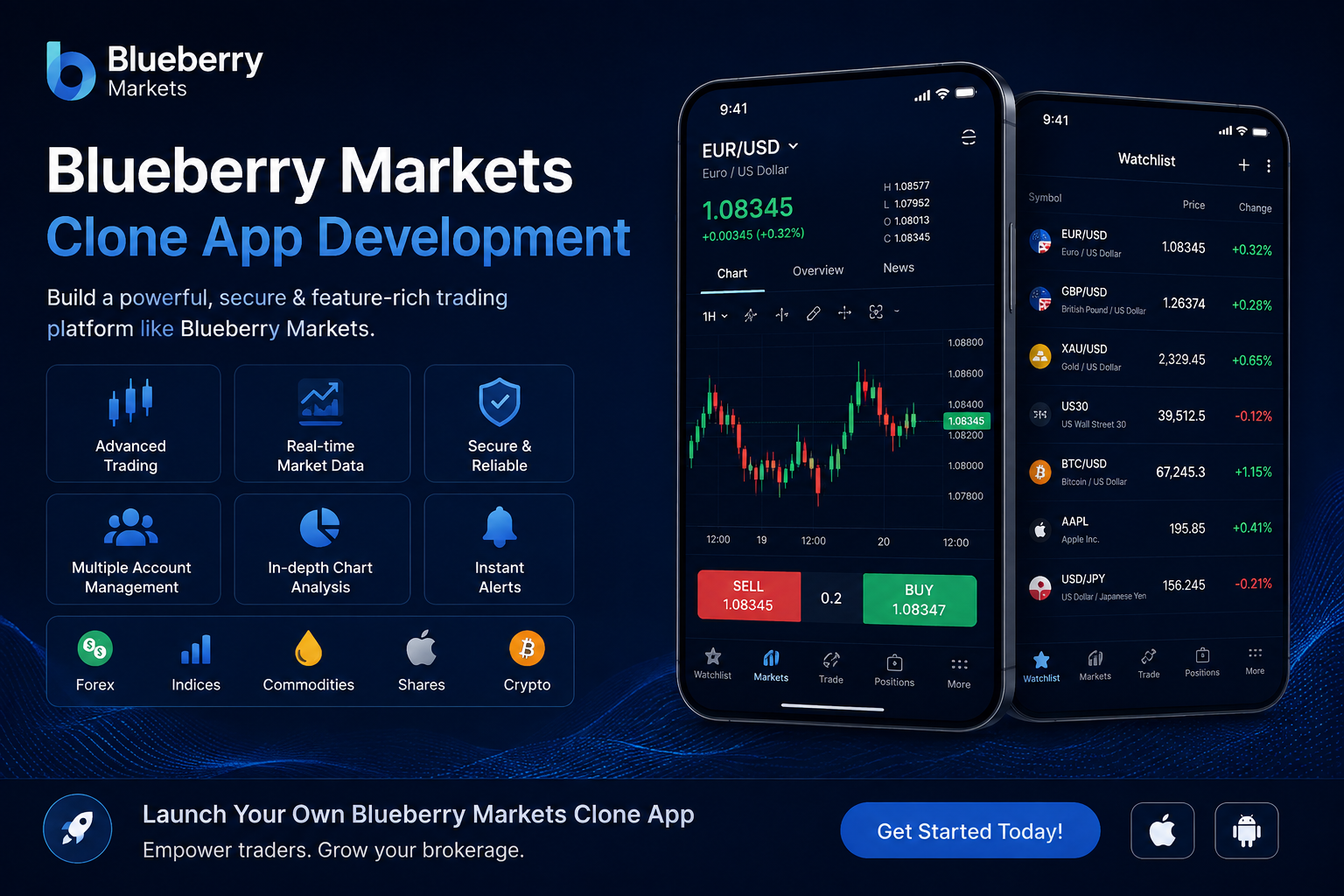
Scaling a brokerage platform is different from scaling a conventional SaaS product. Growth does not simply mean more users and page views. A trading business may simultaneously experience more client registrations, KYC checks, deposit requests, withdrawals, MT4 or MT5 account activity, partner commissions, prop evaluations, support tickets, and compliance events.
A scalable Blueberry Markets Clone therefore needs infrastructure that can handle both customer traffic and operational workloads without sacrificing financial accuracy, security, or auditability.
Miracuves describes its Blueberry Markets Clone as a brokerage operations platform built around Next.js, React, TypeScript, PostgreSQL, REST APIs, event-driven workflows, and configurable integrations.
Start With a Modular Brokerage Architecture
Scalability begins with separating major business responsibilities.
A brokerage platform may include:
- Client onboarding
- KYC and AML
- Wallets
- Deposits and withdrawals
- Trading accounts
- MT4 and MT5 integrations
- IB and affiliate management
- Prop trading
- CRM
- Support
- Compliance
- Administration
Miracuves organizes its PostgreSQL architecture into 93 tables across 12 business domains, with 213 API handlers covering client, partner, administrator, and webhook operations.
This kind of domain separation is important because growth in one area should not require developers to restructure the entire application.
For example, the IB commission engine can evolve independently from KYC workflows or support-ticket management.
Scale PostgreSQL Gradually
A brokerage generates highly relational data.
Clients connect to wallets, transactions, KYC records, trading accounts, referrals, commissions, evaluations, support requests, and administrative actions.
PostgreSQL can provide a strong foundation for these relationships when indexes, connection management, and query patterns are designed carefully.
The Miracuves architecture uses PostgreSQL 14+ with connection pooling through the native database driver and standard SQL that can be moved to managed PostgreSQL infrastructure.
Developers should monitor:
- Slow queries
- Connection usage
- Lock contention
- Transaction duration
- Index efficiency
- Database CPU
- Storage growth
- Replication delay
Database scaling should be based on actual bottlenecks rather than immediately introducing unnecessary distributed systems.
Use Indexed Operational Queries
Some brokerage screens are queried constantly by internal teams.
Compliance staff may continuously access KYC queues. Finance teams may monitor withdrawals. Support staff may work through ticket queues, while partner teams monitor payout requests.
These views can become expensive if they repeatedly scan large database tables.
Miracuves states that KYC, withdrawal, support-ticket, and partner-payout queues use indexed access paths rather than full table scans.
Developers should apply the same principle across operational dashboards.
Frequently filtered fields such as status, user ID, partner ID, transaction date, provider reference, and queue state should have indexing strategies aligned with real query patterns.
Move Recurring Operations to Event-Driven Workflows
Brokerage growth can quickly create an administrative headcount problem if every event requires manual processing.
Deposits, KYC decisions, fraud checks, partner commissions, SLA alerts, and prop evaluations can instead trigger automated workflows.
The Miracuves platform uses event-driven operations for deposits, KYC decisions, SLA breaches, fraud matches, referral credits, and prop evaluations. It also uses webhooks, scheduled jobs, and rule matching for recurring processes.
This allows operational workload to grow more slowly than the total client count.
Examples include automatically:
- Crediting wallets after verified payment webhooks
- Sending withdrawals into AML review
- Evaluating prop drawdown rules
- Triggering SLA alerts
- Calculating referral events
- Updating transaction states
These workflows reduce repeated polling and manual processing.
Scale Payment Processing Carefully
Financial transactions must remain accurate even under heavy load.
Developers should not optimize payment throughput at the expense of reconciliation.
Deposit and withdrawal systems should preserve provider references, transaction states, operator activity, timestamps, and failure reasons.
Miracuves states that wallet balances reconcile against provider records and that adjustments include the responsible operator and reason.
Payment webhooks should also be designed to handle duplicate delivery.
Third-party providers may send the same webhook more than once, so transaction processing should be idempotent wherever possible.
As brokerage volume grows, payment-provider capacity may also become a scaling constraint independent of the application's own infrastructure.
Treat MT4 and MT5 as External Scaling Dependencies
A Blueberry Markets-like platform usually operates around trading infrastructure rather than replacing it.
This means application scalability also depends on external MT4 or MT5 bridges, liquidity infrastructure, market-data providers, and synchronization services.
Developers should monitor:
- Account provisioning latency
- Trade synchronization
- Position updates
- Provider API limits
- Reconciliation failures
- Connection health
Scaling the application servers alone will not solve bottlenecks if the connected trading provider cannot handle increased volume.
Provider capacity should therefore be included in infrastructure planning.
Separate Client Traffic From Operator Workloads
A growing brokerage has two different traffic categories.
The first is client-facing traffic, such as dashboards, wallets, KYC submissions, referrals, and support requests.
The second is operational traffic generated by compliance, finance, support, partner teams, webhooks, and scheduled processes.
Miracuves combines marketing, the client portal, admin console, and REST API inside one Next.js application while enforcing area-level access for six roles: client, partner, admin, support, compliance, and finance.
As usage increases, developers should monitor these workloads individually.
One unusually large compliance queue should not make normal client dashboards slow.
Add Read Replicas When Read Traffic Increases
Not every scaling problem requires a complete database redesign.
For many brokerage platforms, read operations increase faster than writes.
Reporting dashboards, account histories, partner analytics, administrative queues, and client views may repeatedly request existing information.
Miracuves identifies managed PostgreSQL, read replicas, and standard Next.js hosting as its conventional scaling path.
Read replicas can move selected reporting and read-heavy workloads away from the primary database.
However, developers must remember that replicas may have a small synchronization delay, making them inappropriate for workflows that require immediately consistent transaction information.
Keep Demo and Production Environments Separate
Brokerage platforms often need realistic demos for sales, training, and internal testing.
These environments must not accidentally call production payment, trading, or identity providers.
Miracuves includes separate demo and live runtime modes switched at the data layer so training and demonstrations can operate without touching production vendors.
Developers should apply the same separation to credentials, databases, webhook endpoints, storage, and provider integrations.
Environment isolation becomes increasingly important as more employees, partners, and technical teams gain access to the platform.
Preserve Security While Scaling
Scaling infrastructure can introduce security weaknesses if authorization is bypassed in the name of performance.
Brokerages need strong separation of duties.
Miracuves uses area-level authorization rather than simply hiding dashboard navigation. For example, compliance can manage KYC decisions without approving payments, while finance can process money movement without altering KYC decisions.
Developers should preserve these boundaries across APIs, background jobs, new services, replicas, and administrative tools.
Audit logging should also remain active as traffic grows.
Monitor Before Adding Infrastructure
Developers should measure performance before introducing architectural complexity.
Useful metrics include:
- API latency
- Database query time
- Payment webhook failures
- KYC queue size
- Withdrawal processing time
- Background-job failures
- Trading-provider latency
- Database connections
- Error rates
- CPU and memory consumption
- Third-party API limits
Monitoring makes it easier to identify whether a bottleneck exists in the application, PostgreSQL database, payment provider, trading bridge, or external compliance service.
Without observability, teams may scale the wrong component.
Scale Without Rebuilding the Platform
A brokerage does not need institutional-scale distributed architecture on its first day.
Miracuves describes its Blueberry Markets Clone as being designed for a growing retail brokerage rather than a tier-one institutional trading desk. Its documented scaling path focuses on instance sizing, managed PostgreSQL, read replicas, and increased provider capacity rather than replacing the underlying architecture.
This is often a practical approach.
Developers can begin with a conventional stack and introduce additional infrastructure only when actual usage requires it.
Why Source Code Ownership Matters for Scaling
Scaling requirements will change over time.
A brokerage may eventually need to modify database queries, replace providers, add caching, separate workloads, introduce new compliance services, or redesign specific modules.
Miracuves states that customers receive the complete Next.js 16, React 19, TypeScript, and PostgreSQL codebase with the ability to modify and redeploy it.
For technical teams, that provides greater flexibility when growth requires architectural changes.
Conclusion
Blueberry Markets Clone scalability is not simply about adding bigger servers.
Developers need to consider database performance, indexed operational queries, event-driven processing, payment reconciliation, MT4 and MT5 provider capacity, authorization, environment isolation, observability, and infrastructure growth together.
The Miracuves Blueberry Markets Clone provides a conventional technical foundation using Next.js, React, TypeScript, PostgreSQL, event-driven workflows, indexed queries, and a documented path toward managed databases and read replicas.
For growing brokerage platforms, the strongest strategy is to launch with a maintainable architecture, monitor real workloads, and scale individual components when usage demonstrates the need rather than overengineering the platform from the beginning.

 English
 Arabic
 French
 Spanish
 Portuguese
 Deutsch
 Dutch
Dutch
 Italiano
 Russian
 Romaian
 Portuguese (Brazil)
 Greek
Greek