
Industrial Visit Organisers in Surat: Complete Guide for Students & Institutions
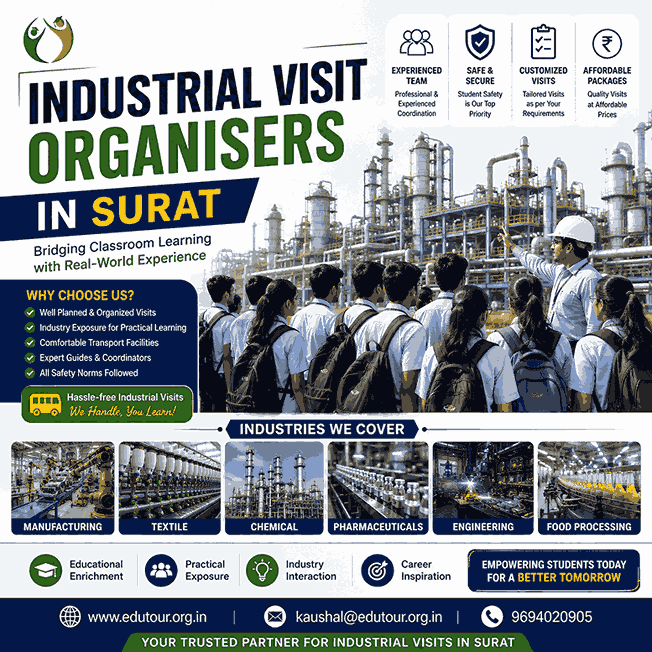
Industrial visits can turn classroom concepts into real-world learning experiences. Instead of only reading about manufacturing, technology, logistics, engineering, or business operations in textbooks, students can observe how these systems function in professional environments. For schools and colleges, however, arranging such a visit involves much more than selecting a destination and arranging transportation. Safety, educational relevance, permissions, scheduling, supervision, and student engagement all need careful attention.
For institutions planning an academic visit to Gujarat’s major commercial and industrial centres, choosing reliable Industrial Visit Organisers in Surat can simplify the planning process while keeping educational objectives at the centre. Surat offers an interesting mix of industries, commercial activities, technology-driven businesses, textile operations, diamond-related enterprises, and service-sector organisations, making it a useful destination for experiential learning.
A successful industrial visit should not feel like a sightseeing trip. It should connect academic theory with workplace practices and encourage students to ask questions, observe processes, and understand how different professional roles contribute to an organisation.
Why Industrial Visits Matter in Modern Education
Traditional classroom education provides students with essential theoretical knowledge, but practical exposure can help them understand how that knowledge is applied. An industrial visit creates an opportunity to see equipment, workflows, quality systems, management practices, and workplace safety procedures in an actual professional setting.
For example, a student studying mechanical engineering may understand production systems from diagrams and lectures. Seeing machinery operating on a factory floor can provide a completely different perspective. Similarly, commerce students can learn more about inventory, accounting, supply chains, marketing, and business operations by observing how a company manages its day-to-day activities.
The value of industrial visits is therefore not limited to technical education. Properly planned visits can support learning in areas such as:
- Engineering and technology
- Commerce and business management
- Information technology
- Textile and fashion studies
- Logistics and supply-chain management
- Science and vocational education
The most effective visits are designed around specific learning outcomes rather than simply visiting a well-known organisation.
Why Surat Is a Strong Destination for Educational Visits
Surat has developed into one of Gujarat’s prominent economic centres, with strong activity across manufacturing, textiles, diamond processing, trade, logistics, technology, and other commercial sectors. Its diverse economic environment gives educational institutions opportunities to explore different types of professional workplaces.
For students, this diversity can make a visit particularly valuable. A textile-related visit, for instance, can demonstrate how raw materials move through processing and production stages before reaching markets. A business-oriented visit may help students understand procurement, administration, customer management, logistics, and distribution.
The city also provides a practical setting for institutions that want students to observe how traditional industries are adapting to modern technologies. Automation, digital systems, quality control, data management, and improved workplace practices are increasingly important across sectors.
The educational value ultimately depends on the organisation selected and how the institution prepares students before the visit.
What Makes an Industrial Visit Educationally Effective?
A memorable visit is not necessarily the one with the largest number of activities. Educational effectiveness comes from alignment between the visit and the curriculum.
Before finalising a programme, academic coordinators should identify what students are expected to learn. These objectives can then guide the selection of an appropriate organisation, schedule, briefing session, and post-visit activity.
For example, if the objective is to understand manufacturing efficiency, students can be encouraged to observe production stages, machinery utilisation, quality checks, maintenance procedures, and workplace safety. If the focus is business management, the visit can concentrate on organisational structure, supply chains, human resources, customer relations, and operational decision-making.
Teachers should also encourage students to prepare questions in advance. This small step can significantly improve participation because students arrive with a clear purpose rather than passively observing their surroundings.
Important Factors to Consider When Planning
Planning an industrial visit involves coordination between the educational institution, students, transport providers, and the host organisation. A structured approach reduces last-minute complications.
1. Define the Academic Objective
The first step is to decide why the visit is being organised. The objective should be connected to the students' course, subject, or skill-development requirements.
A clearly defined objective also helps the host organisation understand what students need to see and learn.
2. Select an Appropriate Industry
The organisation should be suitable for the age group, academic background, and size of the student group. Not every workplace is appropriate for every educational programme.
Institutions should consider whether students will be able to observe meaningful processes and whether the organisation has suitable arrangements for visitors.
3. Confirm Permissions in Advance
Industrial premises often have strict visitor policies. Some areas may be restricted because of safety, confidentiality, operational requirements, or security considerations.
Written confirmation and prior scheduling help prevent misunderstandings on the day of the visit.
4. Plan Transportation Carefully
Travel arrangements should account for the number of students, teachers, pickup and drop-off points, expected traffic, meal breaks, and the duration of the visit.
A realistic itinerary is preferable to an overloaded schedule. Students need sufficient time to travel, receive safety instructions, participate in the industrial interaction, and reflect on what they have learned.
5. Establish Student Supervision
Teachers and faculty members should know their responsibilities before departure. Student groups should remain organised throughout transportation and during the industrial tour.
For larger groups, assigning students to smaller supervised units can make attendance and movement easier to manage.
Safety Should Be a Core Part of the Programme
Safety is one of the most important considerations when students enter an industrial environment. Factories, warehouses, laboratories, workshops, and production facilities may contain machinery, moving equipment, electrical systems, chemicals, elevated platforms, or restricted areas.
Students should receive a safety briefing before entering the premises. They should understand where they can walk, which equipment they must not touch, and how they should respond to instructions from the host organisation.
Depending on the workplace, visitors may also need personal protective equipment such as helmets, safety shoes, protective eyewear, or ear protection.
A responsible programme should also consider emergency procedures, medical requirements, attendance records, emergency contacts, and appropriate teacher-to-student supervision.
Safety should never be treated as paperwork completed before the trip. It should remain part of the visit from departure until students return.
How Teachers Can Prepare Students Before the Visit
Preparation can determine how much students actually gain from an industrial experience. A short classroom session before departure can introduce the organisation, industry, key terminology, and expected learning outcomes.
Teachers can provide students with a simple observation framework. Rather than asking them to remember everything, students can focus on a few important areas such as:
- What products or services does the organisation provide?
- Which major processes did you observe?
- What technologies or machines were used?
- How was quality maintained?
- What workplace safety practices were visible?
Students can also be encouraged to maintain short notes during the visit. These observations can later be used for assignments, presentations, reports, or classroom discussions.
Making the Visit More Interactive
Industrial visits become more meaningful when students have opportunities to interact with professionals. A short question-and-answer session with an engineer, manager, technician, entrepreneur, or other employee can provide insights that may not be available through observation alone.
Students often want to know what qualifications are required for particular jobs, what skills employers value, how technology is changing the industry, and what career paths are available.
Faculty members can prepare a few subject-specific questions beforehand while allowing students to ask their own questions during the interaction.
Another useful approach is to divide students into small observation groups. Each group can focus on a particular topic, such as technology, human resources, production, quality, sustainability, or logistics. After the visit, groups can share their findings with the rest of the class.
The Role of Educational Travel Specialists
Coordinating an industrial visit can become complex when an institution has to manage several components simultaneously. Educational travel specialists can assist with itinerary planning, transportation coordination, communication with host organisations, scheduling, accommodation where necessary, and other logistical requirements.
The important point is that institutions should evaluate such services based on educational suitability rather than convenience alone. A well-organised programme should understand the difference between a leisure excursion and an academic industrial visit.
When evaluating a provider, institutions can consider its experience with student groups, approach to safety, communication process, itinerary flexibility, transparency about inclusions, and ability to accommodate academic requirements.
For institutions researching educational travel and experiential learning options, Edutour’s educational travel resources can also provide useful context when considering how academic travel programmes are structured.
What Students Should Carry
Students should receive a clear checklist before departure. The requirements will vary depending on the destination, season, and type of industry, but practical preparation usually includes comfortable clothing, required identification, personal medicines where applicable, a notebook, pen, and any protective equipment specified by the host organisation.
Students should avoid carrying unnecessary valuables and should follow the dress code communicated by the institution or host facility.
Digital devices can be useful for note-taking or authorised photography, but students should never photograph restricted areas, confidential documents, machinery, employees, or processes without permission.
Turning the Experience Into Long-Term Learning
The learning process should not end when students leave the industrial premises. A post-visit activity can help them connect their observations with academic concepts.
Students might prepare a short report describing the organisation, processes observed, technologies used, safety measures, and major lessons learned. Colleges may also use presentations, group discussions, case studies, or reflective assignments.
For younger students, teachers can use simpler activities, such as asking them to describe three things they learned and explain how the workplace differed from what they had imagined.
For higher-education students, the follow-up can be more analytical. They might examine production efficiency, supply-chain practices, sustainability initiatives, technology adoption, organisational structure, or career opportunities.
This reflection stage is important because it transforms a one-day experience into an educational resource that can continue to support classroom learning.
Common Planning Mistakes to Avoid
Even a well-intentioned industrial visit can lose its educational value if planning is rushed. One common mistake is selecting a destination primarily because it is popular rather than because it matches the academic objective.
Another issue is creating an overly packed itinerary. Students may spend more time travelling between locations than learning at each destination. A smaller number of meaningful activities is usually more effective than trying to cover too much in a single day.
Poor communication is another avoidable problem. Students, teachers, transport teams, and host organisations should have clear information about meeting points, timings, emergency contacts, dress requirements, and behavioural expectations.
Institutions should also avoid treating safety as an afterthought. Every participant should know the basic rules before entering the workplace.
A Practical Planning Timeline
A structured timeline can make the process easier for academic coordinators.
Around several weeks before the visit, the institution can define the academic objective, estimate the group size, shortlist suitable organisations, and begin communication regarding permissions and availability.
After the destination is confirmed, transportation, supervision arrangements, documentation, student instructions, and the detailed itinerary should be finalised. Teachers can then brief students and prepare relevant learning activities.
Closer to departure, the coordinator should reconfirm timings, attendance, transport arrangements, emergency contacts, required documents, and any specific instructions from the host organisation.
On the day itself, punctuality and communication are essential. After returning, the institution should conduct a suitable review or academic activity so students can connect their observations with classroom learning.
Building Better Experiential Learning Programmes
Industrial visits are one part of a broader experiential learning approach. Their greatest value comes when they are connected to classroom teaching, career awareness, skill development, and reflection.
Institutions can gradually build a stronger academic travel programme by combining industrial exposure with expert interactions, workshops, field studies, cultural learning, and project-based assignments.
For students, these experiences can help answer an important question: how does the knowledge they acquire in classrooms translate into real professional environments?
When planned responsibly, an industrial visit can provide that connection without compromising safety or academic purpose.
Conclusion
A successful industrial visit requires thoughtful planning, suitable industry selection, reliable coordination, student preparation, and strong safety practices. Surat’s diverse economic and industrial landscape makes it a practical setting for students to observe real-world applications of subjects they study in classrooms.
The strongest programmes are not simply about visiting a workplace. They are designed around clear learning objectives and give students opportunities to observe, question, interact, record information, and reflect on what they have experienced.
For schools, colleges, teachers, and academic coordinators, the right approach is to treat an industrial visit as an extension of the classroom rather than a one-day excursion. With proper preparation and responsible coordination, students can return with a clearer understanding of industries, professional skills, workplace practices, and potential career pathways.

 Arabic
 French
 Spanish
 Portuguese
 Deutsch
 Turkish
 Dutch
Dutch
 Italiano
 Russian
 Romaian
 Portuguese (Brazil)
 Greek
Greek