
Bug Detection Services for Individuals: Understanding Professional Inspections
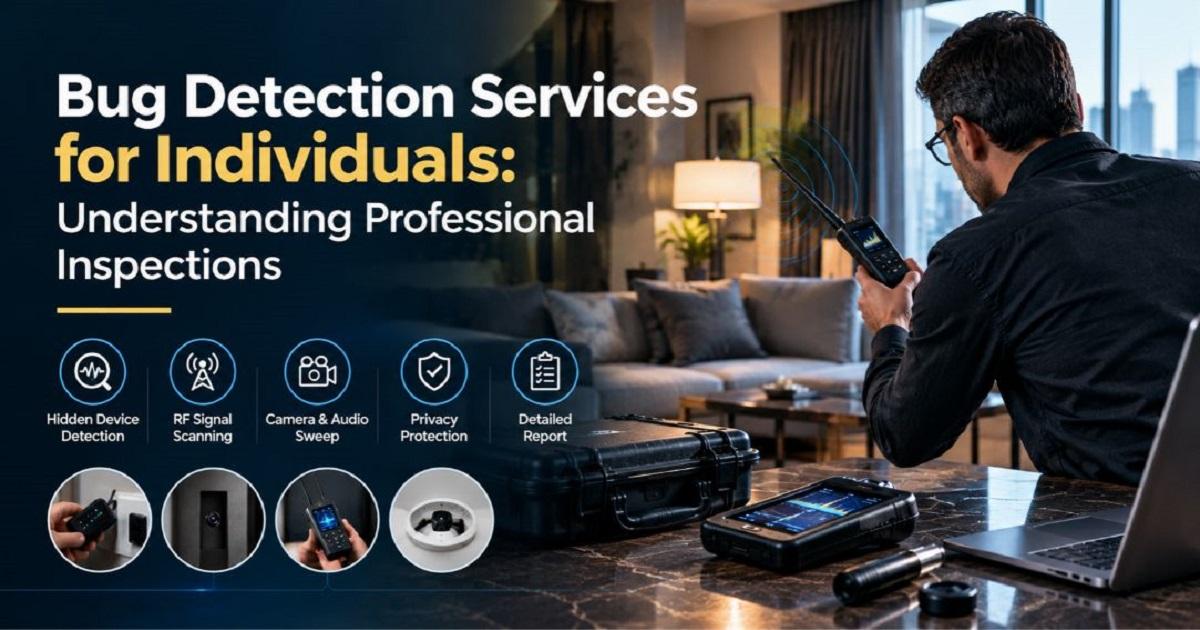
Personal privacy matters at home, in private workspaces, and while travelling. When an individual notices an unfamiliar electronic device, an unexplained change to a personal space, or another specific reason for concern, it can be difficult to know what to do next. Rather than relying on assumptions or consumer gadgets alone, a professional assessment can help evaluate the concern using appropriate inspection methods.
Bug detection services for individuals focus on assessing potential indicators of unauthorized electronic monitoring, such as hidden cameras, listening devices, or tracking devices, within an agreed inspection scope. These services may be relevant to residential properties, private offices, vehicles, and other personal environments where a person has a reasonable concern about electronic surveillance.
What Are Bug Detection Services for Individuals?
Bug detection is a general term used for inspections intended to identify potential indicators of unauthorized monitoring or surveillance equipment. Professional Technical Surveillance Countermeasures assessments may combine physical examination, suitable technical instruments, and careful interpretation of relevant observations.
The appropriate approach depends on the environment and the specific concern. A residential inspection may require different methods from an examination of a vehicle or private office. The inspection provider should explain what they will examine, which methods they may use, and what the findings can reasonably establish.
It is equally important to understand that an unfamiliar object, an unusual signal, or a consumer detector's alert does not automatically prove that surveillance is taking place. Technical findings need to be evaluated in context.
When Might an Individual Consider a Bug Detection Inspection?
People may consider a professional inspection for several reasons. The decision should be based on specific observations or circumstances rather than fear or speculation.
1. Concerns About Privacy at Home
A home is a personal space where people expect a reasonable degree of privacy. If an individual discovers an unfamiliar electronic object, notices an unexplained change to a fixture, or has a specific concern about unauthorized monitoring, a targeted residential inspection may help evaluate the situation.
A professional assessment can examine agreed areas and relevant objects while distinguishing potential indicators from ordinary household electronics.
2. Hidden Camera Detection
Hidden-camera concerns may arise in private residences, rented properties, changing areas, or other places where privacy is expected. An unfamiliar object or small opening does not necessarily indicate a camera, so conclusions should not be drawn from appearance alone.
A structured inspection can examine specific concerns and assess relevant objects or fixtures using appropriate methods. If a device appears to have been placed in an area where privacy is expected, avoid tampering with it unnecessarily and consider appropriate reporting options.
3. Possible Listening Device Concerns
Some individuals worry that private conversations may be monitored without authorization. Listening devices can vary in design and operating behavior, and not every device transmits continuously.
A professional assessment may include physical examination and suitable technical methods, depending on the environment and the concern being investigated. Findings should be interpreted carefully, with the limitations of the inspection clearly explained.
4. Vehicle Tracking Concerns
A person may have questions about a possible unauthorized GPS tracker or another monitoring device associated with a vehicle. In such cases, a targeted vehicle inspection may examine relevant accessible areas and components.
Modern vehicles contain numerous electronic systems, sensors, and accessories. An unfamiliar component is not necessarily a tracking device, and some areas may require assistance from a qualified automotive professional. The inspection should be carried out without compromising vehicle safety or damaging installed systems.
5. Privacy Concerns in Private Workspaces
Individuals who work from home, manage a small business, or regularly use a private office may want to evaluate a specific concern involving their workspace. An assessment can be planned around the relevant room, installed equipment, and reported observations.
The inspection scope should reflect the actual environment rather than assuming that every electronic signal or unfamiliar device represents unauthorized surveillance.
What Does a Professional Bug Detection Inspection Involve?
The inspection process varies according to the location, reported concern, and methods required. A professional assessment may involve the following stages.
Initial consultation: The individual explains the concern, relevant observations, and the type of environment involved.
Defining the inspection scope: The areas, equipment, and potential indicators to be examined are agreed upon before work begins.
Physical examination: Relevant accessible areas, fixtures, objects, and equipment may be examined for indicators that warrant further attention.
Technical assessment: Appropriate instruments and methods may be used to evaluate potential electronic surveillance indicators. RF analysis, for example, can help examine certain radio-frequency activity but does not identify every possible device.
Evaluation and documentation: Observations are interpreted in context. Where reporting is included in the assignment, it should clarify the work performed, relevant findings, limitations, and any recommended next steps.
The objective is to provide a structured assessment of the stated concern—not to make unsupported claims or guarantee that every possible device has been detected.
Professional Bug Detection Services vs Consumer Detectors
Consumer bug detectors are widely available, but their capabilities vary. Some may respond to radio-frequency activity, magnetic fields, or other indicators, depending on their design. Their readings can be difficult to interpret without understanding the surrounding environment and the device's limitations.
A professional assessment may offer a more systematic approach by combining physical inspection, appropriate technical methods, and contextual interpretation.
|
Consumer detection gadgets |
Professional assessment |
|
Capabilities vary by device. |
Methods are selected according to the concern and environment. |
|
Alerts may be difficult to interpret |
Observations can be evaluated in a technical context. |
|
May focus on limited detection methods. |
May combine complementary inspection techniques |
|
Usually provide limited reporting |
Documentation may be available according to the agreed scope. |
Neither approach should be treated as infallible. The suitability of an inspection depends on the concern, the environment, the equipment used, and the limitations of the methods applied.
How to Choose a Bug Detection Service Provider
Before arranging an inspection, individuals should consider more than the advertised equipment or price. A responsible service provider should be able to explain the process clearly and set realistic expectations.
Consider these factors:
- Relevant experience: Ask about experience with the type of location and concern involved.
- Inspection methods: Understand which techniques may be used and why they are appropriate.
- Clearly defined scope: Confirm which areas will be inspected and what is excluded.
- Reporting practices: Ask whether observations, limitations, and recommendations will be documented.
- Confidentiality: Discuss how personal information and inspection findings will be handled.
- Realistic claims: Be cautious of guarantees that every hidden device can be detected or that a location can be declared completely free of surveillance under all circumstances.
A clear consultation before the inspection helps individuals understand the proposed service and make an informed decision.
What Should You Do If You Find a Suspicious Object?
If you discover an object that genuinely raises concern, avoid jumping to conclusions. Consider the following practical steps:
- Stay calm and document the observation. If it is safe to do so, note where and when you noticed the object.
- Avoid unnecessary handling. Do not dismantle, damage, or interfere with an unfamiliar electronic device.
- Consider the context. Check whether the object may be an ordinary fixture or a legitimate electronic component, without putting yourself at risk.
- Seek appropriate assistance. A qualified professional may be able to assess the object and explain the next steps.
- Report serious concerns where appropriate. If you believe the object may be associated with unlawful monitoring, a suspected crime, or an immediate safety risk, consider contacting the relevant authorities.
A professional inspection may help evaluate a specific concern, but it cannot automatically establish who placed an object, why it is present, or whether a legal violation has occurred. Those questions may require additional evidence or investigation.
Frequently Asked Questions
What are bug detection services for individuals?
They are inspection services intended to evaluate potential indicators of unauthorized electronic monitoring in personal environments, such as homes, private offices, or vehicles. The scope and methods depend on the specific concern.
Can professional services detect every hidden camera or listening device?
No inspection method can guarantee detection of every possible device in every environment. Device design, operating status, accessibility, site conditions, and the techniques used can all affect the findings.
Is an unusual RF signal proof of a hidden surveillance device?
No. Many ordinary electronic devices generate radio-frequency signals. A signal must be interpreted in context, and additional examination may be necessary before any conclusion can be reached.
Should I buy a consumer bug detector before hiring a professional?
Not necessarily. Consumer devices have varying capabilities and may produce alerts that are difficult to interpret. If you have a specific concern, discussing it with a professional can help you determine an appropriate next step.
Bug Detection Services for Individuals by Trace Point India
When personal privacy concerns arise, a methodical assessment can help replace guesswork with a clearer understanding of the situation. The right inspection approach depends on the environment, the observations reported, and the scope of work agreed upon.
Trace Point India provides TSCM, debugging, and bug sweeping services for individuals and organizations. Depending on the requirement, an assessment may address potential hidden-camera concerns, listening-device indicators, vehicle tracking concerns, or other relevant electronic surveillance questions.
Whether you need to discuss a residential inspection, a private workspace, or a vehicle-related concern, the first step is to explain the circumstances and understand which inspection options may be suitable.

 English
 French
 Spanish
 Portuguese
 Deutsch
 Turkish
 Dutch
Dutch
 Italiano
 Russian
 Romaian
 Portuguese (Brazil)
 Greek
Greek