
Door Hanger vs Postcard Finding the Right Direct Marketing Solution
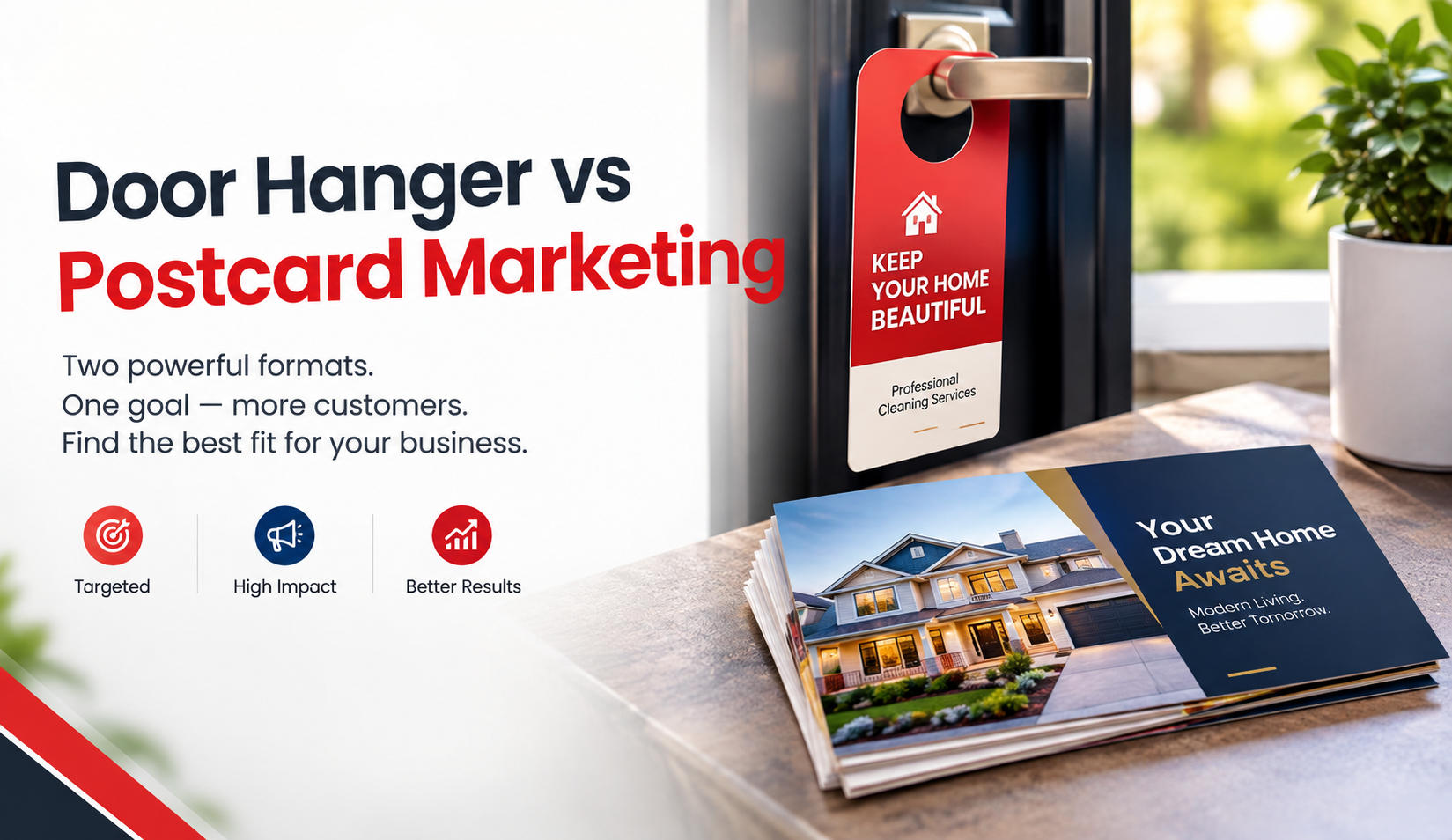
Local businesses often know they need to reach more people in a specific area, but choosing the printed piece creates a harder decision. A roofing company working one subdivision has different needs from a dental office trying to reach several ZIP codes. The same marketing format rarely fits both situations equally well.
We see this decision come up before almost every neighborhood campaign: should the business place something directly on the customer’s door, or should it send the message through the mailbox? Door hanger printing gives businesses strong street-level visibility, while postcards make wider and more controlled distribution easier.
Neither format wins every campaign. The better choice depends on how customers buy, where they live, how large an area the business serves, and what happens after someone sees the message. Looking at those factors first usually leads to a much better decision than choosing based on print price alone.
Door Hanger vs Postcard: Start With How You Need to Reach Customers
The most useful way to compare a door hanger vs postcard campaign starts with distribution. A door hanger reaches the property physically. A postcard enters through an established mailing route. That sounds like a small distinction, but it changes the entire campaign strategy.
Door hangers make sense when location itself adds meaning to the advertisement. Postcards make more sense when a business needs predictable coverage across a larger area or wants to reach a defined group of customers.
Door Hangers Create Street-Level Presence
We often see door hangers work well for businesses that already operate inside residential neighborhoods. Think about a landscaper finishing a yard, a roofer working on a nearby home, or a pressure-washing company cleaning a driveway.
Neighbors can already see evidence of the service. A door hanger gives that visible activity a name, a phone number, and a clear next step. The marketing piece connects naturally with something happening nearby.
That local context gives door hanger marketing its strength. Instead of asking someone to imagine whether a company serves the neighborhood, the business can show that it already works there.
Postcards Provide Controlled Market Coverage
Postcards solve a different problem. They help businesses reach addresses without sending employees or contractors door to door.
That difference matters when a company serves several neighborhoods, cities, or customer groups. A postcard campaign can cover selected mailing areas, existing customer records, prospect lists, or broader neighborhood routes according to the campaign goal.
For businesses that plan recurring promotions, postcard mailing also creates a process that teams can repeat more consistently. They can define an audience, set a mailing schedule, change the offer, and compare one campaign against another.
When Door Hanger Marketing Makes the Most Sense
Door hangers work best when a business can take advantage of geographic concentration. Trying to use them everywhere often turns a simple marketing idea into an expensive distribution project.
We usually recommend thinking about the route before thinking about the design. If covering the intended area requires too much driving, staffing, or coordination, the economics can change quickly.
Promote Around an Active Service Job
One of the strongest door hanger strategies starts around work that customers can see.
A roofing contractor may distribute hangers on nearby streets while completing a project. A lawn company can reach surrounding properties after improving a highly visible yard. A painting contractor can introduce the company to neighboring homeowners while crews already work in the area.
The message should acknowledge that local context. A generic headline such as “Professional Home Services” wastes the advantage. Something connected to nearby work gives residents a clearer reason to pay attention.
Focus on Compact Neighborhoods
Door hangers suit campaigns where a business wants density rather than broad geographic reach.
A local cleaning company might concentrate on one subdivision. A pest-control business could target streets surrounding an existing customer cluster. A real estate professional may focus on homes in a specific farming area.
We have seen businesses make the mistake of spreading a small quantity across too much territory. That weakens repetition and makes distribution harder to manage. Concentrated coverage usually gives the campaign a clearer purpose.
Use a Message People Can Understand Quickly
A person standing at the front door will not study a crowded piece of advertising.
Successful door hanger design usually relies on a strong service headline, one useful reason to respond, visible contact information, and a straightforward call to action. Supporting details should earn their space.
Photography can help, especially for visual services such as landscaping, exterior cleaning, remodeling, and painting. Still, the image should support the message rather than compete with it.
When Postcard Marketing Becomes the Better Choice
Postcards become more practical once the campaign moves beyond a few streets.
Businesses can use them for customer acquisition, seasonal reminders, reactivation campaigns, grand openings, service promotions, event announcements, and many other local marketing needs.
The real advantage comes from combining physical mail with deliberate audience selection.
Reach Larger Service Areas Efficiently
Imagine a home-services company that covers ten or fifteen neighborhoods. Sending staff through every street creates a distribution problem before the campaign even begins.
Postcards remove much of that fieldwork. The business can plan coverage according to the locations it wants to reach and build the campaign around those areas.
This makes postcards particularly useful for companies with established service territories. HVAC companies, dentists, insurance agencies, contractors, restaurants, healthcare offices, and automotive businesses often need coverage that extends far beyond one neighborhood.
Reach Existing Customers Again
Businesses sometimes focus so heavily on finding new customers that they overlook people who already know them.
A postcard can reconnect with past customers before a seasonal service period, maintenance interval, renewal window, or special event. That audience already has some familiarity with the company, so the message can focus on the next useful action instead of introducing the business from scratch.
We often find that this type of campaign also produces better creative decisions. The business knows who will receive the piece, which makes it easier to write a specific message.
Build Campaigns Around Audience Segments
Postcards also allow more selective targeting when a service does not suit every household.
A remodeling company may care about homeowners within certain neighborhoods. A business-to-business provider may want to reach companies within particular industries. A healthcare practice may focus on households within a realistic travel radius.
Defining the audience before designing the postcard prevents one of the most common direct marketing problems: creating an attractive piece that reaches people who have little reason to respond.
Door Hanger vs Postcard Costs Go Beyond Printing
Business owners naturally compare printing costs, but print price only represents one part of the campaign.
Door hangers require distribution. Postcards require mailing. Each approach carries costs that businesses should calculate before deciding which format looks cheaper.
Calculate Door Hanger Distribution Costs
A door hanger campaign may require staff time, vehicles, route planning, fuel, supervision, and enough labor to cover the area properly.
That does not make door hangers expensive by default. Within a small target area, distribution can make perfect financial sense. The problem appears when a business looks only at the printed unit cost and ignores the labor needed to put every piece on a door.
We suggest calculating the full cost of putting the piece into a prospect’s hands, not simply the cost of producing it.
Calculate the Entire Postcard Campaign
Postcard campaigns include printing and mailing-related expenses, but they can reduce the amount of physical distribution work the business must manage.
Audience selection also affects the numbers. Reaching fewer, better-qualified prospects may cost more per delivered piece while producing a more useful campaign.
For that reason, cost per thousand pieces rarely tells the whole story. Cost per inquiry, cost per qualified lead, and cost per booked customer provide more meaningful information after the campaign runs.
Compare Targeting Before Choosing the Format
Targeting has more influence on direct marketing performance than many design choices.
A beautiful advertisement sent to the wrong people still wastes money. A simple piece delivered to households that genuinely need the service has a much stronger foundation.
For a concise overview of how the two formats fit different local campaigns, this format comparison offers additional context.
Geographic Targeting Favors Both Formats Differently
Door hangers allow extremely local distribution. A company can cover a particular street, a group of blocks, or the immediate area surrounding a job.
Postcards allow geographic targeting at a broader and more structured level. Businesses can develop campaigns around mailing areas, customer locations, prospect lists, or selected neighborhoods.
The right option depends on how tightly the company needs to define its territory.
Customer Data Gives Postcards More Flexibility
When a business already has a useful customer database, postcards gain another advantage.
The company can contact past buyers, inactive customers, specific service groups, or customers approaching a logical reorder or maintenance date. That gives the message more relevance than a general neighborhood advertisement.
The important step comes before printing: clean the data. Old addresses, duplicate records, and poorly organized customer lists can undermine an otherwise sensible campaign.
Message Design Should Match the Way People See the Piece
Door hangers and postcards do not receive attention in the same environment. Their designs should reflect that difference.
A door hanger meets someone at an entrance. A postcard competes with other mail. Each format has only a short window to communicate its value.
Design Door Hangers for Fast Recognition
The upper portion of a door hanger deserves special attention because the shape and die-cut area affect usable space.
We keep important details away from the cutout and make the core service easy to identify from a quick glance. Headlines should communicate the service without making residents decode a clever slogan.
Phone numbers, web addresses, QR codes, and calls to action also need breathing room. Trying to fill every empty area usually makes the piece harder to use.
Design Postcards Around a Visual Hierarchy
Postcards offer two sides, but that extra space can tempt businesses to include too much.
We normally build the front around one dominant idea. The back can support that idea with additional details, credibility points, contact information, and the response action.
A postcard promoting five unrelated services, three offers, two phone numbers, and several competing headlines forces readers to decide what matters. Most people will not spend that much time on it.
The Offer Often Matters More Than the Format
Businesses sometimes spend days choosing between paper stocks and sizes while giving only a few minutes to the actual offer.
The format helps deliver the message. It cannot rescue a weak reason to respond.
Give Customers a Specific Reason to Act
“Call us today” does not explain why someone should call.
A stronger offer connects with a real customer need. A seasonal maintenance reminder, neighborhood service date, new-customer incentive, complimentary estimate, appointment availability window, or useful deadline can give the piece a purpose.
The best offer does not always require a discount. Service businesses often have other forms of value they can communicate without cutting price.
Keep the Call to Action Simple
One marketing piece should usually drive one primary action.
If the goal involves phone calls, make the number easy to find. If the campaign directs people online, use a relevant landing page. If a QR code supports the response, test it on multiple devices before printing.
We have seen good campaigns lose opportunities because the marketing piece creates unnecessary friction after earning attention.
Track Door Hanger and Postcard Campaigns Separately
Print marketing becomes much easier to improve when a business can tell where responses came from.
Without tracking, teams tend to rely on impressions such as “we received more calls that week.” That observation can help, but it cannot show which neighborhood, message, or format actually produced the calls.
Use Campaign-Specific Response Methods
Businesses can assign separate QR codes, landing pages, promotional codes, or tracked phone numbers to different campaigns.
For example, a company testing two neighborhoods can use a separate response code for each one. The next campaign can then favor the location that generated more qualified inquiries.
The setup does not need to become complicated. It simply needs to provide enough information to guide the next decision.
Measure Business Results, Not Distribution Volume
Printing 10,000 pieces does not equal success.
We focus on responses, qualified inquiries, appointments, estimates, booked jobs, sales, and customer value. Those numbers tell a much more useful story than the number of pieces distributed.
A campaign with fewer responses can still outperform another campaign if those responses turn into more profitable customers.
Using Door Hangers and Postcards Together
Businesses do not always need to choose one format permanently.
In some local campaigns, the two formats can support different stages of the same strategy.
Use Postcards to Establish Initial Awareness
A business can first introduce itself through postcards across a selected service area.
That initial mailing creates familiarity before crews, representatives, or service teams begin working inside the neighborhood. The business may then reinforce its presence around actual jobs with door hangers.
The customer sees a consistent company rather than two unrelated advertisements.
Use Door Hangers Around Newly Won Jobs
When a postcard campaign produces a customer inside a target neighborhood, a nearby door hanger campaign can build on that presence.
This works especially well for services that neighbors can see: roofing, windows, solar installation, lawn care, painting, cleaning, paving, tree work, and exterior remodeling.
The second piece should not simply repeat the postcard word for word. It should give residents a fresh reason to respond based on what is happening nearby.
Common Direct Marketing Mistakes We See Businesses Make
Most print campaigns do not struggle because someone chose the “wrong” paper. Problems usually start earlier in the planning process.
A few recurring mistakes can affect both door hangers and postcards.
Choosing the Format Before Defining the Audience
Starting with “we want 5,000 postcards” puts production ahead of strategy.
Start with the customer. Where do they live? How broad is the service area? Does the company have useful customer data? Does a nearby job make the message more relevant?
Once those questions have answers, the appropriate format becomes much easier to identify.
Trying to Say Everything at Once
Businesses understandably want to get maximum value from every printed piece, so they add every service they offer.
The result often feels crowded and unfocused.
A homeowner considering roof repair does not need to read about ten unrelated company services before finding the roofing message. Give the campaign a job and let the design support that job.
Running One Campaign and Drawing a Final Conclusion
One mailing or distribution round can provide useful data, but it rarely answers every marketing question.
Timing, weather, seasonality, audience selection, creative execution, the offer, and follow-up can all affect results.
Instead of declaring “postcards do not work” or “door hangers work better” after one test, identify what happened and improve the next campaign.
How to Choose Between Door Hangers and Postcards
The final decision becomes easier when businesses strip away personal preference and look at practical requirements.
Choose door hangers when the campaign depends heavily on proximity, visible local work, or highly concentrated neighborhood coverage. Choose postcards when the campaign requires broader reach, customer-list marketing, planned mailing areas, or repeatable distribution at scale.
Businesses with larger marketing programs can also test both. Real response data from the target market gives a stronger answer than assumptions about which format “should” perform better.
Frequently Asked Questions
Are Door Hangers Better Than Postcards for Local Businesses?
Door hangers often work better when a business wants to reach a compact neighborhood, especially around an existing service job. Postcards usually provide more practical coverage when a business needs to reach larger areas, past customers, mailing lists, or multiple neighborhoods. The service area and audience should guide the choice.
Are Postcards More Expensive Than Door Hangers?
Not necessarily. Businesses need to compare complete campaign costs rather than print prices alone. Door hangers require physical distribution, while postcards involve mailing expenses. Labor, route planning, audience selection, printing, mailing, and campaign management all affect the final cost.
Which Businesses Benefit Most From Door Hanger Marketing?
Home-service businesses often find natural uses for door hangers because their work takes place inside neighborhoods. Roofing, landscaping, pest control, painting, pressure washing, lawn care, real estate, cleaning, and similar services can connect the printed message with visible local activity.
Can a Business Use Door Hangers and Postcards in the Same Campaign?
Yes. A business might use postcards to introduce its services across a target neighborhood and then distribute door hangers around jobs that result from the campaign. The formats can reinforce one another when each piece serves a distinct purpose and maintains consistent branding.
Conclusion
The door hanger vs postcard decision does not come down to which printed product looks better. It comes down to how the business needs to reach customers.
Door hangers bring the message directly to the property and work particularly well around active jobs or tightly defined neighborhoods. Postcards provide more structured reach across larger territories, mailing lists, customer databases, and repeat campaigns. Both formats perform better when businesses define the audience, simplify the message, create a meaningful offer, and track responses before making the next decision.
We approach direct marketing by looking at the campaign before the print specification. Service area, audience quality, distribution method, timing, message, and response tracking should shape the piece. Businesses planning either format can use MailProsUSA to explore printing and direct mail options while deciding which approach fits the campaign.
The strongest next step is simple: define exactly who needs to receive the message and where those people live. Once those two questions have clear answers, choosing between a door hanger and a postcard becomes much easier.

 Arabic
 French
 Spanish
 Portuguese
 Deutsch
 Turkish
 Dutch
Dutch
 Italiano
 Russian
 Romaian
 Portuguese (Brazil)
 Greek
Greek