
Could Vietnam’s Public Cloud Expansion Transform Enterprise Technology?
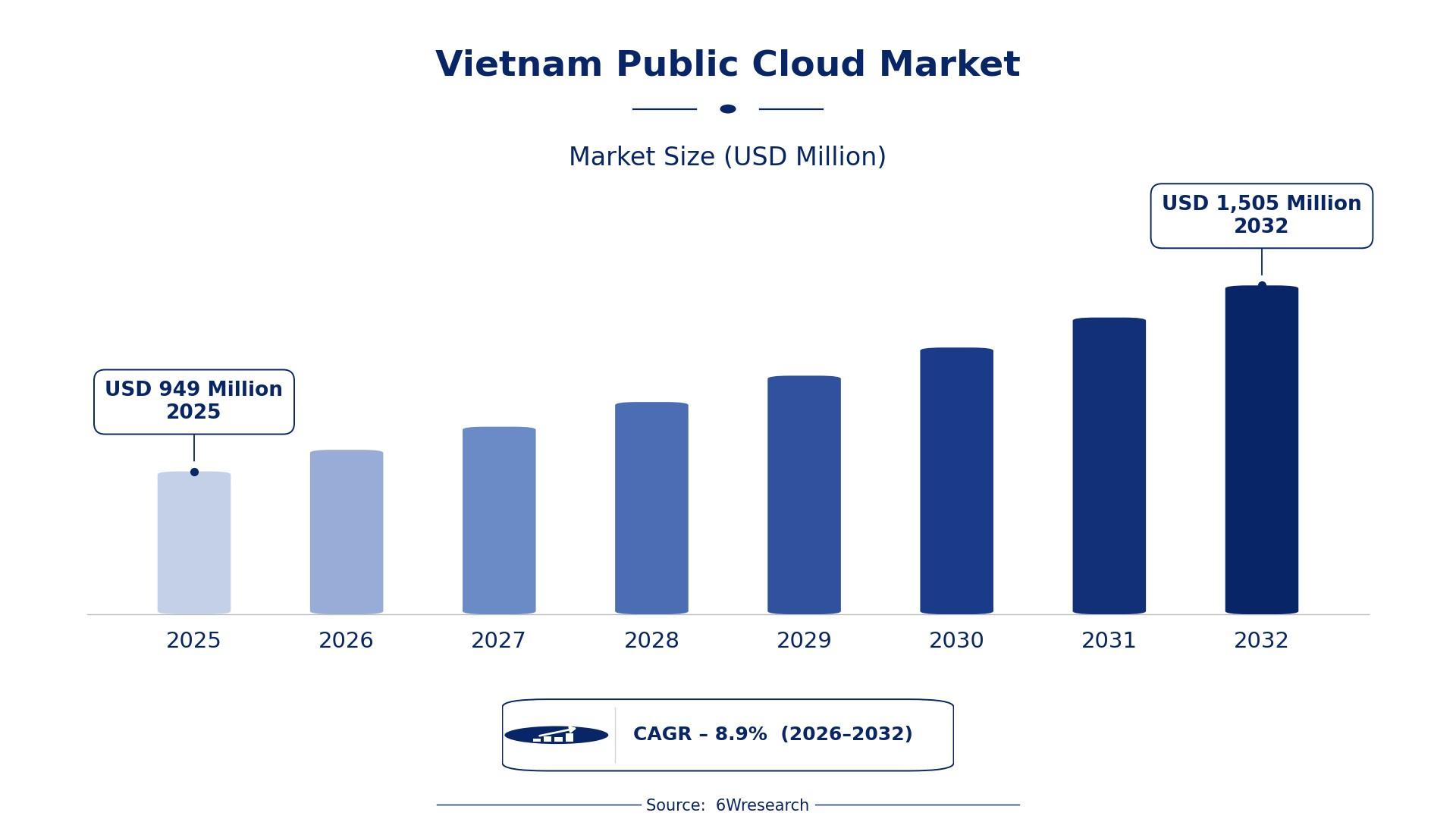
The Vietnam Public Cloud Market is becoming an increasingly important part of the country’s enterprise technology landscape as organizations modernize infrastructure, applications, and digital operations. According to 6Wresearch, the market was valued at USD 949 million in 2025 and is projected to reach USD 1,505 million by 2032, registering a CAGR of 8.9% during 2026–2032. This growth reflects increasing demand for scalable infrastructure, cloud applications, analytics, and flexible technology solutions.
Why Are Enterprises Moving Toward Public Cloud?
Enterprise technology requirements have changed considerably as businesses adopt digital channels, remote operations, automation, and data-driven decision-making. Maintaining large physical infrastructure can require significant investment and continuous maintenance.
Public cloud services provide another approach by allowing companies to access computing resources according to their requirements. Businesses can expand workloads, introduce applications, and support new users without necessarily investing in equivalent physical infrastructure.
Key advantages include:
-
Flexible computing capacity
-
Faster application deployment
-
Access to modern technology services
-
Reduced dependence on physical infrastructure
-
Greater operational scalability
-
Support for distributed teams and digital services
These characteristics make cloud adoption relevant across both established companies and rapidly expanding digital businesses.
How Are Different Cloud Services Supporting Growth?
The market encompasses Infrastructure as a Service, Platform as a Service, and Software as a Service. Each model addresses a different technology requirement.
IaaS provides fundamental computing, networking, and storage resources. Enterprises can use these capabilities while retaining greater control over their applications and workloads.
PaaS provides development environments and tools that allow organizations to create, test, and deploy applications more efficiently.
SaaS delivers ready-to-use software through cloud platforms. It can help businesses access business applications without managing the underlying infrastructure themselves.
The availability of these models allows organizations to select cloud services according to their technical capabilities and operational priorities.
Which Business Sectors Are Driving Adoption?
The 6Wresearch market segmentation covers BFSI, telecommunications, IT and ITeS, government and public sector, retail and consumer goods, manufacturing, energy and utilities, and media and entertainment.
Financial institutions can use cloud environments to support digital banking, analytics, and customer applications. Retail companies can deploy scalable e-commerce and customer engagement platforms. Manufacturing organizations can connect digital systems with operational environments.
Telecommunications and IT companies represent another important area because their services increasingly depend on scalable computing and application infrastructure.
Can Cloud Help Vietnamese SMEs Compete?
Cloud technology can also provide opportunities for small and medium enterprises. Instead of building extensive internal infrastructure, SMEs can access cloud-based applications and computing capabilities according to their needs.
This can lower some barriers to digital adoption and allow smaller organizations to experiment with online services, analytics, collaboration tools, and customer-facing applications.
SaaS solutions may be particularly attractive because organizations can use business applications without maintaining the underlying hardware environment.
What Role Will AI Play?
Artificial intelligence is becoming another factor influencing cloud investment. AI applications can require substantial computing resources, data processing, and scalable infrastructure.
Cloud platforms can support AI development by providing access to computing resources without requiring every organization to establish dedicated infrastructure.
Potential applications include:
-
Predictive analytics
-
Intelligent automation
-
Customer service applications
-
Recommendation systems
-
Business forecasting
-
Data analysis
As AI adoption develops, cloud infrastructure can become an important foundation for experimentation and deployment.
What Challenges Must Enterprises Address?
Cloud expansion also introduces important considerations. Data security and privacy remain major concerns when organizations move sensitive information into external environments. Compliance requirements can further influence cloud architecture and provider selection.
6Wresearch identifies cybersecurity, connectivity limitations, shortage of skilled professionals, and cloud management complexity among challenges affecting market development.
Enterprises therefore need appropriate governance frameworks, security controls, workforce training, and workload-management strategies.
Is Multi-Cloud Becoming More Important?
Hybrid and multi-cloud strategies are emerging as significant trends. Organizations may use different cloud environments for different applications based on security, performance, compliance, cost, or operational requirements.
However, managing multiple environments can increase complexity. Companies need suitable monitoring, governance, security, and technical skills to manage distributed cloud infrastructure effectively.
What Does the Future Hold?
The outlook through 2032 points toward continued adoption as Vietnamese organizations pursue digital transformation, AI, analytics, smart manufacturing, and modern applications. Public cloud is increasingly becoming more than an infrastructure alternative; it is developing into an enabling layer for digital business.
As enterprises continue modernizing their technology environments, Vietnam’s public cloud ecosystem is positioned to remain closely connected with the country’s broader digital transformation journey.
Who We Are
About 6Wresearch: 6Wresearch is a commercial strategy and growth advisory firm founded in 2011 and headquartered in New Delhi, India, with partners across Southeast Asia and the Middle East & Africa. The firm has delivered over 20,000 commercial engagements for over 2,000 organizations, including Fortune 500 companies, government agencies, and multilateral institutions such as the World Bank and the Asian Development Bank. Backed by proprietary market research and advanced analytics, 6Wresearch combines sector expertise with data-driven intelligence to help organizations navigate market complexity and drive sustainable growth. These capabilities explain why organizations trust 6Wresearch Global Market Research & Consulting Firm for reliable commercial insights and confident decision-making.
Our Proprietary Platform: 6W Export GTM
6W Export GTM is 6Wresearch's proprietary trade intelligence and go-to-market platform, built on UN Comtrade data and enhanced with 6Wresearch's in-house analytical and simulation models, including system dynamics-based forecasting. Unlike broad, sector-level market sizing tools, 6W Export GTM operates at the individual product level down to specific HS codes and micro-segments to identify precise, actionable export opportunities by country and product pair, including markets where trade currently does not exist. This granular, simulation-driven approach allows 6W Export GTM to surface opportunities that sector-wide analysis typically misses, positioning it among a small number of platforms globally offering this depth of product-and-country-specific export intelligence.

 English
 Arabic
 Spanish
 Portuguese
 Deutsch
 Turkish
 Dutch
Dutch
 Italiano
 Russian
 Romaian
 Portuguese (Brazil)
 Greek
Greek