
How Digital Archives Help Enterprises Manage Growing Information Volumes
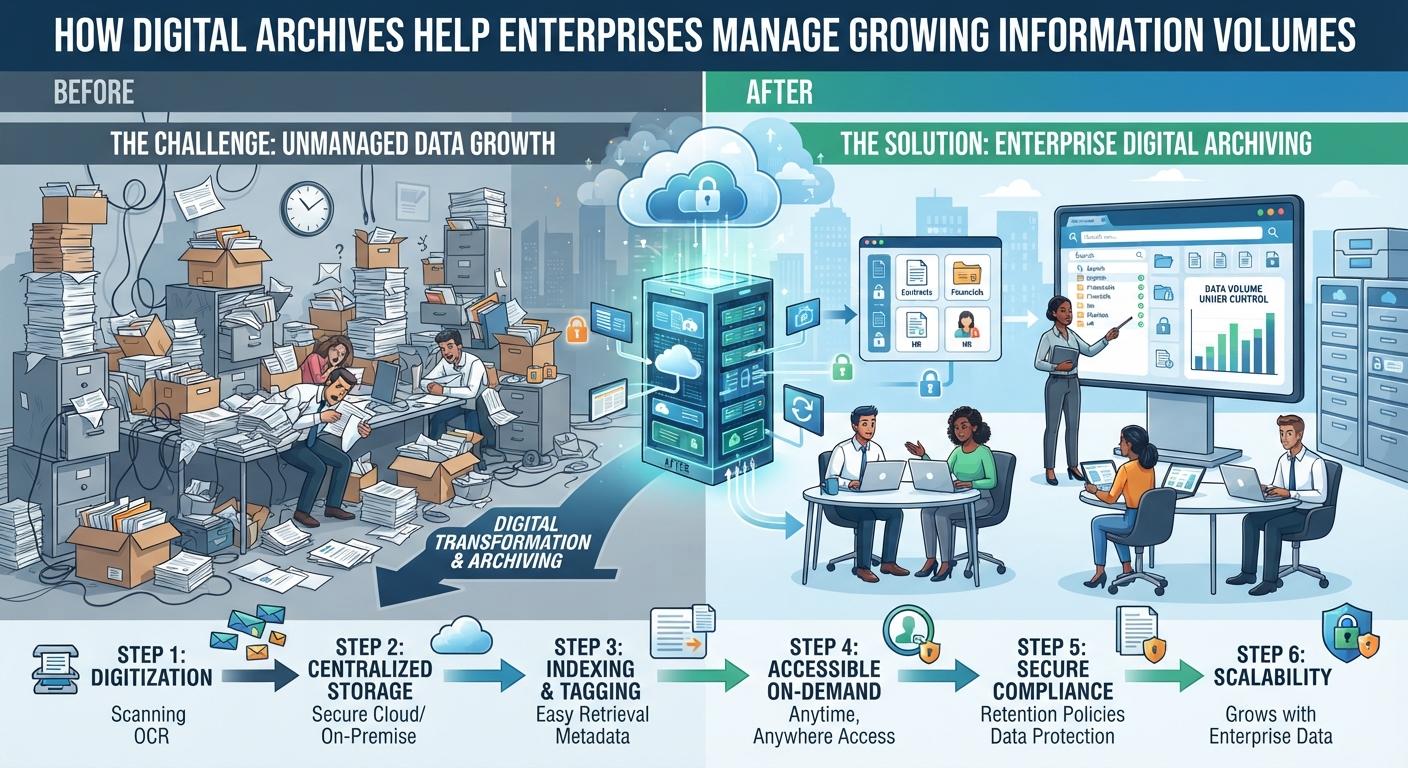
Enterprises are creating and collecting more digital information than ever before. Contracts, invoices, customer records, emails, employee documents, operational files, and compliance records can accumulate across dozens of systems. As this information grows, simply adding more storage does not solve the underlying management problem. Organizations need a structured way to preserve important records, control access, and retrieve information when it is needed. This is why understanding What Is Digital Archiving is important for modern enterprise information management.
Digital archiving provides a long-term approach to managing information that is no longer part of everyday operations but still needs to be retained. It helps organizations reduce information clutter while keeping valuable records accessible, protected, and trustworthy.
What Is Digital Archiving?
Digital Archiving is the process of securely storing, organizing, managing, and preserving digital records for long-term access.
The purpose of an archive is different from ordinary file storage. Active storage supports information that employees frequently use, while an archive focuses on records that need to be retained for business, legal, regulatory, or historical reasons.
A digital archive can manage:
-
Business documents
-
Contracts and agreements
-
Financial records
-
Customer information
-
Compliance records
-
Metadata and document relationships
The goal is to ensure that important records remain accessible and understandable even when the systems that originally created them are changed or retired.
Why Growing Information Volumes Create Problems
Information growth can affect enterprises in several ways.
More Data Makes Retrieval Harder
When records are spread across shared drives, applications, email accounts, and cloud repositories, employees may struggle to locate specific information.
This can slow down:
-
Audits
-
Customer requests
-
Legal reviews
-
Business decisions
A structured archive gives organizations a more organized environment for managing long-term records.
Legacy Systems Keep Information Locked Away
Many enterprises maintain older applications because they contain historical information.
These applications can become expensive to operate and difficult to support.
Organizations may eventually want to retire them, but doing so becomes complicated when records still need to be accessed.
Digital archiving provides a way to preserve those records independently of the original application.
Compliance Requires Controlled Retention
Some information must be retained for defined periods.
Organizations may need to demonstrate that records are complete, protected, and available when required.
A structured archive can support retention and access policies while providing greater visibility into record management.
How Digital Archives Help Manage Information Growth
Digital archives address information growth by adding structure and governance to long-term records.
Separating Active Data From Historical Records
Not every document needs to remain in an active business application.
Moving inactive but valuable records into an archive can reduce the amount of information that active systems need to manage.
This can help organizations create cleaner operational environments while retaining access to historical information.
For example, older contracts may no longer be needed for daily operations but could still be required for legal or compliance purposes.
Centralizing Long-Term Records
Digital archives can provide a dedicated environment for records that need to be preserved.
Instead of maintaining historical information across multiple disconnected systems, organizations can establish a more consistent approach to:
-
Storage
-
Classification
-
Search
-
Access
-
Retention
This makes long-term information easier to manage.
Preserving Metadata and Context
A digital record is more than its file contents.
Metadata can provide information about:
-
Who created the record
-
When it was created
-
What type of record it is
-
How it relates to other records
-
How long it should be retained
Preserving this context helps ensure that information remains understandable over time.
Maintaining Information Integrity
Historical records may need to serve as evidence years after their creation.
Organizations therefore need confidence that archived information has not been improperly modified.
Digital archives can use controls such as:
-
Access permissions
-
Audit trails
-
Integrity checks
-
Validation processes
These controls help maintain trust in long-term records.
Supporting Long-Term Accessibility
Technology changes continuously.
Applications and file formats that are common today may become obsolete later.
Digital archiving strategies account for these changes by considering:
-
File formats
-
Migration requirements
-
Preservation methods
-
Future access
The objective is to ensure that records remain usable even when the original technology is no longer available.
Digital Archiving vs Digital Storage
Digital storage and digital archiving are often treated as the same thing, but they have different purposes.
|
Digital Storage |
Digital Archiving |
|
Designed for active information |
Designed for long-term records |
|
Supports daily operations |
Supports long-term retention |
|
Focuses on availability |
Focuses on preservation and reliability |
|
Often optimized for frequent access |
Optimized for managed historical information |
|
May have limited retention controls |
Supports structured retention and governance |
Storage helps employees work with current information. Archiving helps organizations protect information that must remain available over time.
Digital Archiving and Application Retirement
Growing information volumes are closely connected to legacy application problems.
An enterprise may want to retire an outdated system but still need access to its historical data.
A typical approach is:
-
Identify information that must be retained
-
Extract relevant records from the legacy application
-
Preserve documents and metadata
-
Establish secure access to the archive
-
Decommission the outdated system
This allows organizations to reduce technical debt without sacrificing historical information.
Benefits of Digital Archives for Enterprises
A structured digital archive can provide several long-term benefits.
Better Information Retrieval
Employees can find historical records without searching through multiple outdated systems.
Reduced Technology Dependency
Organizations can preserve information without keeping legacy applications active.
Improved Compliance Management
Retention, access, and preservation processes become easier to manage.
Lower Operational Complexity
Separating historical records from active systems can simplify the overall technology environment.
Stronger Knowledge Retention
Important business information remains available even as systems and teams change.
The Role of Digital Archives in Enterprise Information Strategy
Digital archiving should not operate separately from other information management processes.
A complete information lifecycle may look like:
Create → Capture → Manage → Retain → Archive → Preserve → Dispose
Not every record needs to remain permanently archived. Organizations should apply retention policies based on business value, legal requirements, and applicable regulations.
This approach helps enterprises avoid both uncontrolled information accumulation and premature deletion.
The Future of Digital Archiving
Enterprise information volumes will continue growing as businesses adopt more digital workflows.
Modern archive platforms are increasingly incorporating:
-
Artificial intelligence
-
Automated classification
-
Advanced search
-
Workflow automation
-
Stronger security controls
These technologies can help organizations manage larger information environments without relying entirely on manual processes.
However, technology should support a clear information governance strategy rather than replace it.
Conclusion
Understanding What Is Digital Archiving is essential for enterprises dealing with growing information volumes.
Digital archives provide a structured way to preserve historical records, maintain context, control access, and support long-term retrieval. They also help organizations reduce dependency on legacy applications and create a more manageable information environment.
For modern enterprises, the objective is not simply to store more information. It is to ensure that important information remains organized, protected, accessible, and useful for as long as the business needs it.

 Arabic
 French
 Spanish
 Portuguese
 Deutsch
 Turkish
 Dutch
Dutch
 Italiano
 Russian
 Romaian
 Portuguese (Brazil)
 Greek
Greek