
Bio-Based PE Skincare Tubes Market Packaging Innovation Outlook
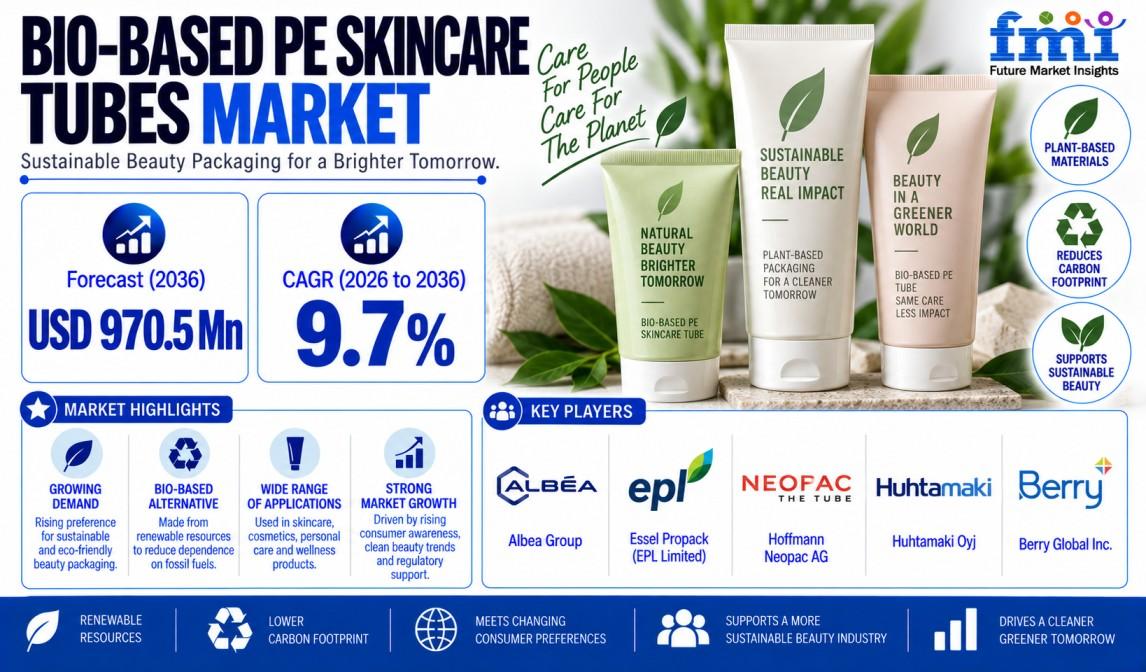
The global bio-based PE skincare tubes market is projected to grow from USD 383.6 million in 2026 to USD 970.5 million by 2036, expanding at a CAGR of 9.7%, as cosmetic packaging suppliers respond to demand for renewable feedstocks, recyclable tube structures and lower reliance on fossil-derived polyethylene.
The market was valued at USD 345.6 million in 2025. Growth is being supported by the adoption of plant-derived polyethylene in facial care, body care, sun care and hand and foot care packaging, while packaging developers continue to balance sustainability objectives with barrier performance, decoration quality, filling-line compatibility and supply availability.
>> Request Your Sample Now - Growth Potential and Discover Key Market Opportunities: https://www.futuremarketinsights.com/reports/sample/rep-gb-32247
Why are beauty brands moving toward bio-based PE tubes?
Bio-based polyethylene allows packaging manufacturers to retain many of the processing and functional characteristics associated with conventional PE while replacing fossil-derived feedstock with renewable sources.
For skincare brands, the transition is not limited to material procurement. Packaging teams must evaluate extrusion conditions, layer structures, closures, formula compatibility and decoration requirements before approving a new tube specification.
Multi-layer/co-extruded tubes account for 68.4% of market revenue in 2026, reflecting the importance of barrier performance for formulations containing oxygen-sensitive or otherwise demanding active ingredients.
The shift also creates a supply-chain challenge. Bio-based resin availability, certification, traceability and long-term supply agreements can become important qualification criteria when brands standardize sustainable primary packaging across multiple product lines.
Which skincare tube formats are driving demand?
The 51 ml to 100 ml segment represents 42.5% of the market in 2026, positioning the format as an important volume range for everyday skincare applications.
Facial care is the leading end-use application, accounting for 45.8% of market revenue in 2026. The segment benefits from the continued use of squeeze tubes for cleansers, treatments, moisturizers and other products where controlled dispensing and lightweight primary packaging are important.
Flip-top caps account for 54.2% of the closure-type segment in 2026, reflecting the continued importance of one-handed dispensing and reclosure functionality in bathroom and personal-care environments.
Ismail Sutaria, Principal Consultant for Packaging at Future Market Insights, said:
“In our recent Bio-Based PE Skincare Tubes Market assessment, my team and I have observed that brand credibility increasingly hinges on measurable sustainability outcomes rather than symbolic material substitutions. Bio-based polyethylene enables brands to retain the mechanical strength, squeeze performance, and decoration compatibility of conventional tubes while lowering reliance on fossil feedstocks.”
The statement highlights a broader issue for packaging buyers: renewable feedstock substitution creates value only when the resulting tube continues to meet the performance and production requirements of the finished skincare product.
Market Snapshot
- 2026 market size: USD 383.6 million
- 2036 projected value: USD 970.5 million
- 2026–2036 CAGR: 9.7%
- 51 ml–100 ml capacity: 42.5% share
- Multi-layer/co-extruded tubes: 68.4% share
- Flip-top caps: 54.2% share
- Facial care: 45.8% share
- China: 12.5% CAGR through 2036
What is driving the bio-based PE skincare tubes market?
Three factors are increasingly connected: renewable material sourcing, packaging sustainability targets and the need to preserve conventional tube functionality.
Extended producer responsibility initiatives and corporate packaging commitments are encouraging brands to examine the material origin and lifecycle characteristics of primary packaging. At the same time, packaging converters must maintain the mechanical, barrier and visual performance expected by premium skincare brands.
Cost remains a constraint. Bio-based PE can carry a price premium compared with conventional fossil-derived polyethylene, while access to consistent renewable feedstock can vary by supplier and region.
This creates an important procurement consideration. Brands pursuing large-scale conversion may need to evaluate long-term resin availability and supplier qualification alongside the environmental attributes of the material.
👉 Access the Complete Report in PDF Format: https://www.futuremarketinsights.com/reports/brochure/rep-gb-32247
Which regions are expanding fastest?
China is projected to record the highest growth among the countries listed in the FMI analysis, at 12.5% CAGR from 2026 to 2036. India follows at 11.8%, while the United States is projected at 9.2%.
Germany records an 8.7% CAGR, South Korea 8.4%, Japan 7.9% and the United Kingdom 7.5%.
The geographic variation reflects differences in cosmetic manufacturing, sustainable packaging adoption, regulatory pressure and availability of local packaging-conversion capabilities.
Asia Pacific is particularly important because China, India, South Korea and Japan combine significant beauty-product manufacturing and increasingly sophisticated packaging requirements. North American and European markets continue to provide demand linked to corporate sustainability programs and packaging compliance considerations.
Competitive Landscape
The competitive environment includes established tube manufacturers and packaging suppliers with capabilities spanning extrusion, lamination, decoration, closure integration and sustainable material development.
Key companies profiled in the FMI analysis include Albea Group, Essel Propack (EPL Limited), Hoffmann Neopac AG, Huhtamaki Oyj, Berry Global Inc., Tubex Holding GmbH, Viva Healthcare Packaging, Laminate Tubes Industries, CTI Packaging and IntraPac International.
Competition is increasingly focused on the ability to provide reliable bio-based resin integration without compromising tube appearance, barrier performance, filling-line efficiency or supply continuity.
For packaging buyers, supplier qualification therefore extends beyond the resin itself. Tube construction, closure compatibility, decoration capabilities and documented material traceability can all influence commercialization.
About the Bio-Based PE Skincare Tubes Market Report
Future Market Insights analyzes the market by capacity, layer type, closure type and end-use application across North America, Latin America, Europe, East Asia, South Asia, Oceania, and the Middle East & Africa.
The report covers:
- Capacity: Up to 50 ml, 51 ml to 100 ml, 101 ml to 150 ml, Above 150 ml
- Layer type: Mono-layer, Multi-layer/Co-extruded
- Closure type: Flip-top Cap, Screw Cap, Pump Dispenser, Others
- End-use application: Facial Care, Body Care, Sun Care, Hand & Foot Care
The forecast period covers 2026 to 2036.
Explore More Research Reports by FMI:
PBS Film Market: https://www.futuremarketinsights.com/reports/pbs-film-market
Micro Perforated Films Packaging Market: https://www.futuremarketinsights.com/reports/micro-perforated-films-for-packaging-market
Polyethylene Mailers Market: https://www.futuremarketinsights.com/reports/polyethylene-mailers-market
About Future Market Insights (FMI)
Future Market Insights, Inc. (FMI) is an ESOMAR-certified, ISO 9001:2015 market research and consulting organization, trusted by Fortune 500 clients and global enterprises. With operations in the U.S., UK, India, and Dubai, FMI provides data-backed insights and strategic intelligence across 30+ industries and 1200 markets worldwide.
Media Contact
Future Market Insights, Inc.
Christiana Corporate
200 Continental Drive, Suite 401
Newark, Delaware 19713, United States

 Arabic
 French
 Spanish
 Portuguese
 Deutsch
 Turkish
 Dutch
Dutch
 Italiano
 Russian
 Romaian
 Portuguese (Brazil)
 Greek
Greek