
Shop Beeps Don't Prove Your tag reader Will Work
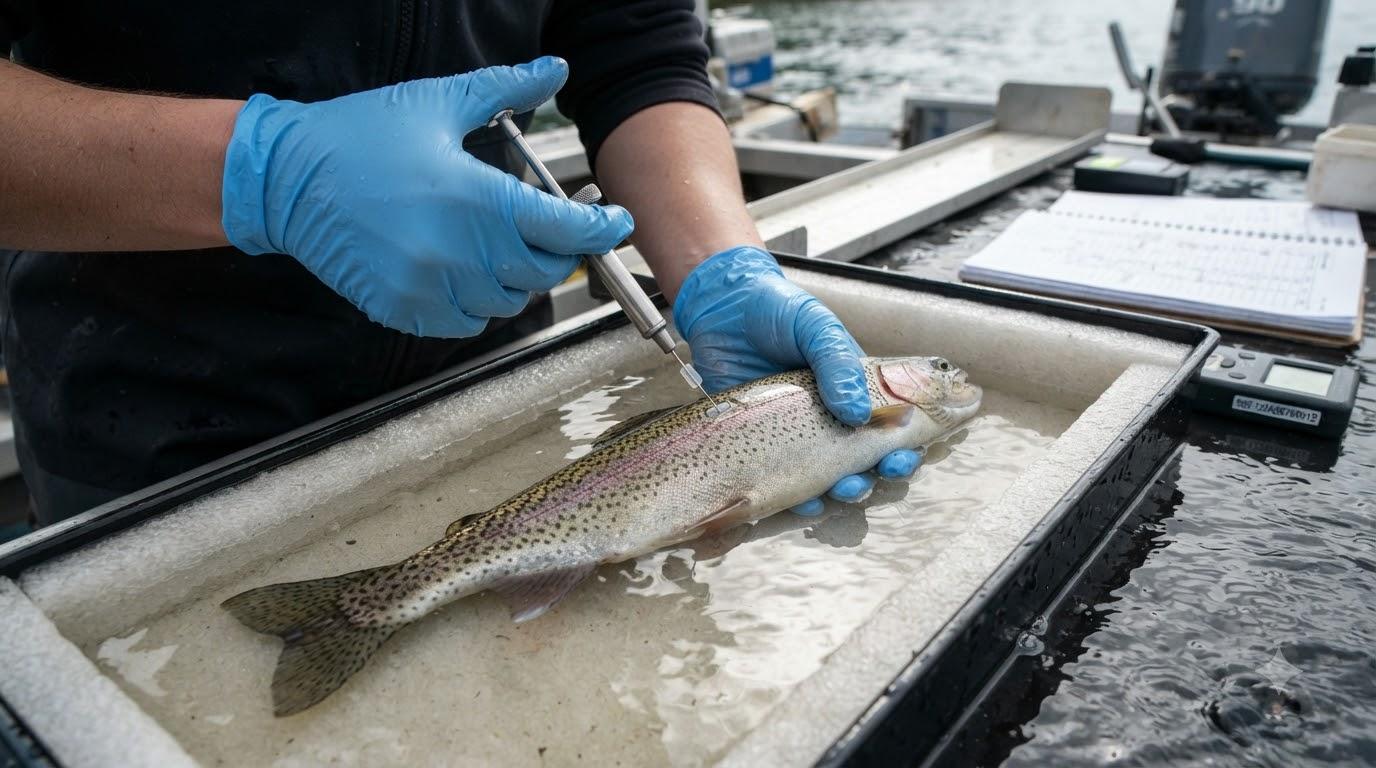
A handheld that sings over a tray of glass implants can still miss the same animals at a noisy gate, a wide culvert, or a partner site running a different protocol. The shop beep only proves the capsule is alive in ideal conditions. It does not prove your detection path will hold during a real run.
Before you blame mortality or tag loss, line up field-ready tag reader gear for PIT programs against every place an ID must be recovered: marking table, mobile survey, fixed antenna, and any shared agency checkpoint. One strong wand is not a system.
False confidence starts at the marking table
Most crews verify implants with a single close-range device. That habit hides four mismatches:
-
The table unit uses a different protocol than the river antennas
-
The read range is fine at contact and useless at pass-through speed
-
Electrical noise at the gate is nothing like the warehouse
-
Staff change antennas or cables and nobody re-tests with known tags
When the season file looks empty, people argue about survival. Often the animals are fine and the reads never happened.
Name the jobs a reader must do
“Reader” is several tools wearing one word.
Marking verification needs fast, repeatable confirmation in a wet hand, clear ID display, and low mis-key risk. Range can be short.
Mobile surveys need portable power, stable reads around rocks and debris, and a form factor the crew will actually carry for hours.
Fixed-site detection needs antennas, tuning, power resilience, timestamp integrity, and the ability to catch fish that never slow down for your convenience.
Audit and troubleshooting needs a trusted reference device and a small set of known-good implants so you can tell gear failure from biological failure.
If one device is asked to do all four jobs without testing, it will fail the least forgiving one silently.
Protocol splits create phantom mortality
Full-duplex and half-duplex systems both show up in fisheries work. They are not interchangeable just because both are RFID and both “read PIT.”
A tag reader that only speaks one protocol will cheerfully confirm a capsule at the table while every antenna on the other protocol stays quiet. From the database side, those fish look like they vanished.
Practical controls:
-
Label vials and devices with protocol, not only brand color
-
Keep a mixed-protocol test card if your basin truly runs both
-
Never assume a partner’s gate matches your wand because the connectors look similar
-
Record protocol in the metadata for every download
If your network is mixed on purpose, design for that on day one. If it is mixed by accident, fix procurement before the next marking pulse.
Range claims versus pass speed and angle
Bench range is measured slowly, on-center, in a quiet electrical environment, often with the implant in a friendly orientation. Fish do not cooperate with any of that.
Misses rise when:
-
Animals bolt through the edge of the field
-
The implant lies parallel to a weak axis
-
Water level pushes fish farther from the antenna plane
-
Cables, pumps, chargers, or fence units raise noise
-
Power sags right when passage peaks
So a tag reader and antenna pair should be judged by miss rate under ugly passes, not by the best demo beep of the day.
A simple on-site drill:
-
Use known implants of the same length you mark with
-
Pass them at realistic speed through center and edges
-
Rotate orientation between passes
-
Repeat after pumps or generators turn on
-
Log hits and misses as percentages, not vibes
If the pair only works with slow centerline wand waves, it is not ready for peak migration.
Handheld units: what matters in a wet hand
For table and survey work, ergonomics and ID integrity matter as much as coil strength.
Look for:
-
Readable display in bright sun and at night
-
Secure grip with gloves
-
Fast decode so crews do not linger air-exposed fish
-
Reliable storage or Bluetooth workflow that does not drop records
-
Clear failure behavior when a read is ambiguous
Weak spots to probe before bulk buy:
-
Does it mis-read when two capsules are close in a tray?
-
Does it freeze in cold rain?
-
Do batteries die mid-shift without warning?
-
Can staff export and name files without a specialist?
A tough, boring handheld that keeps honest records beats a sensitive unit that drops data when the screen gets wet.
Fixed sites: the reader is only as good as the whole chain
At a gate, the “reader” people point at is often a box in a chain: power, control electronics, antenna loop, tuning, cabling, grounding, and logging.
When hits disappear, test the chain in order instead of swapping random parts:
-
Known-good implant at the antenna
-
Power stability under load
-
Antenna integrity and tuning
-
Cable damage and connectors
-
Noise sources cycling on and off
-
Clock time and file write success
-
Protocol match to the implant inventory
Changing the control box first is a common way to spend money without finding a chewed cable or a new pump motor on the same circuit.
Noise, metal, and “it worked last year”
Sites drift. Someone adds a camera, a charger, a different solar controller, or a steel plate. Water routes change after a flood and fish start using a quieter edge lane outside your old sweet spot.
After any infrastructure change, rerun the known-tag drill. “Last year’s settings” are a starting guess, not a certificate.
Metal near a loop, loose connectors, and intermittent grounding produce the worst kind of failure: occasional reads. Occasional reads are enough to convince a crew the system is fine while detection probability collapses for analysis.
Shared inventories and multi-crew chaos
Problems multiply when several crews, hatcheries, and agencies touch the same animals.
Minimum operating rules:
-
One reference list of approved reader models per protocol
-
Shared test implants with documented IDs
-
Standard file naming and time sync expectations
-
A short commissioning checklist after any antenna move
-
Clear ownership of who interprets silent sites
Without that, each team trusts its own tag reader and distrusts everyone else’s download. The fish become the referees in a hardware argument they cannot win.
Buying decisions that cut whole classes of failure
Procurement should answer questions in this order:
-
Which protocols must be detected across the project lifetime?
-
Which sites are handheld-only, and which need pass-through performance?
-
What implant lengths are already in the water from prior years?
-
What power and noise conditions exist at the weakest site?
-
Who will maintain tuning and cables after installation?
Only then compare price. A cheaper box that cannot hear legacy implants forces either a silent cohort or an expensive remonitoring plan.
If you are mid-study, compatibility with tags already released beats feature novelty. New features do not resurrect fish you failed to detect last spring.
A practical weekly habit during peak passage
Short checks prevent month-long holes:
-
Pass a known implant through each critical site after maintenance days
-
Confirm clocks before large pulses of fish
-
Eye battery and solar health before remote weekends
-
Keep a paper or phone log of noise sources toggled during tests
-
Compare hit rates day-over-day for sudden cliffs, not only seasonal slopes
A detection cliff after “nothing changed” usually means something changed that nobody wrote down.
When the reader is fine and the biology is not
Honest troubleshooting also protects you from the opposite error: blaming gear for real mortality, real spill bypass, or real tag expulsion.
Use retention scans and control implants together. If known tags in the antenna field read and recently marked fish do not, investigate handling and expulsion. If known tags fail, fix gear first. If both succeed and numbers still tank, look at hydrology, predation, and routing.
A disciplined tag reader program does not claim every gap is electronic. It separates electronic gaps from biological ones fast enough to act.
Frequently Asked Questions
Can one handheld certify implants for every fixed site we run?
No. A handheld confirms the capsule can respond at close range on that device’s protocol. It does not certify pass-through geometry, noise tolerance, or range at each gate. Use known tags at the actual antennas.
How often should fixed sites be re-tested with known tags?
After installation, after any hardware or power change, and on a regular interval during the season—weekly at critical sites in peak passage is reasonable. Add a test whenever hit rates drop without a clear biological explanation.
What is the first thing to check when reads suddenly fall?
Start with a known-good implant at the antenna, then power, then connectors and cabling, then noise sources, then protocol match. Random part swaps waste days and create new variables.
Do we need the same brand of tag reader everywhere?
Not necessarily the same brand, but you do need proven protocol compatibility, comparable timekeeping and file practices, and a shared test method. Brand variety without standards is how mixed networks fracture.
Why do partners see different hit counts on the same run?
Different antenna sizes, tuning, noise, pass lanes, and decode settings produce different detection probabilities even on the same implant family. Compare methods and test tags before comparing biological conclusions.

 Arabic
 French
 Spanish
 Portuguese
 Deutsch
 Turkish
 Dutch
Dutch
 Italiano
 Russian
 Romaian
 Portuguese (Brazil)
 Greek
Greek