
How QR Codes Improve Event Tickets, Check-Ins, and Guest Engagement
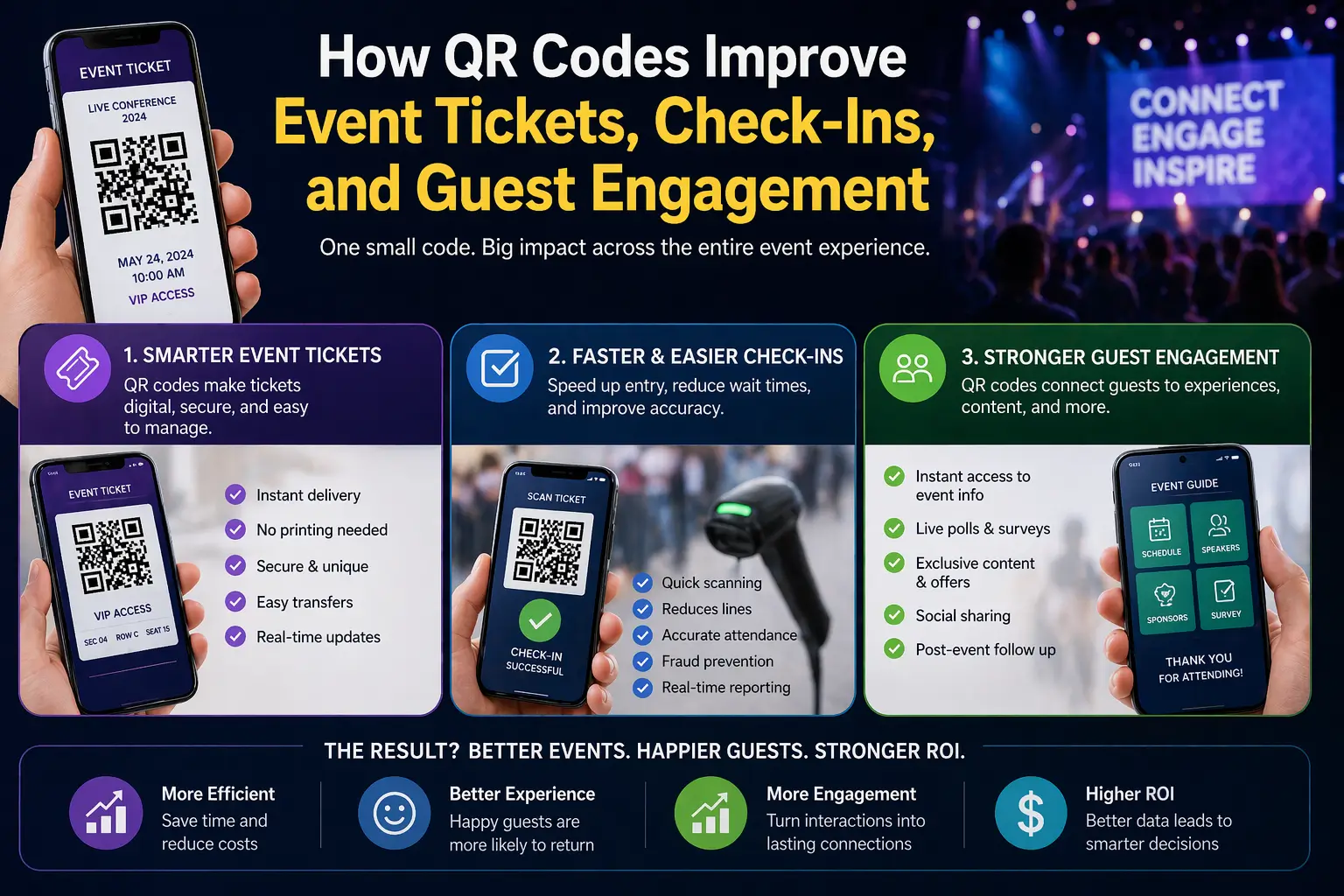
Events are all about coordination—people arriving, checking in, moving between sessions, and staying informed. Even small inefficiencies can create delays or confusion.
QR codes offer a simple way to streamline these touchpoints. With one scannable code, organizers can manage access, share information, and keep attendees engaged throughout the event.
The Challenge of Managing Events Efficiently
Whether it’s a conference, concert, or private gathering, events involve multiple moving parts:
-
Ticket distribution
-
Entry management
-
Information sharing
-
Attendee engagement
Traditional methods—printed tickets, manual check-ins, paper schedules—often slow things down.
QR codes replace these steps with faster, digital alternatives.
Digital Tickets That Simplify Access
QR codes are widely used as digital tickets.
Instead of printing physical passes, each attendee receives a unique QR code that acts as their entry credential.
How it works
-
A QR code is generated for each ticket
-
The attendee receives it via email or mobile
-
Staff scan the code at the entrance
Why it works
-
Eliminates the need for printed tickets
-
Reduces the risk of lost or damaged passes
-
Speeds up entry for large groups
-
Makes distribution instant and scalable
This approach is now standard across many types of events.
Faster Check-Ins and Better Flow
Entry points are often where delays happen.
QR code scanning makes check-ins significantly faster by replacing manual verification.
Key improvements
-
Shorter queues at entrances
-
Fewer manual errors
-
Real-time attendance tracking
-
Better control over crowd movement
For larger events, this can dramatically improve the overall experience from the moment guests arrive.
Using QR Codes to Share Event Information
QR codes are also useful beyond entry.
They can provide attendees with quick access to:
-
Event schedules
-
Maps and directions
-
Speaker or performer details
-
Session materials or downloads
Instead of printing guides, organizers can keep everything accessible and up to date digitally.
Increasing Engagement During and After Events
QR codes can turn passive attendees into active participants.
They can link to:
-
Feedback forms and surveys
-
Live polls or interactive content
-
Social media pages
-
Email sign-ups or future event registrations
This extends engagement beyond the event itself and helps organizers build ongoing relationships.
Where QR Codes Add the Most Value
Placement plays a key role in effectiveness.
QR codes work best when positioned where attendees naturally look or interact:
-
At entrances for ticket scanning
-
On signage for directions or schedules
-
At booths or stands for additional information
-
On screens during presentations
-
On printed materials or badges
The goal is to make access intuitive and immediate.
Best Practices for Event QR Codes
To ensure a smooth experience:
-
Provide clear instructions
Let attendees know what they’ll get when scanning -
Keep the destination focused
Avoid overwhelming users with too many options -
Ensure fast loading pages
Speed is critical in high-traffic situations -
Use high-contrast designs
Make codes easy to scan in different lighting conditions -
Test everything before the event
Verify functionality across devices and scenarios
Setting Up QR Codes for Events
Creating QR codes for events is straightforward.
Organizers can use platforms like QRColor to generate QR codes for tickets, schedules, and engagement tools → https://qrcolor.com
This allows for quick implementation without complex infrastructure.
Are QR Codes Suitable for Every Event?
QR codes are effective across a wide range of events, including:
-
Conferences and seminars
-
Concerts and festivals
-
Corporate events
-
Workshops and training sessions
-
Private or invitation-based gatherings
They are particularly valuable when managing large audiences or multiple event touchpoints.
Conclusion
QR codes offer a practical way to improve how events are organized and experienced.
By simplifying ticketing, speeding up check-ins, and enabling real-time engagement, they help create smoother and more efficient events.
With minimal setup and broad accessibility, QR codes have become a reliable tool for modern event management.

 English
 Arabic
 French
 Spanish
 Portuguese
 Turkish
 Dutch
Dutch
 Italiano
 Russian
 Romaian
 Portuguese (Brazil)
 Greek
Greek